
Blog
The frontman of Judas Priest has expressed his candid opinion regarding Led Zeppelin, stating that “women were not expected to perform in the same manner as Janis Joplin”

During an appearance on Fan First, Judas Priest frontman Rob Halford discussed his musical heroes, including Led Zeppelin, Janis Joplin, and more.
When the interviewer stated, “I’d like to begin with a paragraph from your book, which I quote, ‘Led Zeppelin swept me away. I’ll never forget lying down on my bed in the beach shell between my two speakers and hearing ‘Whole Lotta Love’ for the first time. I was astounded by the left-right, left-right interaction between Robert Plant and Jimmy Page, as well as the switching between speakers. “So, how did that vocal power and intensity affect you in a primal way?” Rob said (transcribed by UG).
“Every artist is inspired by other musicians; it’s what we do. That is the wonderful thing about rock ‘n’ roll.
“We all have our heroes, and it’s great that you mentioned that moment because I didn’t have a stereo record player, which sounds crazy, but I got an amplifier and figured out how to do stereo left and right.”
“And it was really mesmerising to see Jimmy use that stereo for Led Zeppelin, and it was one of my first loves of that musical experience, that metal magic that we can have.
“But Robert’s voice, both then and now, was a tremendous springboard for me as a singer because it made me realise how versatile the human voice is.
“And I don’t recall singing that way when I heard Robert sing. Obviously, I was in my early metal years, but I am sure I mimicked his expressions during jams, rehearsals, and anything else I was doing.
“Robert adores the blues, and if you look back to Bessie Smith, Muddy Waters, and Little Richard, when everyone was shouting and moaning…
“I also believe that you are never too old for a fresh memory or notion, and what I learnt from those performances was that you simply have to let your inhibitions go.
“You simply need to show it off in the truest emotional sense and not be afraid. And there’s something incredibly profound about witnessing Robert Plant or Janis Joplin shout their hearts out in Monterey.
“Women weren’t supposed to perform like that; it was the norm back then. And so, for me, all of those great artists, especially vocalists, were just a thrilling prelude to all of these fantastic adventures that came later.”
“Well, Glenn, like myself, was enamoured in the early days by a band like The Beatles, who were just a big revolution of their own creation.
“Nobody was doing music like that. And in the brief period they were together, they went from ‘She Loves You’ to ‘The White Album,’ and the difference in those years was incredible.
“So I know Glenn was a major Beatles and Jimi Hendrix lover. I recall coming to Glenn’s apartment around the time ZZ Top came out, and he just kept playing ZZ Top endlessly.
“He was crazy about that band, Billy Gibbons, and everybody. Glenn is an excellent blues guitar player. Glenn’s music has a lot of blues, as evidenced by his phrasing.
“Ian’s [Hill, bass] been a lot like me; he’s just very open-minded about his love of different types of music.”
“But I know his two musical heroes were [Cream bassist] Jack Bruce and Jaco Pastorius.” And Ian’s father used to play double bass, so I suppose Ian was a fan of his.
“I am not making that up, but I believe there was a connection there. We’ve had a lot of drummers; who would you like to pick on? Scott [Travis] is an admirer of several drummers.
“Again, there’s a beautiful image on the internet of Scott with Ringo Starr; he met Ringo in Las Vegas.
“Richie [Faulkner] is a huge Randy Rhoads fan.” K.K. was an avid Hendrix lover. So we are all enamoured with our rock ‘n’ roll mates.”
Rob Halford explains how Judas Priest ended up opening for Led Zeppelin in 1977, and what Robert Plant had to say in a 2025 interview
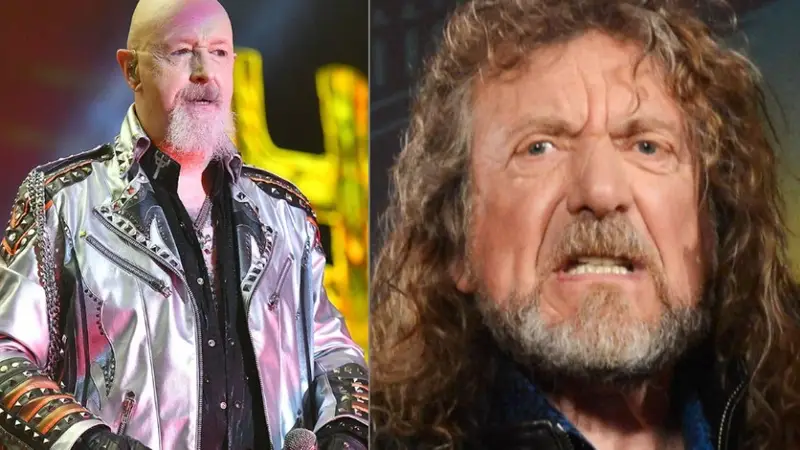
When Metal Met Majesty: Rob Halford Recalls Opening for Led Zeppelin in 1977
In a recent interview filled with nostalgia and reverence, Rob Halford of Judas Priest recounted the night they opened for Led Zeppelin in 1977—a moment that has since become a legendary tale among fans of classic rock and heavy metal. Long before Judas Priest had solidified their own place in the pantheon of metal gods, they stood as the rising newcomers, charged with the daunting task of performing before the thunderous might of Zeppelin’s loyal fanbase.
The concert took place at the Oakland Coliseum, a venue whose sheer magnitude matched the gravity of the event. Judas Priest, at that point still on the rise, were trying to carve out their identity in the ever-evolving hard rock landscape. Being asked to open for a band like Led Zeppelin wasn’t just a career opportunity—it was a defining moment.
Halford remembered feeling a mix of fear and awe. The pressure of sharing a stage with a band they had all idolized was immense. Zeppelin were not just giants in the music industry; they were the template for every hard rock band that followed. Yet, despite the nerves, Halford and the band accepted the challenge with every ounce of energy they had.
The invitation came through a mutual connection at their record label, and Zeppelin’s team had been keeping tabs on Priest’s rising status in the UK. With the hard edge Priest brought to the stage, there was a sense that they could complement Zeppelin’s grandeur with something more raw, more electric.
As Priest took the stage, Halford recalled the sea of long-haired fans dressed in denim and leather, arms crossed, waiting to see if this band from Birmingham could even hold a candle to the headliners. Within moments of their set, however, it became clear that Priest was there not to mimic Zeppelin, but to assert their own brand of power and speed.
Their performance was fierce. Halford’s soaring vocals, K.K. Downing and Glenn Tipton’s dueling guitars, and Ian Hill’s unshakeable bass lines turned skeptical looks into approving roars. By the end of the set, they had transformed curiosity into applause. Judas Priest didn’t just survive the Zeppelin crowd—they won them over.
After their performance, Halford was invited backstage. It was there he came face to face with Robert Plant, the golden god himself. Halford expected polite applause or a handshake, but what he got was far more memorable. Plant clapped him on the back, grinned, and said, “You’ve got some serious pipes, mate. That was bloody impressive.”
It was a compliment Halford has never forgotten. To hear such praise from a singer of Plant’s magnitude validated years of work, struggle, and relentless ambition. Halford later said that single moment gave him a confidence that carried him through the band’s next major creative leaps.
Jimmy Page also made an appearance backstage, reserved as always but observant. According to Halford, Page nodded with approval and muttered something about the “tightness” of Priest’s rhythm section. For a young band trying to prove themselves, even a subtle gesture from the legendary guitarist meant everything.
That night marked a significant turn in Priest’s career. They weren’t just opening for Zeppelin—they were proving they could someday headline similar stages themselves. And eventually, they did. That show helped propel them from cult favorites to international stars.
Halford has often cited that night as a turning point, not just in career momentum but in personal belief. To stand in Zeppelin’s shadow and not be overwhelmed by it was a test few could pass. But for Judas Priest, it was confirmation that their brand of heavy metal could command even the grandest of arenas.
The bond between Priest and Zeppelin never turned into a formal collaboration, but there was a mutual respect that lingered. Decades later, Halford and Plant would cross paths at various events, exchanging warm greetings and subtle nods to that shared night in ’77.
The experience also impacted the way Judas Priest viewed their role in the rock ecosystem. They realized that while Zeppelin had pioneered a mystical, blues-rooted hard rock, Priest’s mission was different—they were shaping what would become the new wave of British heavy metal. The contrast made both bands shine in their own right.
That opening set has since been referenced in documentaries, interviews, and fan forums as one of the rare moments when titans of different eras shared the same stage. It’s a time capsule of transition, from rock to metal, from past glory to future dominance.
Fans who were lucky enough to witness the show often describe it as a moment where history briefly overlapped. The majestic mysticism of Zeppelin met the grinding gears of Judas Priest’s precision. It wasn’t just a concert—it was a glimpse into rock’s evolution.
To this day, Halford speaks about that night with deep humility and gratitude. He calls it one of the greatest honors of his career. Not because of the size of the crowd, but because it proved they could stand among giants and hold their own.
The story is now etched into heavy metal folklore—a night when the old gods nodded to the new, and the future of the genre began to shine a little brighter under the Californian sky. For Rob Halford and Judas Priest, it wasn’t just a performance. It was their rite of passage.
And as the years roll on, fans continue to celebrate that shared moment between two titans of rock. One band finishing a golden era, and the other just beginning to blaze their trail. A passing of the torch, unspoken but unmistakable.
-
 Blog8 months ago
Celtic issues a fiery VAR statement after Trusty’s red card appeal is dismissed, as furious chiefs release referee audio publicly.
-

 Blog1 month ago
Former official calls on SFA to contact Rangers over fan scenes during Celtic match, labeling them “completely unacceptable.”
-

 Blog8 months ago
Celtic informed their January signing under Martin O’Neill that he wouldn’t play a single minute this season.
-

 Blog8 months ago
Celtic issued an £83 million warning amid looming UEFA threats.
-

 Blog8 months ago
SFA Expected to Review Missed Penalty in Rangers v Celtic Clash
-

 Blog7 months ago
Police respond after reported disorder following Middlesbrough vs Millwall clash
-

 Blog4 weeks ago
Middlesbrough receive a warning following Steve Gibson’s submission of a £1.5bn proposal.
-

 Blog1 year ago
“Courtside to Aisle-Side: Tyrese Haliburton and Jade Jones Set New Wedding Date”