
Blog
Aleksander Kilde, Mikaela Shiffrin’s fiancé, was speechless after the United States won the first ski competition of the season

Mikaela Shiffrin has recovered from an early setback in the giant slalom race in Austria by winning her first slalom competition of the season. With a total time of 1:48.92, which included 56.08 in her first race and 52.84 in her second, the American skier won the competition in Levi on Saturday.
Her fiancé, Norwegian skier Aleksander Kilde, was in amazement of her accomplishment, which came after she finished fourth in her first giant slalom event of the season.
Kilde Offers Support to Mikaela Shiffrin After Heroism in Levi
On the skiing circuit, Shiffrin’s slalom triumphs in Levi have come to be taken for granted. The two-time Olympic gold medallist has won five top-podium finishes in her past six visits at the venue and has nine slalom triumphs in this World Cup leg. But this win is particularly meaningful because it sets the tone for her in the lead-up to a crucial Olympic season.
Kilde, her fiancé, also praised Shiffrin’s outstanding performance on Instagram. The Norwegian skier said, “T-20 🤩🤩🤩🤩,” after posting a video on his story that captured the last moments of Shiffrin’s race in Levi. In response, Shiffrin shared this tale on her Instagram account.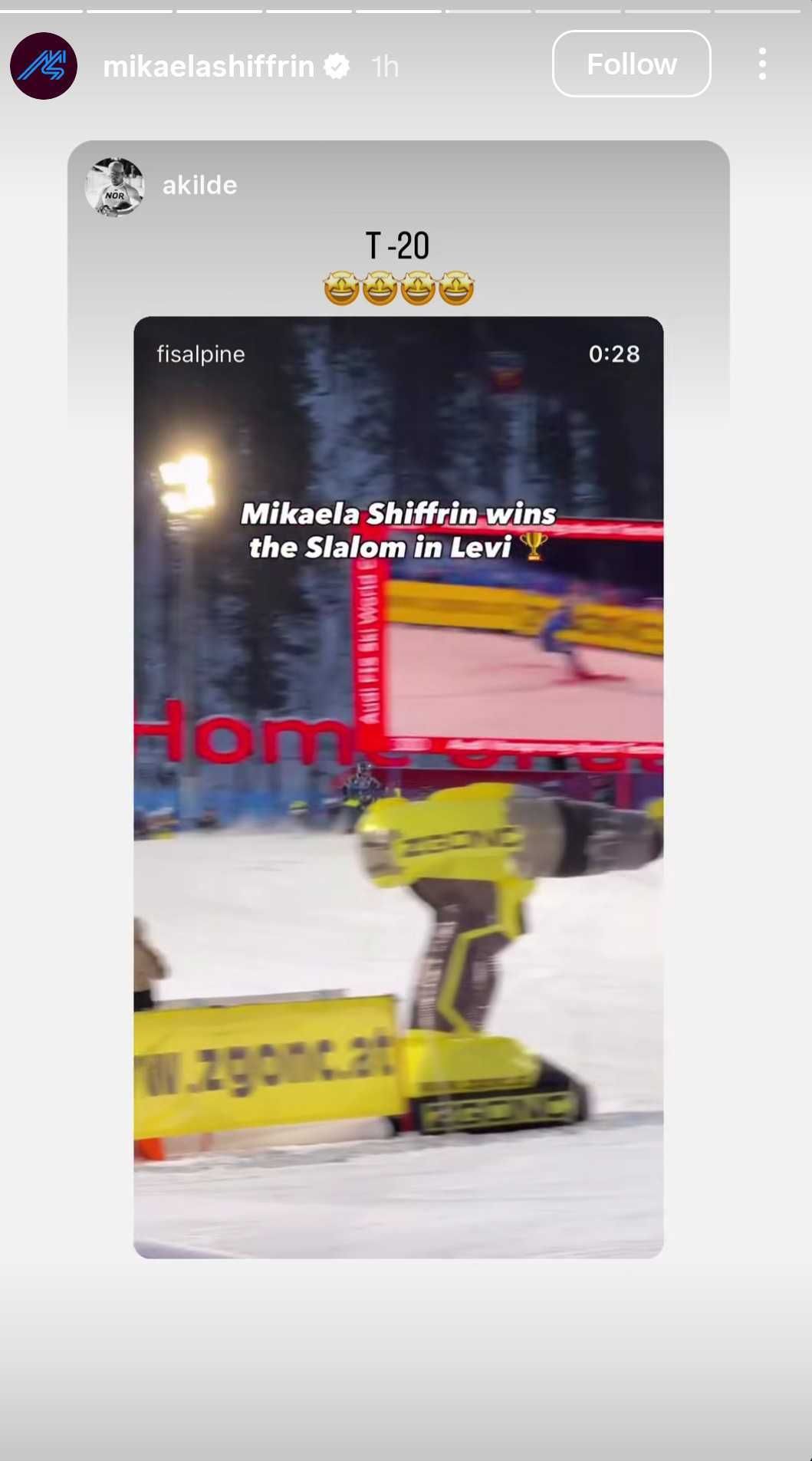 Screenshot of Shiffrin’s story
Her fiancé hasn’t started his season yet, despite Shiffrin’s momentum being on track following the Levi event. For the season, the Norwegian has been working out hard on the slopes in Chile and other places.
Shiffrin attributes her success in Levi to her pre-season homework.
Since Shiffrin is an expert on the slopes, the debate is never about her skill set but rather her capacity to mentally recover after a difficult season the previous year. Shiffrin had to battle her mental health issues throughout the 2024–25 season after the crash in Killington in 2024.
Why I Believe I’m the Best: Inside Mikaela Shiffrin’s Candid Olympic Interview
Mikaela Shiffrin has always been known for her precision, her discipline, and the quiet intensity that follows her into every race. But in a recent Olympic interview, she shocked many when she uttered a rare and powerful statement: “Why am I the best? Because I’ve worked every single day to become someone I can rely on—even when the world can’t.”
It wasn’t arrogance. It wasn’t ego. It was truth spoken from a place of humility, sacrifice, and relentless determination. And behind that truth lies a story far deeper than medals, podiums, or praise.
When Mikaela Shiffrin discusses greatness, she doesn’t talk about her victories first. She talks about effort. She talks about doubt. She talks about the lonely mornings on the mountain when the sun hasn’t risen yet, and she’s already tightening her boots. “Being the best isn’t about talent,” she said during the interview. “It’s about waking up and choosing to push yourself, even on the days when you’d rather hide.”
Those words reflect the core of her identity as an athlete. Shiffrin’s journey to becoming one of the most decorated skiers in history wasn’t smooth, nor was it pre-destined. It was built on habit, repetition, and an obsessive commitment to mastering her craft.
In the interview, she explained that what separates the good from the great in skiing often comes down to invisible work—the hours nobody sees, the routines nobody applauds. “People watch the race and think it lasts a minute,” she said. “But that one minute took thousands of hours.”
Even so, the interviewer asked a question that made her pause: Do you ever feel pressure to live up to this image of perfection?
Her response was honest and disarming. “All the time. People think I’m fearless, but fear is part of my daily life. I fear failure, injury, disappointment. But what makes me strong is that I keep going anyway. Pressure doesn’t crush me—it sharpens me.”
What truly fascinated viewers was how openly Shiffrin spoke about her mental resilience, especially after the painful moments in her Olympic career. She addressed the setbacks that once left the world questioning her ability to bounce back. Instead of deflecting, she leaned into the vulnerability. “Those moments broke me,” she said quietly. “But they also rebuilt me. You can’t call yourself the best if you only shine when everything is easy.”
Shiffrin’s greatness, she believes, comes not from dominance but from endurance. She explained how grief, doubt, and public criticism became part of her story—and how overcoming them became just as important as winning races. “I didn’t become the best because of the medals,” she said. “I became the best because I refused to let the hardest moments define me.”
Her interviewer pressed further, asking what she thinks truly sets her apart from other elite athletes. Shiffrin smiled, as if choosing her words carefully. “I don’t chase perfection,” she said. “I chase improvement. Every day, I ask myself—how can I be one percent better? That mindset has carried me through every obstacle.”
Perfection, she explained, is an illusion. But effort is real. Growth is real. And those who focus on growth will always rise above those who idolize perfection.
Another surprising moment came when she talked about confidence—something she has often been shy to claim openly. “Confidence doesn’t mean believing you’ll always win,” she said. “It means knowing you’ll still stand the next day even if you lose.”
This was perhaps the most powerful line in the entire interview. It captured everything about her approach: the steadiness, the humility, the resilience.
When asked whether she ever compares herself to her competitors, Shiffrin gave a thoughtful answer. “I don’t compete to be better than someone else,” she said. “I compete to be better than the version of myself I was last season, last month, last week. That’s why I win—because the only person I try to beat is me.”
This philosophy, she said, frees her from bitterness, jealousy, or fear of others’ success. It’s what keeps her grounded even as new talents rise and the sport evolves.
She also talked about what the word “best” means to her now, after years of racing, heartbreak, growth, and maturity. “Being the best isn’t about being unbeatable,” she said. “It’s about being undeniable. You show up. You work. You learn. You evolve. That’s what makes a champion.”
But perhaps the most emotional part of the interview came when she talked about the role her late father played in shaping her mindset. “My dad always told me, ‘Be proud of your work, not just your results.’ That’s stayed with me forever. I think that’s why I can call myself the best without feeling guilty—because I know I’ve earned it.”
Her voice wavered when she spoke about the lessons he taught her, lessons she still carries into every race. “He made me believe that greatness isn’t something you’re born with—it’s something you build. Brick by brick.”
As the interview wrapped up, the reporter asked one final question: Do you think you’ll always be the best?
Shiffrin laughed softly, shaking her head. “No one stays the best forever. But what I do know is that I’ll always give my best. And that’s enough for me.”
That final statement captured everything: her humility, her wisdom, her quiet strength. She wasn’t claiming eternal dominance; she was claiming ownership of her journey. And that’s what separates true champions from momentary stars.
As fans and critics watched the interview spread across social media, many said it was the most authentic they had ever seen her. She wasn’t hiding behind medals or records. She wasn’t trying to impress or perform. She was simply Mikaela—ambitious, vulnerable, disciplined, self-aware.
If greatness has a voice, it sounded exactly like hers that day.
And perhaps she was right.
Perhaps being “the best” isn’t about triumph.
Perhaps it’s about truth.
-

 Blog8 months ago
Celtic issues a fiery VAR statement after Trusty’s red card appeal is dismissed, as furious chiefs release referee audio publicly.
-

 Blog4 weeks ago
Former official calls on SFA to contact Rangers over fan scenes during Celtic match, labeling them “completely unacceptable.”
-

 Blog8 months ago
Celtic informed their January signing under Martin O’Neill that he wouldn’t play a single minute this season.
-

 Blog8 months ago
Celtic issued an £83 million warning amid looming UEFA threats.
-

 Blog7 months ago
SFA Expected to Review Missed Penalty in Rangers v Celtic Clash
-

 Blog6 months ago
Police respond after reported disorder following Middlesbrough vs Millwall clash
-

 Blog2 weeks ago
Middlesbrough receive a warning following Steve Gibson’s submission of a £1.5bn proposal.
-

 Blog1 year ago
“Courtside to Aisle-Side: Tyrese Haliburton and Jade Jones Set New Wedding Date”