
Blog
The truth about Wilfried Nancy’s short spell as Celtic boss behind closed doors

Wilfried Nancy’s short and troubled time in charge of Celtic has continued to provoke discussion, with new details emerging that offer a clearer picture of what truly unfolded behind the scenes at Parkhead.
The French coach’s tenure was over almost as soon as it began. Appointed as Brendan Rodgers’ permanent successor, Nancy lasted just 33 days in the role before being dismissed, marking one of the briefest managerial spells in Celtic’s modern history. His departure brought a sudden and messy end to a period that never found stability, forcing the club to turn once again to Martin O’Neill, who returned for a second interim stint this season in an effort to restore calm.
In the weeks since Nancy’s exit, questions have persisted about how things deteriorated so rapidly. Now, former Hearts midfielder and current pundit Michael Stewart has offered insight into what he believes went wrong during Nancy’s time at the helm, revealing a behind-the-scenes atmosphere defined by uncertainty, mixed messages, and a lack of clarity.
Speaking on BBC Radio Scotland, Stewart explained that there had been significant expectations surrounding Nancy’s arrival. Many assumed the new manager would bring a clear tactical vision, detailed preparation, and strong communication — qualities often associated with modern coaching appointments. Instead, Stewart claims what unfolded inside the dressing room was very different.
According to Stewart, feedback he received from within the Celtic squad suggested that players were left without clear instructions. Rather than being guided through a structured plan, they reportedly found themselves unsure of their roles, responsibilities, and overall direction on the pitch. For a club operating under constant pressure to win, that uncertainty quickly became a major problem.
This confusion was compounded by the scale and speed of the changes Nancy attempted to introduce. Stewart was particularly critical of the manager’s decision to rapidly dismantle Celtic’s existing tactical framework almost immediately after taking charge. In his view, such a drastic overhaul was ill-timed and unnecessary, especially given the limited time available and the importance of upcoming fixtures.
One moment that stood out in Stewart’s analysis was the proximity of a crucial match against the league leaders. With only days to prepare, Nancy attempted to implement sweeping tactical changes that would normally require weeks — if not months — of training, repetition, and adjustment. Stewart described this approach as unrealistic, arguing that even the most gifted squads need time to adapt to new systems.
He went further, suggesting that there was an element of overconfidence in Nancy’s belief that such changes could be absorbed instantly. For Stewart, this was less about innovation and more about a failure to respect the realities of elite football management, where timing and context are everything.
What frustrated Stewart even more was how Nancy reportedly responded when results failed to improve. The manager, he claimed, pointed to a lack of time as a reason for patience and understanding. Stewart found this argument contradictory. If time was always going to be an issue, he questioned why such radical changes were introduced in the first place.
In Stewart’s view, this inconsistency weakened Nancy’s position. On one hand, the manager appeared eager to reshape the team in his own image immediately. On the other, he later cited limited time as a defence for underwhelming performances. That disconnect, Stewart suggested, damaged credibility both internally and externally.
While Stewart acknowledged that players must shoulder some responsibility for Celtic’s struggles during that period, he was keen to defend the quality and experience within the squad. He reminded listeners that this is a group that has dominated Scottish football for much of the last decade, winning titles, cups, and consistently performing on the biggest domestic stages.
According to Stewart, the idea that Celtic’s players were incapable of understanding sophisticated tactical concepts simply does not hold up. This is not an inexperienced or technically limited squad. Instead, he believes the issue stemmed from a lack of clear communication rather than an overload of complex ideas.
Stewart described the situation as chaotic, using the word “shambles” to capture the level of confusion he believes existed within the dressing room. Players were not overwhelmed by tactical demands, he argued; they were frustrated by ambiguity. Without knowing precisely what was expected of them, performances suffered, confidence dropped, and cohesion disappeared.
This lack of direction proved especially damaging given the pressure-cooker environment of Celtic Park. At a club where success is demanded immediately and scrutiny is relentless, any uncertainty is magnified. When players do not fully understand the manager’s vision, it becomes almost impossible to deliver consistent results.
Nancy’s brief reign now stands as a cautionary tale about the importance of communication, adaptability, and situational awareness. Taking over at a club like Celtic requires more than fresh ideas and ambition. It demands an understanding of the culture, the expectations, and the need to bring players with you from day one.
The decision to reinstall Martin O’Neill as interim manager highlights Celtic’s desire for familiarity and stability after a turbulent period. O’Neill’s deep understanding of the club, its supporters, and its demands offers a sharp contrast to the uncertainty that defined Nancy’s spell.
In the end, Stewart’s assessment suggests that Nancy’s downfall was not due to a lack of intelligence or football knowledge. Instead, it was rooted in an inability to adapt his approach to the environment he had entered. By trying to leave an immediate imprint, he may have overlooked the basic requirement of clarity — something even the most talented squads cannot function without.
For Celtic, the episode is likely to spark reflection about future managerial appointments and the balance between innovation and continuity. It is a reminder that change, no matter how well intentioned, must be managed carefully — especially at a club where patience is limited and expectations are sky-high.
Nancy’s time at Parkhead may have been brief, but its lessons are significant. In a matter of weeks, a promising appointment unravelled, leaving behind questions that will linger long after one of the shortest managerial stints in the club’s history came to an end.
-
 Blog7 months ago
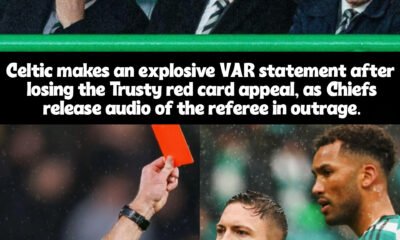
Celtic issues a fiery VAR statement after Trusty’s red card appeal is dismissed, as furious chiefs release referee audio publicly.
-

 Blog1 week ago
Former official calls on SFA to contact Rangers over fan scenes during Celtic match, labeling them “completely unacceptable.”
-

 Blog7 months ago
Celtic informed their January signing under Martin O’Neill that he wouldn’t play a single minute this season.
-

 Blog7 months ago
Celtic issued an £83 million warning amid looming UEFA threats.
-

 Blog7 months ago
SFA Expected to Review Missed Penalty in Rangers v Celtic Clash
-

 Blog6 months ago
Police respond after reported disorder following Middlesbrough vs Millwall clash
-

 Blog1 year ago
“Courtside to Aisle-Side: Tyrese Haliburton and Jade Jones Set New Wedding Date”
-

 Blog7 months ago
£6m star is looking to leave Rangers this summer and has already announced his next club publicly.