
Blog
Martin O’Neill’s call for six Celtic signings set a British transfer record – and still leaves fans uneasy

Martin O’Neill’s weary request for understanding as questions swirled around Celtic’s January transfer business carried far more weight than a casual plea for patience. “Cut me some slack,” the 73-year-old sighed after guiding his side past Falkirk, clearly exasperated by the relentless focus on signings that have yet to materialise. Yet to interpret his words as resignation or blind loyalty to the board would be to misunderstand both the man and the moment.
Few figures in Celtic’s modern history are less deserving of labels like compliant or obedient than O’Neill. Across decades in management, he has consistently challenged those above him, pressing for ambition in the transfer market and demanding the backing required to compete at the highest level. That reputation has not faded simply because he has stepped out of near-retirement to steady a club drifting through one of its most chaotic campaigns in years.
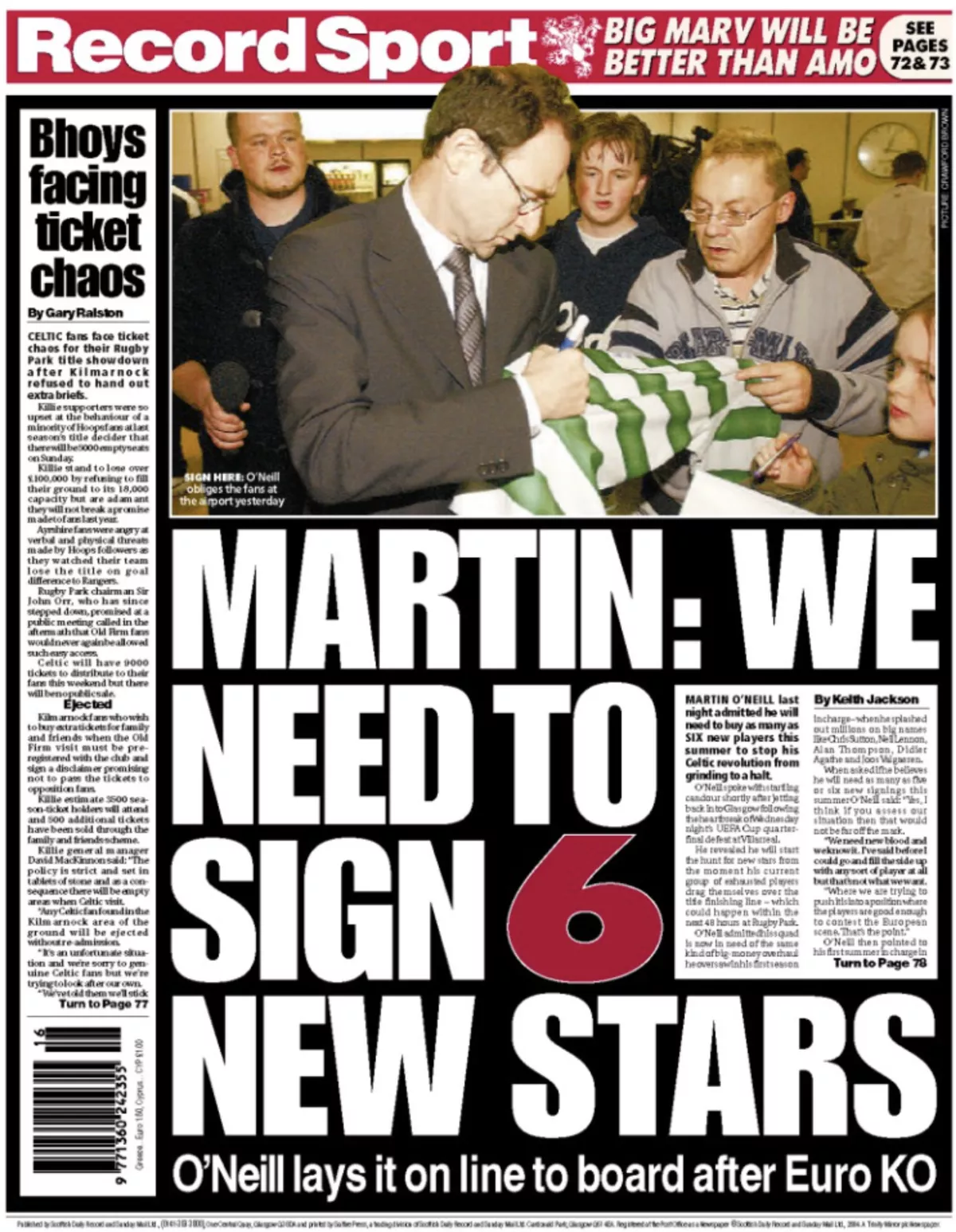
O’Neill’s plea was back page news in 2004 (Image: )
Six weeks ago, O’Neill could hardly have imagined being thrust back into the dugout after Wilfried Nancy’s brief and troubled reign ended. He traded the comfort of television studios for the pressure of rescuing a club he loves, fully aware that the season already teetered on the edge of disaster – perhaps even eclipsing the heartbreak of the failed 10-in-a-row bid. His return was never about sentiment; it was about responsibility.
The sense of déjà vu now surrounding Celtic’s transfer struggles is deeply unsettling. More than two decades ago, O’Neill made a similar appeal that still makes supporters wince when they recall how events unfolded. In April 2004, after Celtic’s UEFA Cup quarter-final exit to Villarreal, he spoke with stark honesty about the scale of rebuilding required. Fresh from eliminating Barcelona and dreaming of back-to-back European finals, Celtic were staring into the void of a post-Henrik Larsson era.
Standing in an airport departure lounge after the defeat, O’Neill did not sugar-coat the challenge ahead. He openly stated that around six new signings would be necessary to keep Celtic competitive on the European stage. It was not a reckless demand but a calculated assessment of where the squad stood and where it needed to go. Celtic, he insisted, did not require bodies for the sake of numbers, but players of genuine quality capable of bridging the gap between domestic dominance and continental credibility.
What followed remains a cautionary tale. The search for Larsson’s successor became a protracted and chaotic saga. High-profile names came and went in rumours and trials. Rivaldo declined a short-term deal, Marco Amoroso failed to convince, and a host of strikers were linked without resolution. Eventually, the club sanctioned a £1.5 million loan move for Wolves forward Henri Camara – a record fee for a temporary signing in British football at the time.
The gamble backfired spectacularly. Camara struggled to make an impact and was moved on by January, replaced by Craig Bellamy in a move that effectively admitted the initial mistake. Elsewhere, Juninho arrived well past his peak, while Stéphane Henchoz never resembled the defender who had once excelled at Liverpool. O’Neill had asked for six signings, received four, and only one truly delivered. The consequences of that misjudged recruitment lingered long after.
Fast forward more than 21 years, and O’Neill once again finds himself urging Celtic’s hierarchy to act decisively. The parallels are impossible to ignore and deeply uncomfortable. This time, the task is not replacing Larsson but navigating the void left by Kyogo’s decline and eventual departure. The recruitment strategy has appeared so erratic that the club even explored the possibility of bringing the Japanese striker back, a move that spoke volumes about the lack of clarity in planning.
Supporters, already on edge, know that another window defined by half-measures and misfires could prove catastrophic. The margin for error is slimmer than ever, with Rangers and Hearts both posing genuine threats. A repeat of the hit-and-miss approach of 2004 would almost certainly inflame tensions further and undermine O’Neill’s efforts to stabilise the season.
Despite the fatigue in his voice, O’Neill’s message remains consistent with everything he has stood for throughout his career. His plea is not born of weakness but urgency. He understands better than most that sentiment and patience mean little without decisive action. Celtic, once again, are at a crossroads. Whether the lessons of the past have truly been learned may define not only this transfer window, but the direction of the club for years to come.
-

 Blog7 months ago
Celtic issues a fiery VAR statement after Trusty’s red card appeal is dismissed, as furious chiefs release referee audio publicly.
-

 Blog1 week ago
Former official calls on SFA to contact Rangers over fan scenes during Celtic match, labeling them “completely unacceptable.”
-

 Blog7 months ago
Celtic informed their January signing under Martin O’Neill that he wouldn’t play a single minute this season.
-

 Blog7 months ago
Celtic issued an £83 million warning amid looming UEFA threats.
-

 Blog7 months ago
SFA Expected to Review Missed Penalty in Rangers v Celtic Clash
-

 Blog6 months ago
Police respond after reported disorder following Middlesbrough vs Millwall clash
-

 Blog1 year ago
“Courtside to Aisle-Side: Tyrese Haliburton and Jade Jones Set New Wedding Date”
-

 Blog7 months ago
£6m star is looking to leave Rangers this summer and has already announced his next club publicly.