
Blog
Willie Collum’s ‘100% conclusive evidence’ remarks could reemerge with Celtic VAR developments

The debate surrounding VAR and handball decisions in Scottish football has once again intensified after comments made by Willie Collum regarding Celtic’s controversial penalty against Motherwell drew comparisons with remarks he made earlier in the season.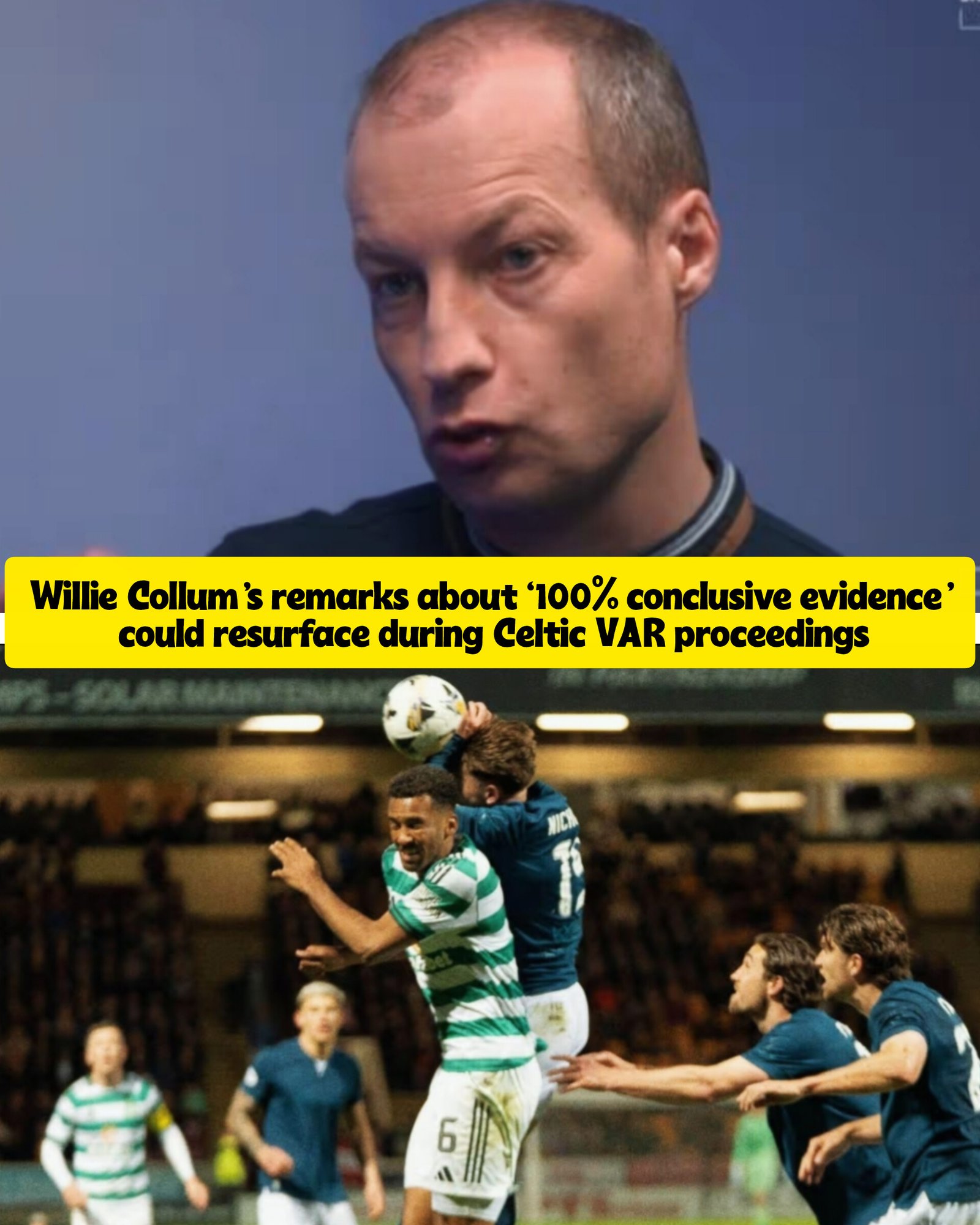
Collum, who serves as the Scottish FA’s head of refereeing, appeared on the latest edition of the VAR Review Show to discuss a number of key decisions from recent Scottish Premiership matches. Among the incidents examined, none generated more discussion than the penalty awarded to Celtic during their dramatic victory over Motherwell at Fir Park.
The incident occurred late in the match and proved crucial in Celtic securing all three points. The victory ensured they remained in the title race and maintained pressure on league leaders Hearts. However, the decision to award the penalty sparked considerable controversy among supporters, pundits and observers, many of whom questioned whether there was enough evidence for VAR to intervene.
The penalty was awarded after a review of a possible handball involving Motherwell’s Sam Nicholson. Critics of the decision argued that the available footage did not provide a definitive angle showing the ball making contact with Nicholson’s arm. As a result, they believed the original on-field decision should have remained unchanged because VAR is only supposed to intervene when there is clear and obvious evidence that an error has been made.
Addressing the matter, Collum defended the process that led to the penalty being awarded. He explained that the refereeing team felt the available images provided sufficient proof that the ball had struck Nicholson’s hand. According to Collum, the officials involved in the review process were confident in their assessment.
He pointed to a specific still image that showed the positions of the player’s head, arm and the ball. In the opinion of the officiating team, that image offered enough evidence to conclude that contact had occurred. Collum stressed that both the VAR and assistant VAR carefully analysed the footage before reaching their verdict.
He also highlighted the context surrounding the incident. With the match deep into stoppage time and the stakes extremely high, the officials followed the established review procedure before recommending that referee John Beaton examine the footage himself. After reviewing the images on the pitch-side monitor, Beaton agreed with the VAR team’s assessment and awarded the penalty.
Collum emphasised that the key figures in the decision-making process were the match officials directly involved. Since both the VAR team and the referee independently arrived at the same conclusion, the Scottish FA fully supported the final outcome.
The release of the audio from the review process added another dimension to the discussion. During the exchange, Beaton could be heard asking the VAR whether the ball had definitely struck the player’s arm before making his decision. Some observers felt the speed with which the referee reached his conclusion raised questions about whether enough scrutiny had been applied to such a significant incident.
Collum, however, defended the communication and process. He explained that when a referee is called to the monitor for a potential handball offence, the VAR team has already completed extensive checks and reached a conclusion that the ball has made contact with the hand or arm. Therefore, the referee’s primary task during the review is not to establish whether contact occurred but rather to assess the position of the arm and determine whether the handball is punishable under the laws of the game.
According to Collum, the referee is initially shown the incident at normal speed and often on a repeated loop. This allows them to evaluate the overall movement and positioning of the player’s arm. Once satisfied with that aspect of the review, the referee may seek confirmation regarding the point of contact, but the groundwork has already been completed by the VAR team.
Collum argued that referees are not brought to the monitor unless VAR officials are already convinced that contact with the hand has occurred. In his view, the review involving Nicholson followed that principle correctly and therefore justified the intervention and subsequent penalty award.
Despite Collum’s explanation, attention quickly turned to comments he made previously when discussing a different handball incident involving Dundee United and Hibernian. Those earlier remarks appeared to present a stricter interpretation of the evidence required before VAR should overturn an on-field decision.
Speaking about that earlier case, Collum acknowledged that the ball may well have struck a player’s arm. However, he stressed that officials did not possess what he described as “100 per cent conclusive evidence” proving that contact had taken place. Because certainty was lacking, the original decision made by the referee on the pitch was allowed to stand.
At the time, Collum argued that speculation or probability was not enough to justify VAR intervention. Even if some people believed the ball likely hit the arm, he maintained that the evidence available to officials needed to be definitive before an on-field decision could be overturned.
He explained that the standard being applied was one of proof rather than possibility. In situations involving handball decisions, officials were expected to be completely confident in what they were seeing before recommending a review or changing a decision. Anything short of that level of certainty was deemed insufficient.
Collum also acknowledged that such an approach could lead to frustration from clubs who felt a decision had gone against them. Nevertheless, he insisted that consistency required referees and VAR officials to rely only on evidence that clearly demonstrated what had happened.
Furthermore, he revealed that Scottish FA officials had been coaching VAR teams to avoid interventions unless there was a factual basis for overturning a decision. The emphasis, he said, was on obtaining clear evidence rather than relying on subjective interpretation or assumptions.
These previous comments have now resurfaced because some observers believe they contradict the reasoning used to justify Celtic’s penalty against Motherwell. Critics argue that if the footage in the Dundee United versus Hibernian incident was judged insufficiently conclusive, then similar standards should have been applied to the Nicholson handball review.
The debate has reignited wider questions about consistency in VAR decision-making and the threshold of evidence required for interventions. While Collum and the Scottish FA remain convinced that the Celtic penalty was correctly awarded, the contrasting interpretations of what constitutes clear and conclusive proof continue to fuel discussion among supporters and analysts.
As a result, the incident has become another prominent example of the challenges facing VAR, particularly when dealing with handball decisions where camera angles and available footage can leave room for differing opinions. Whether supporters agree with Collum’s explanation or not, the controversy highlights the ongoing scrutiny surrounding refereeing decisions and the role of video technology in modern football.
-
 Blog7 months ago
Celtic issues a fiery VAR statement after Trusty’s red card appeal is dismissed, as furious chiefs release referee audio publicly.
-

 Blog1 week ago
Former official calls on SFA to contact Rangers over fan scenes during Celtic match, labeling them “completely unacceptable.”
-

 Blog7 months ago
Celtic informed their January signing under Martin O’Neill that he wouldn’t play a single minute this season.
-
 Blog7 months ago
Celtic issued an £83 million warning amid looming UEFA threats.
-
 Blog7 months ago
SFA Expected to Review Missed Penalty in Rangers v Celtic Clash
-

 Blog6 months ago
Police respond after reported disorder following Middlesbrough vs Millwall clash
-

 Blog1 year ago
“Courtside to Aisle-Side: Tyrese Haliburton and Jade Jones Set New Wedding Date”
-

 Blog7 months ago
£6m star is looking to leave Rangers this summer and has already announced his next club publicly.