
Blog
Southampton have regained confidence, and the EFL won’t be pleased to hear this.

For several days, Southampton Football Club remained largely silent while controversy surrounding their disciplinary case continued to grow. Supporters demanded answers, the club’s Fan Advisory Board sent formal correspondence seeking clarification, and media outlets questioned the lack of communication from St Mary’s. The frustration among fans intensified as speculation filled the vacuum left by the club’s silence.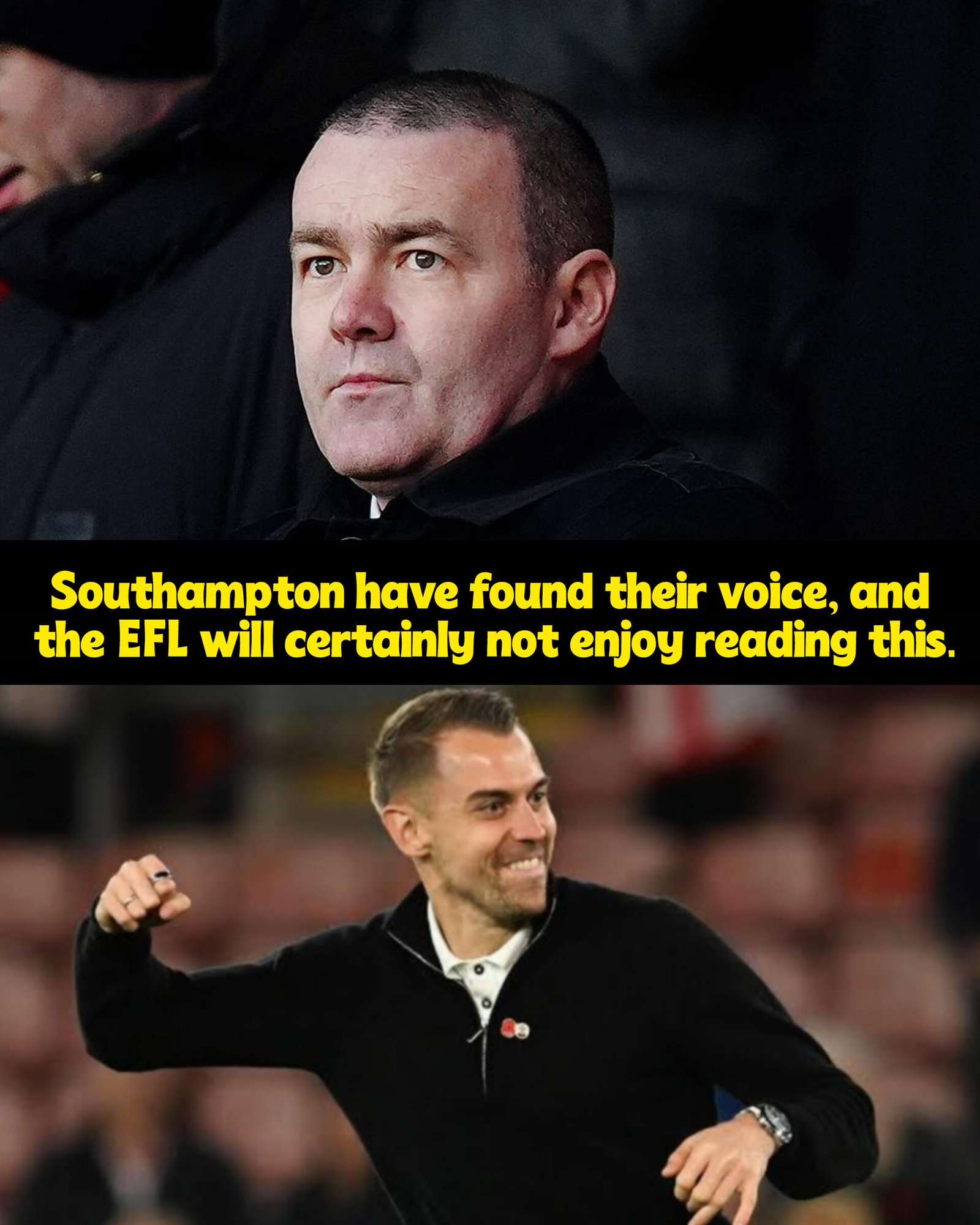
That silence ended on Monday when Southampton released a carefully crafted statement addressing the outcome of their unsuccessful appeal against sanctions imposed by the English Football League. The statement was notable not because it denied wrongdoing, but because it challenged aspects of the disciplinary process itself.

Nottingham Forest v Southampton – Premier League – City Ground | Mike Egerton – PA Images/GettyImages
While the club once again accepted responsibility for breaching regulations, it also raised serious concerns about the fairness, perception, and structure of the proceedings that led to the punishment. In doing so, Southampton shifted the focus from their own conduct to the methods used by the authorities responsible for judging the case.
The statement was measured in tone, avoiding inflammatory language or outright accusations. Yet beneath its restrained wording lay a series of pointed questions directed at the EFL, the disciplinary panel, and the broader system of governance within English football.
Southampton Accept Responsibility
A central theme of Southampton’s statement was accountability. The club did not attempt to dispute the fact that rules had been broken. Instead, it openly acknowledged that it had breached the relevant regulations and accepted that disciplinary authorities were entitled to determine that proof of sporting advantage was not necessary to establish a serious offence.
The club admitted that mistakes had been made in its handling of the situation, particularly during the early stages. Southampton conceded that its initial response lacked the level of scrutiny and oversight that should have been applied from the outset. Looking back, the club recognised that matters should have been managed differently and described this failure as an error of judgement.
Importantly, Southampton also accepted responsibility for the impact its actions had on junior members of staff. The statement acknowledged that younger employees should never have been placed in circumstances where they felt under pressure. The club accepted that this represented a failure of leadership and oversight at an organisational level.
At the same time, Southampton emphasised that once the EFL launched a formal investigation, the club cooperated fully with the process. It pointed to its admissions, honesty, and willingness to assist investigators as evidence that it had taken the matter seriously and sought to address the situation transparently.
Questions Raised About Panel Independence
While accepting responsibility for the breach itself, Southampton made clear that it had concerns about the individuals selected to judge the case.
The club highlighted what it described as apparent historic and indirect links between two members of the disciplinary panel and Middlesbrough, one of the clubs connected to the wider circumstances surrounding the investigation.
Southampton was careful not to accuse anyone of actual bias. The statement explicitly acknowledged that such connections alone do not prove prejudice or unfairness. However, the club argued that they raise legitimate questions regarding perception, consistency, and the standards of independence that should be expected in proceedings carrying significant consequences.
This distinction was important. Rather than claiming the panel acted improperly, Southampton questioned whether the EFL should have avoided creating circumstances that could generate doubts about impartiality in the first place.
The club’s argument centred on appearances as much as reality. In high-profile disciplinary matters, confidence in the process is often dependent not only on actual fairness but also on the perception that proceedings are entirely free from potential conflicts or questionable associations.
Southampton suggested that the EFL failed to meet that standard.
The David Winnie Connection
One of the panel members identified in discussions surrounding the case was solicitor David Winnie.
Historical records show that Winnie made a single appearance for Middlesbrough while on loan in 1994. That appearance came in a 4-0 defeat against Tranmere Rovers, and he played no significant role in Middlesbrough’s wider history.
Winnie has strongly rejected suggestions that this connection could have influenced his judgement. He stated that a solitary appearance decades ago had absolutely no impact on his ability to approach the case objectively and fairly.
His position is understandable. Many observers would agree that such a limited historical connection is unlikely to affect professional decision-making.
However, Southampton’s concern extends beyond whether actual bias existed. The club’s argument focuses on why individuals with any identifiable association to Middlesbrough were selected at all when alternative options were available.
The point raised is not necessarily about what happened inside the hearing room but about the process through which panel members were chosen. Southampton believes that greater care should have been taken to avoid any appearance of potential conflicts, regardless of whether those conflicts had practical significance.
The Wider Selection Process
Southampton’s criticism inevitably leads to broader questions about the EFL’s selection procedures.
The club noted that there are approximately 176,000 practising solicitors in the United Kingdom. Against that backdrop, it questioned why individuals with historical Middlesbrough links were appointed to oversee a case connected to Middlesbrough when so many alternatives existed.
This issue strikes at the heart of public confidence in disciplinary systems. Sporting organisations frequently stress the importance of transparency, independence, and integrity. Southampton’s argument is that these principles should apply equally to the governing bodies and panels responsible for enforcing rules.
The club believes the EFL has yet to provide a satisfactory explanation regarding how these appointments were made and why potential concerns about perception were not addressed beforehand.
Even if the appointments were entirely appropriate, Southampton argues that the governing body should be prepared to explain the reasoning behind them in order to maintain trust in the disciplinary framework.
Concerns Over Evidence
Another significant aspect of Southampton’s statement involved the evidence used during the disciplinary proceedings.
The club expressed concern about the weight attached to claims that junior employees had been pressured into involvement. According to Southampton, some of the most serious allegations appeared not to have been supported by direct evidence.
This is a crucial issue because disciplinary findings often depend heavily on the quality and reliability of evidence presented. Allegations carrying serious reputational consequences are generally expected to be supported by clear and compelling proof.
Southampton suggested that certain conclusions may have relied more on assertions and interpretations than on direct evidence.
The club did not deny that mistakes occurred or that staff may have felt uncomfortable. Indeed, it accepted responsibility for placing junior employees in difficult situations. However, Southampton questioned whether some of the strongest allegations were adequately substantiated before being used to justify severe sanctions.
By raising this point, the club is effectively asking whether the evidential threshold applied during the proceedings was sufficiently rigorous.
Sporting Advantage Remains Unproven
Perhaps the most striking aspect of the entire case is that no finding was made that Southampton actually gained a sporting advantage.
The disciplinary authorities concluded that the existence of a breach and an attempted breach was enough to constitute a serious offence under the regulations. As a result, proving that the club benefited competitively was not considered necessary.
Southampton accepted that this interpretation was permissible under the rules. Nevertheless, the club highlighted the fact that no evidence demonstrated any tangible sporting gain.
The practical outcomes of the matches involved provide an interesting context. Southampton drew two of the games connected to the investigation and lost the third.
These results do not suggest a team that successfully gained a meaningful competitive edge through the conduct under scrutiny. Any advantage that may have existed remained hypothetical rather than proven.
For Southampton, this distinction matters. While accepting that rules were broken, the club appears uncomfortable with a system that imposes severe penalties without requiring evidence that competitive outcomes were actually influenced.
The EFL, meanwhile, maintains that protecting the integrity of competition requires strict enforcement regardless of whether benefits can be demonstrated after the fact.
Supporters Finally Receive Answers
Throughout the controversy, many Southampton supporters felt frustrated by what they perceived as a lack of communication from the club.
Fans wanted explanations, accountability, and a clear understanding of how the situation had developed. The prolonged silence created uncertainty and allowed speculation to dominate discussions.
The club’s latest statement therefore represents a significant shift in approach.
For the first time, Southampton directly addressed not only its own mistakes but also its concerns about the process that followed. The statement provided supporters with the clarity and detail many had been seeking.
While opinions will differ on whether the club’s arguments are persuasive, there is little doubt that Southampton has finally articulated its position in a comprehensive and detailed manner.
Looking Ahead
Despite its criticisms of the disciplinary process, Southampton made clear that its focus is now on learning from the experience.
The club stated that it will carefully examine the published reasons behind the appeal decision and conduct a thorough review of its internal procedures. Governance structures, oversight mechanisms, and decision-making processes will all be assessed with the aim of preventing similar situations from occurring in the future.
Southampton emphasised that responsibility ultimately rests with the club. It acknowledged the lessons arising from the case and committed to strengthening standards of judgement, discipline, and integrity moving forward.
At the same time, the statement leaves behind important questions for the EFL.
Southampton is not claiming innocence. It is not denying that rules were breached. Instead, it is asking whether the disciplinary process itself met the standards of transparency, independence, and evidential scrutiny that governing bodies demand from clubs.
Those questions now form a significant part of the debate.
The club has accepted punishment and admitted mistakes. Yet it has also challenged the authorities to explain and defend the procedures that led to those sanctions.
Whether the EFL chooses to respond in detail remains to be seen. What is certain is that Southampton’s statement has shifted attention away from the original offence and onto the system that judged it.
For supporters, administrators, and observers alike, the discussion is no longer solely about what Southampton did wrong. It is also about whether the disciplinary framework operated in a way that inspires confidence, fairness, and trust.
That debate is unlikely to disappear anytime soon.
-
 Blog7 months ago
Celtic issues a fiery VAR statement after Trusty’s red card appeal is dismissed, as furious chiefs release referee audio publicly.
-

 Blog1 week ago
Former official calls on SFA to contact Rangers over fan scenes during Celtic match, labeling them “completely unacceptable.”
-

 Blog7 months ago
Celtic informed their January signing under Martin O’Neill that he wouldn’t play a single minute this season.
-

 Blog7 months ago
Celtic issued an £83 million warning amid looming UEFA threats.
-

 Blog7 months ago
SFA Expected to Review Missed Penalty in Rangers v Celtic Clash
-

 Blog6 months ago
Police respond after reported disorder following Middlesbrough vs Millwall clash
-

 Blog1 year ago
“Courtside to Aisle-Side: Tyrese Haliburton and Jade Jones Set New Wedding Date”
-

 Blog7 months ago
£6m star is looking to leave Rangers this summer and has already announced his next club publicly.