
Blog
Bobby Madden shares his opinion on controversial Celtic penalty decision vs Motherwell

Former Scottish referee Bobby Madden has weighed in on the controversial penalty awarded to Celtic against Motherwell, insisting that the decision should never have resulted in a spot-kick.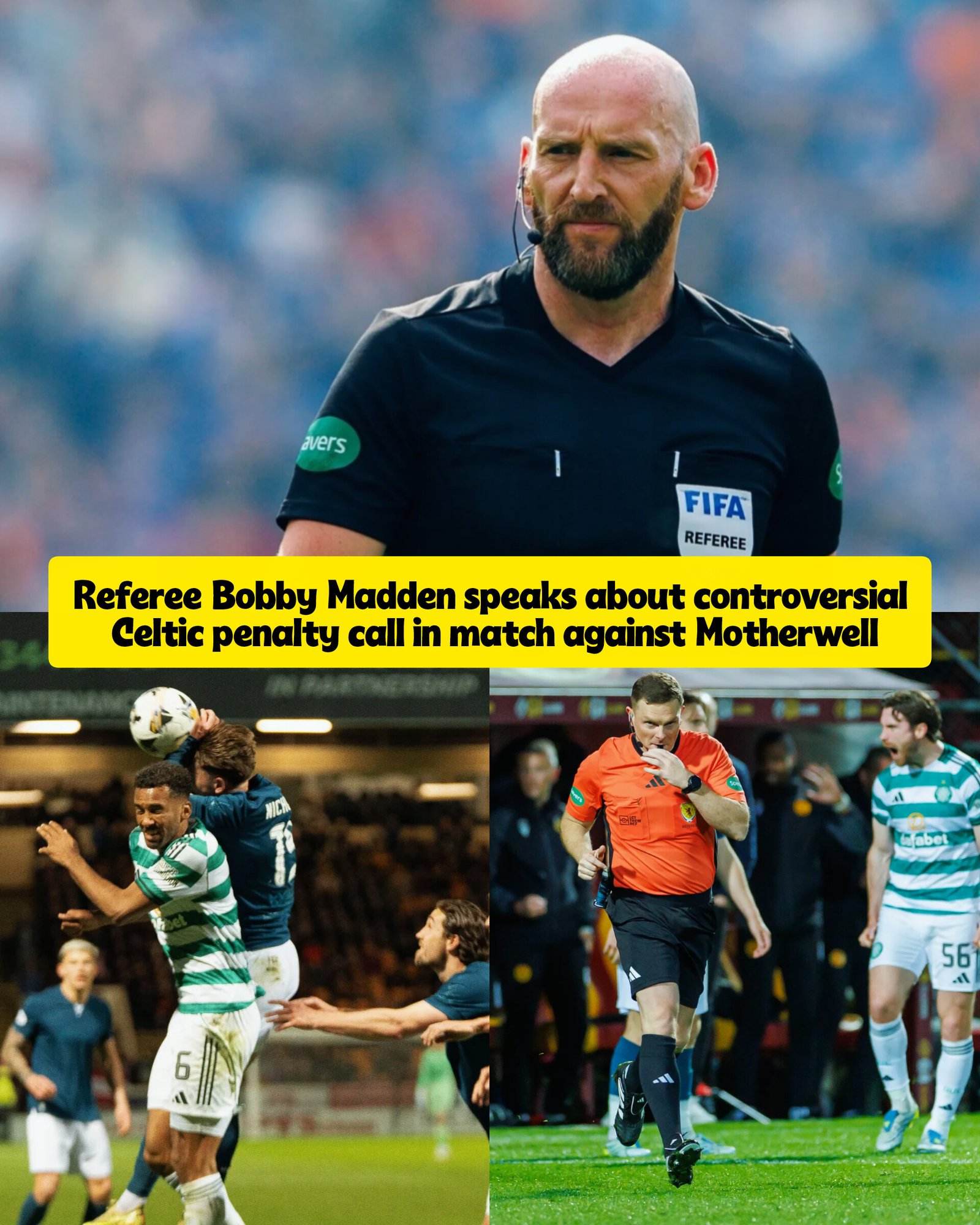
The incident has remained one of the most heavily debated refereeing moments of the Scottish Premiership season, with opinions divided among supporters, pundits, and former officials.
Madden believes that the intervention from VAR was incorrect and has urged the Scottish Football Association to provide greater transparency by publicly explaining how the decision was reached.
Dramatic Incident Sparks Fresh Debate

Motherwell’s Sam Nicholson was given a controversial handball for this challenge in the boxCredit: Alamy
The contentious moment came during stoppage time at Fir Park when Celtic were awarded a penalty following a lengthy VAR review.
Motherwell defender Sam Nicholson appeared to challenge for a long throw into the penalty area during the frantic closing moments of the match. Referee John Beaton initially allowed play to continue, showing no indication that he had spotted a handball offence.
However, VAR official Andrew Dallas advised Beaton to review the incident on the pitch-side monitor.
After viewing the footage, Beaton quickly pointed to the penalty spot. Celtic striker Kelechi Iheanacho then calmly converted the kick, securing a crucial victory for the visitors.
The result proved enormously significant in the title race, leaving Celtic needing only a victory over Hearts in their next fixture to clinch the Scottish Premiership crown.
Decision Draws Widespread Criticism
The penalty immediately generated fierce criticism from various quarters.
Former England striker and broadcaster Gary Lineker described it as one of the worst VAR decisions he had ever seen.
Hearts manager Derek McInnes was equally furious, branding the ruling “disgusting” due to its potential impact on the championship race.
Motherwell boss Jens Berthel-Askou also struggled to understand the decision, arguing that there was no possible way the incident should have resulted in a penalty.
The controversy quickly became one of the most discussed refereeing calls of the season.
Madden Explains Why He Believes It Was Not Handball
Speaking on BBC Radio Scotland, Madden made it clear that he did not believe Motherwell should have been punished.
According to the former FIFA referee, while some observers pointed to Nicholson’s arm position as evidence supporting the penalty, the overall context of the incident had to be considered.
Madden argued that Nicholson’s arm was not unnaturally extending away from his body in a manner designed to block the ball.
Instead, he believed the position of the arm was influenced by physical contact from a Celtic player while the Motherwell defender was challenging for the ball.
Contact Changes The Interpretation
Madden stressed that when assessing handball incidents, officials must examine how and why a player’s arm reaches a particular position.
In this case, he felt that Nicholson’s movement resulted directly from the challenge rather than any deliberate attempt to make himself larger or obstruct the ball.
He further argued that even if the ball had not made contact with Nicholson’s arm, it would likely have struck his head instead.
That fact, in Madden’s view, significantly weakens the argument that the defender gained any advantage through the arm position.
As a result, he concluded that awarding a penalty was the wrong outcome.
VAR Intervention Faces Scrutiny
Perhaps Madden’s strongest criticism was aimed at the use of VAR.
He insisted that the evidence available did not meet the threshold required to overturn the referee’s original decision.
Under VAR protocols, intervention is supposed to occur only when there is a clear and obvious error.
Madden believes that standard was not met in this case.
For him, the footage did not provide definitive proof that Beaton had made a mistake by initially allowing play to continue.
Therefore, the on-field decision should have remained unchanged.
The Importance Of Supporting The Original Call
Madden highlighted that football officials are under immense pressure in the modern game.
Every decision is dissected from multiple angles, with referees facing intense scrutiny from supporters, clubs, and the media.
Because of this environment, he believes it is essential that VAR only intervenes when there is overwhelming evidence.
In situations where doubt remains, the original decision should stand.
According to Madden, the Motherwell incident was far from clear-cut, making the VAR intervention difficult to justify.
Call For Greater Transparency From The SFA
The former official also suggested that the Scottish Football Association should be more open regarding controversial decisions.
Rather than allowing speculation and criticism to continue unchecked, Madden believes the governing body would benefit from explaining the reasoning behind the verdict.
He suggested that releasing VAR audio or offering a detailed breakdown of the review process could help supporters better understand how officials reached their conclusion.
Such transparency, he argued, would strengthen confidence in refereeing decisions and reduce confusion.
Questions About Additional Camera Angles
One of Madden’s main concerns relates to what footage was available during the review.
He questioned whether officials examined additional camera angles that were not shown publicly.
Without knowing exactly what evidence the VAR team considered, many observers remain puzzled about how the decision was reached.
Madden acknowledged that Scottish football authorities are unlikely to admit an error publicly but maintained that greater explanation would benefit everyone involved in the game.
Scottish Football’s Reputation At Stake
Another concern raised by Madden was the impact these controversies can have on the image of Scottish football.
He argued that the league has delivered exciting matches and compelling storylines throughout the season.
However, repeated discussions about refereeing controversies often dominate headlines instead of the football itself.
Madden believes Scottish football deserves recognition for its entertainment value rather than becoming defined by contentious officiating decisions.
Inconsistency Across Recent Handball Calls
The former referee also pointed to several other recent handball incidents that have created confusion.
One example involved a match between Hearts and Rangers, where Dujon Sterling appeared to handle the ball but no penalty was awarded.
According to Madden, clubs were later informed that Sterling was actively challenging for the ball, meaning the handball offence was not considered punishable.
That explanation has led many to question why similar reasoning was not applied in the Motherwell-Celtic incident.
Previous Motherwell Decision Adds To Frustration
Madden also referenced another handball incident involving Motherwell that he personally believed should have resulted in a penalty.
On that occasion, no spot-kick was awarded despite what he viewed as stronger grounds for intervention.
The contrast between that decision and the one involving Nicholson has only fuelled claims of inconsistency.
For supporters and clubs, differing interpretations of similar incidents create frustration and uncertainty regarding how handball laws are being applied.
Hearts Supporters Feel Hard Done By
Given the implications for the title race, many Hearts fans have expressed anger over the penalty award.
Madden acknowledged those feelings, suggesting supporters have legitimate reasons to question the consistency of recent officiating decisions.
With Hearts competing directly with Celtic for the championship, the outcome at Fir Park carried enormous significance.
Any controversial call was always likely to attract intense scrutiny.
Steve Conroy Shares Similar View
Former referee Steve Conroy also offered his assessment and largely agreed with Madden’s conclusions.
Conroy argued that the available footage failed to conclusively prove that Nicholson handled the ball in a punishable manner.
In his opinion, VAR did not possess the level of certainty required to overturn the referee’s original judgment.
Like Madden, he stressed that VAR exists to correct obvious mistakes rather than reinterpret subjective incidents.
No Clear Change In Ball Direction
Conroy pointed out that the ball’s trajectory appeared largely unchanged throughout the sequence.
Even when slowed down repeatedly, he felt there was no definitive evidence demonstrating that contact with Nicholson’s hand altered the ball’s path.
That lack of visible deviation further undermined the argument for a VAR intervention.
Without conclusive proof, Conroy believes the decision should never have progressed to an on-field review.
Debate Over A Player’s Natural Movement
Conroy also criticised the complexity of modern handball interpretations.
He suggested that football authorities have created increasingly complicated guidelines for what should remain a relatively straightforward aspect of the game.
Looking at Nicholson’s body position, Conroy argued that defenders naturally use their arms when jumping to challenge for aerial balls.
Expecting players to leap with their arms fixed tightly against their sides is unrealistic and physically unnatural.
Silhouette Argument Revisited
The former referee referred to previous guidance centred on a player’s body silhouette.
According to that interpretation, officials should assess whether an arm makes a player’s body unnaturally larger.
Conroy believes Nicholson’s position did not meet that standard because removing the arm from the equation would still have resulted in the ball striking another part of his body, most likely his face.
As such, he saw no justification for awarding a penalty.
Ongoing Questions Remain
Despite support for the officials from some quarters, criticism continues to surround the decision.
Madden and Conroy both maintain that the intervention failed to satisfy the standards expected of VAR reviews.
Their comments add further weight to calls for greater transparency and consistency from Scottish football’s refereeing authorities.
As debate continues, the Motherwell-Celtic penalty remains one of the most controversial moments of the season and is likely to be discussed long after the title race reaches its conclusion.
-
 Blog7 months ago
Celtic issues a fiery VAR statement after Trusty’s red card appeal is dismissed, as furious chiefs release referee audio publicly.
-
 Blog1 week ago
Former official calls on SFA to contact Rangers over fan scenes during Celtic match, labeling them “completely unacceptable.”
-

 Blog7 months ago
Celtic informed their January signing under Martin O’Neill that he wouldn’t play a single minute this season.
-
 Blog7 months ago
Celtic issued an £83 million warning amid looming UEFA threats.
-
 Blog7 months ago
SFA Expected to Review Missed Penalty in Rangers v Celtic Clash
-

 Blog6 months ago
Police respond after reported disorder following Middlesbrough vs Millwall clash
-

 Blog1 year ago
“Courtside to Aisle-Side: Tyrese Haliburton and Jade Jones Set New Wedding Date”
-

 Blog7 months ago
£6m star is looking to leave Rangers this summer and has already announced his next club publicly.