
Blog
Gold hunt begins for Vonn, Shiffrin and Odermatt in Milan Cortina

Alpine skiing is one of the oldest disciplines on the Winter Olympic programme, with roots stretching back more than a century. The sport first appeared at the Olympic Games in 1936 in Garmisch-Partenkirchen, Germany, and while formats and rules have evolved over time, the core events familiar to fans today — such as downhill and slalom — remain central to the competition. With the Milan Cortina Winter Olympics just weeks away, here is a comprehensive look at how Alpine skiing will unfold in Italy and who is expected to shine.
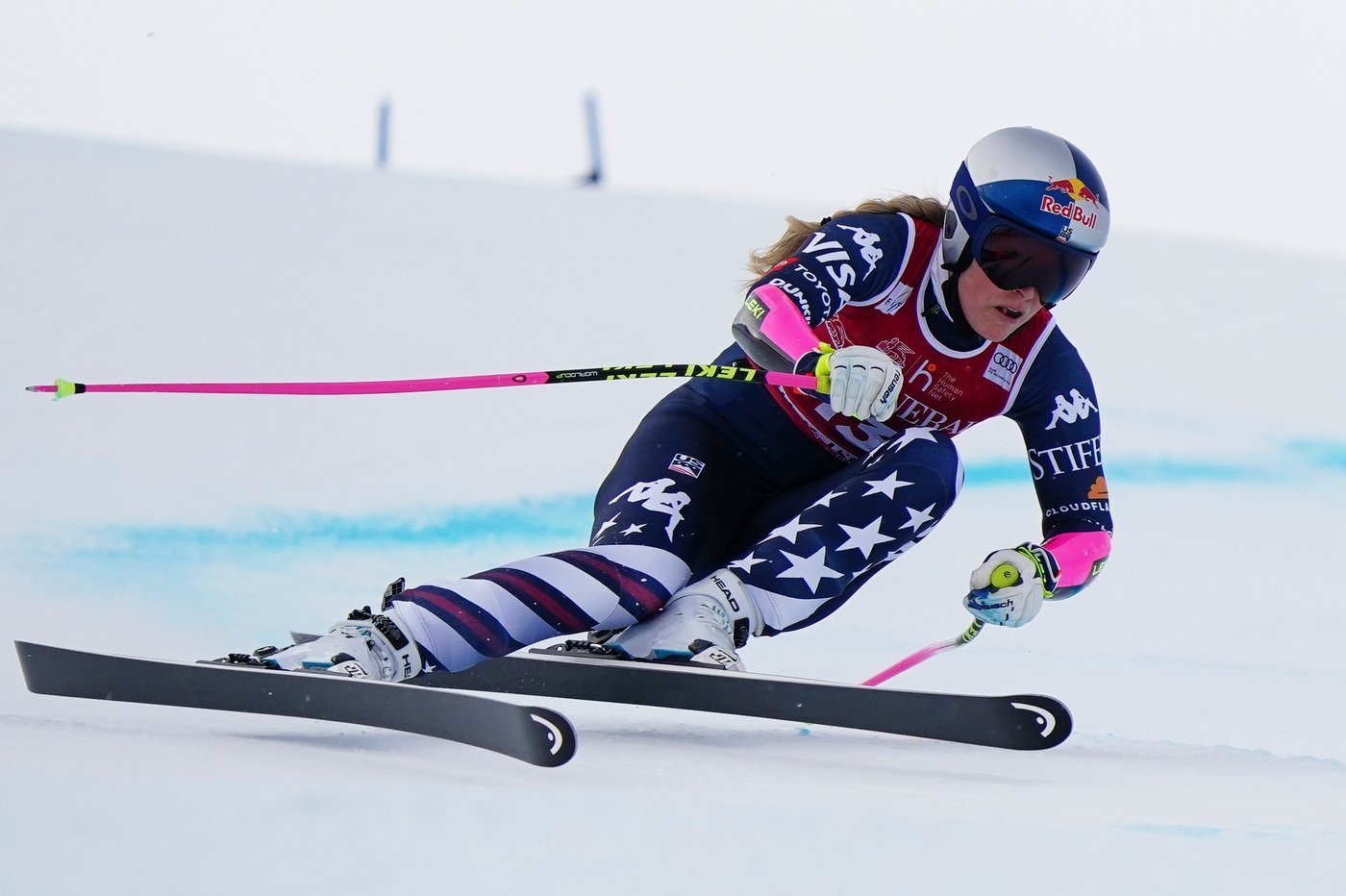
FILE – United States’ Lindsey Vonn speeds down the course during an alpine ski, women’s World Cup super-G in Val d’Isere, France, Sunday, Dec. 21, 2025. (AP Photo/Pier Marco Tacca, File)
How Alpine skiing works at the Olympics
There will be five Alpine skiing events for both men and women at these Games. Four are individual races: downhill, super-G, giant slalom, and slalom. The fifth is the team combined, which will make its Olympic debut in Milan Cortina.
The downhill and super-G are known as the speed events. In these races, competitors are allowed only one run, meaning there is no room for error. Giant slalom and slalom, by contrast, are contested over two runs. After the first leg, the fastest 30 skiers qualify for the second run, starting in reverse order of their opening times, adding an extra layer of drama and strategy.
The newly introduced team combined event pairs two skiers from the same nation. One athlete competes in the downhill portion, while the other takes on the slalom. Their combined times determine the final standings, blending speed and technical skill into a single contest.
Athletes to watch
The United States arrives in Italy with two of the most decorated skiers in history. Mikaela Shiffrin, already a multiple Olympic champion, remains a dominant force in slalom and giant slalom. Alongside her is Lindsey Vonn, now 41, whose legacy is built on excellence in downhill and super-G. There is growing speculation that the pair could join forces in the team combined event, creating one of the most formidable pairings in Olympic skiing.
The American team is further strengthened by Breezy Johnson, the reigning downhill world champion, and Ryan Cochran-Siegle, who claimed a silver medal in super-G at the previous Olympics.
Italy, competing on home snow, boasts a powerful squad of its own. Sofia Goggia and Federica Brignone headline the women’s team, with hopes that Brignone will recover in time from injury. On the men’s side, Dominik Paris leads the charge. Meanwhile, Switzerland’s Marco Odermatt enters the Games as the standout men’s skier in the world and a leading contender across multiple disciplines.
Venues and competition schedule
The Alpine skiing events will be split between two iconic locations. Men’s races will take place in Bormio, while women’s events will be held in Cortina d’Ampezzo, a venue steeped in Olympic and skiing history.
The schedule begins with the men’s downhill on February 7, followed by the women’s downhill on February 8. The giant slalom events are set for February 14 (men) and February 15 (women). The men’s slalom will be contested on February 16, with the women’s slalom on February 18, which will also mark the final Alpine skiing event of the Games.
Iconic Olympic memories
Alpine skiing has produced some of the most unforgettable moments in Winter Olympic history. At the 1968 Grenoble Games, France’s Jean-Claude Killy delivered a legendary performance by winning gold in all three men’s events on home snow.
Shiffrin etched her name into the record books at the 2014 Sochi Olympics, where she became the youngest slalom gold medalist in history at just 18 years old.
Another defining moment came at the 1998 Nagano Games, when Austria’s Hermann Maier rebounded from a terrifying downhill crash to capture gold medals in both the super-G and giant slalom, one of the most remarkable comebacks the sport has ever seen.
Fascinating facts
Italian great Alberto Tomba remains the country’s most successful Olympic skier, with five medals to his name — three gold and two silver — earned across the 1988 Calgary, 1992 Albertville, and 1994 Lillehammer Games. Though he hails from the Bologna region, Tomba spent many winters training in Cortina d’Ampezzo before rising to global stardom.
Another Italian legend, Deborah Compagnoni, was born in Bormio and raised nearby in Santa Caterina di Valfurva. She achieved the rare feat of winning Alpine skiing gold medals at three consecutive Olympics: 1992, 1994, and 1998.
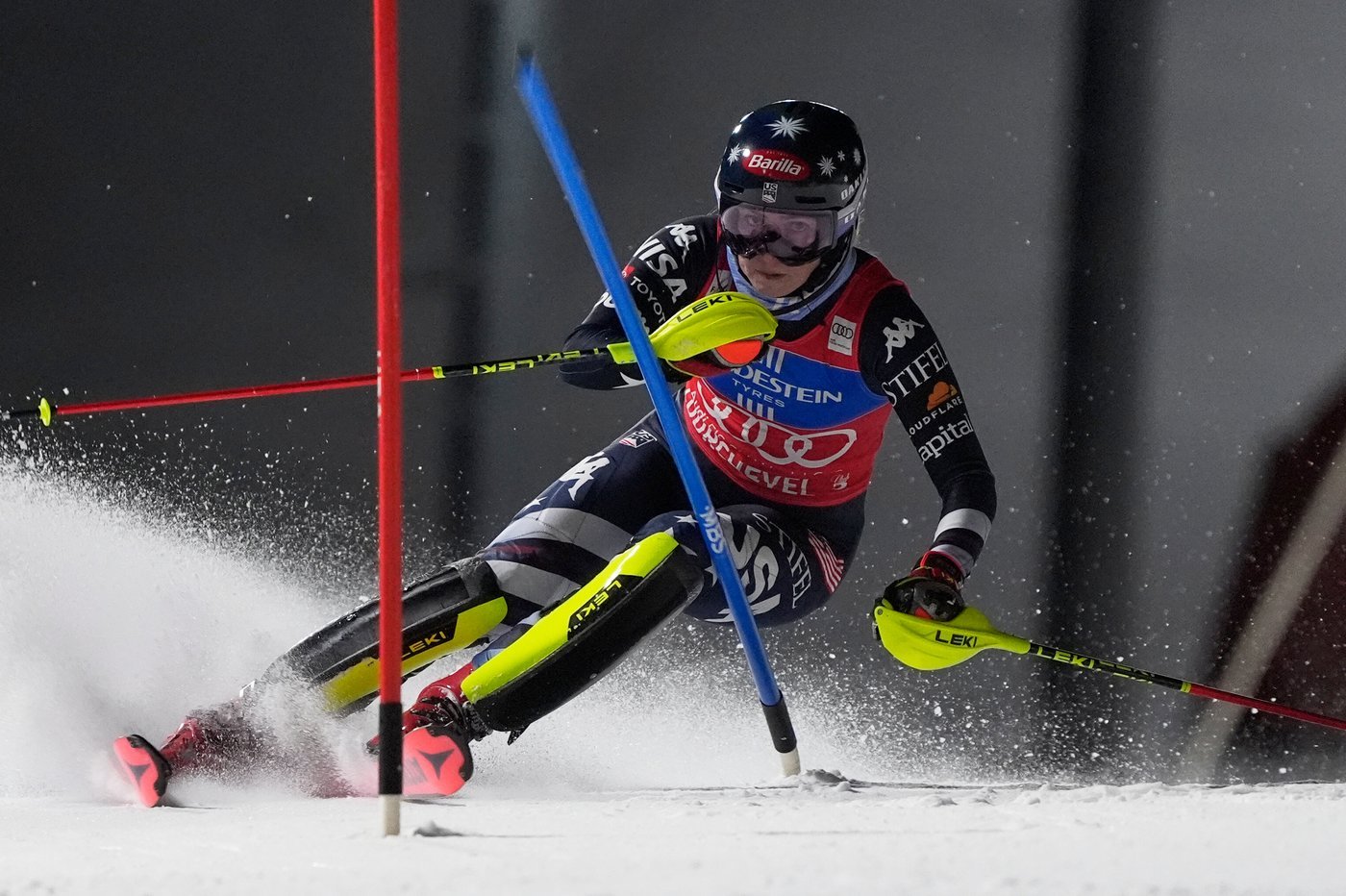
United States’ Mikaela Shiffrin competes in an alpine ski, women’s World Cup slalom, in Courchevel, France, Tuesday, Dec. 16, 2025. (AP Photo/Giovanni Auletta)
Interestingly, the combined event is actually the oldest Alpine skiing competition at the Olympics, having featured when the sport debuted in 1936. However, its format has changed several times over the decades, leading to the modern team combined version that will debut in Milan Cortina.
As the countdown to the Winter Games continues, Alpine skiing once again promises speed, drama, and history in the making on the slopes of Italy.
Women’s World Cup slalom start list as Shiffrin carries her winning streak into Kranjska Gora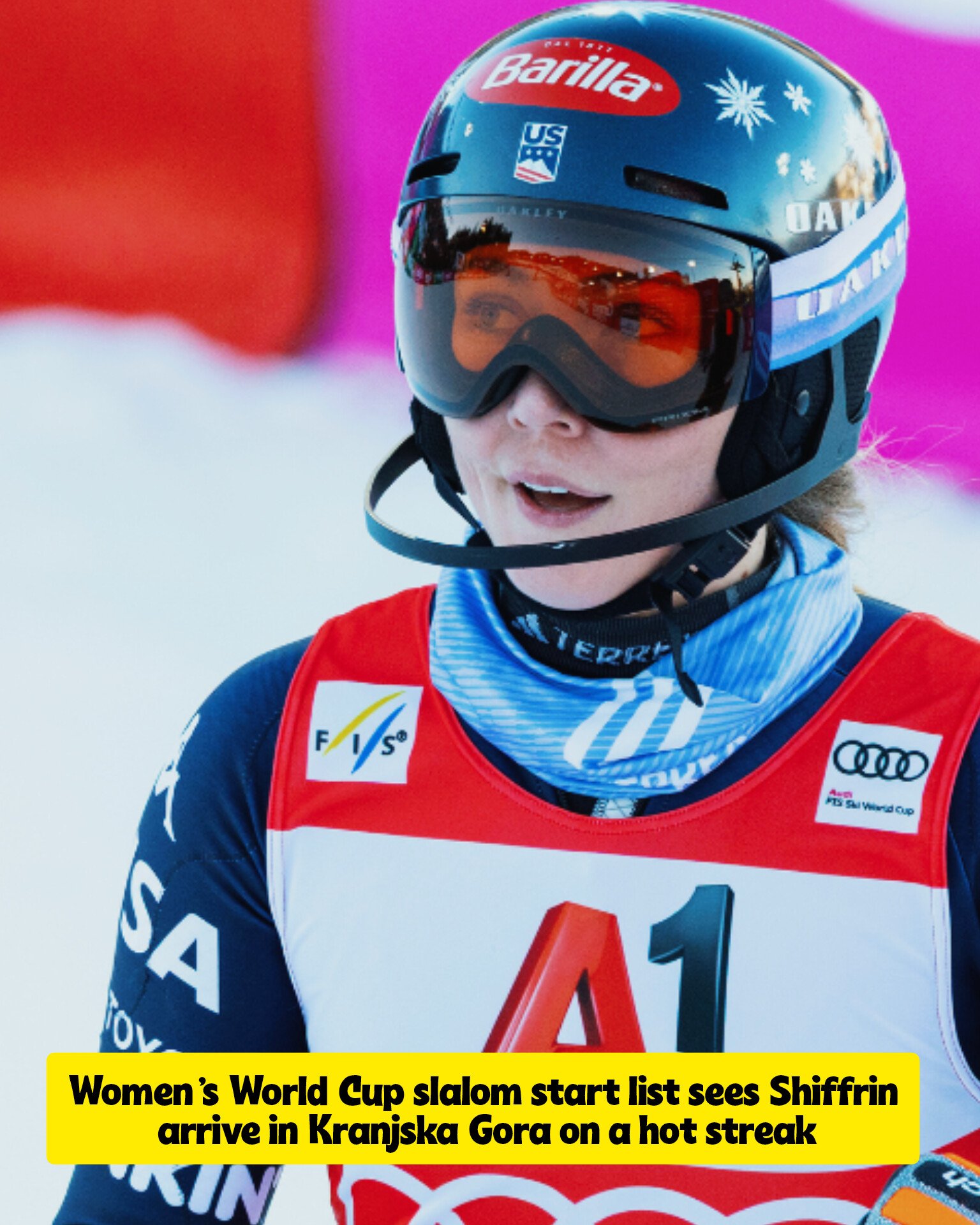
As the women’s Alpine World Cup heads to Kranjska Gora, Slovenia, one familiar question once again dominates the conversation: is anyone capable of stopping Mikaela Shiffrin?
The answer, for now, remains elusive. The American superstar arrives at this latest slalom stop carrying a commanding six-race winning streak in the discipline, having swept every slalom contested so far this season. Until a rival breaks that run, Shiffrin’s dominance continues to define the women’s slalom landscape.
With the season now reaching its midpoint and the 2026 Winter Olympics looming ever closer, the stakes in Kranjska Gora extend far beyond a single race result. Momentum, confidence, and Olympic positioning are all increasingly in play.
Olympic tension builds at midseason
The Kranjska Gora slalom represents the sixth race in a 10-event slalom calendar. After this weekend, just three slaloms remain before the Olympic Games, followed by two more races after the Games conclude. That structure leaves little margin for caution or experimentation.
Every run now carries multiple layers of significance. Athletes are not only fighting for podiums and points but also for Olympic selection, favourable start numbers, and qualification for the season-ending finals. In slalom, where hundredths of a second often separate victory from disappointment, even small hesitations can have major consequences.
As the pressure mounts, skiers must strike a delicate balance between aggression and control — a challenge Shiffrin has mastered better than anyone else in the field.
Shiffrin firmly in control of the standings
At the halfway point of the season, Shiffrin has already created a sizable gap between herself and the rest of the field. Her consistency and ability to win under varying conditions have forced her rivals into attack mode, often increasing risk in an attempt to keep pace.
After five slalom races, the top of the World Cup standings paints a clear picture of her authority:
- Mikaela Shiffrin (USA) leads the standings with 500 points, sitting comfortably in first place.
- Lara Colturi (Albania) follows in second with 280 points.
- Camille Rast (Switzerland) holds third with 262 points.
- Wendy Holdener (Switzerland) sits fourth on 208 points.
- Katharina Truppe (Austria) rounds out the top five with 186 points.
Shiffrin’s six consecutive slalom victories stretch back to last season’s finals, underlining how long she has remained untouchable in this discipline. The rest of the field is effectively racing each other — unless someone finds a way to disrupt her rhythm.
A loaded start list in Kranjska Gora
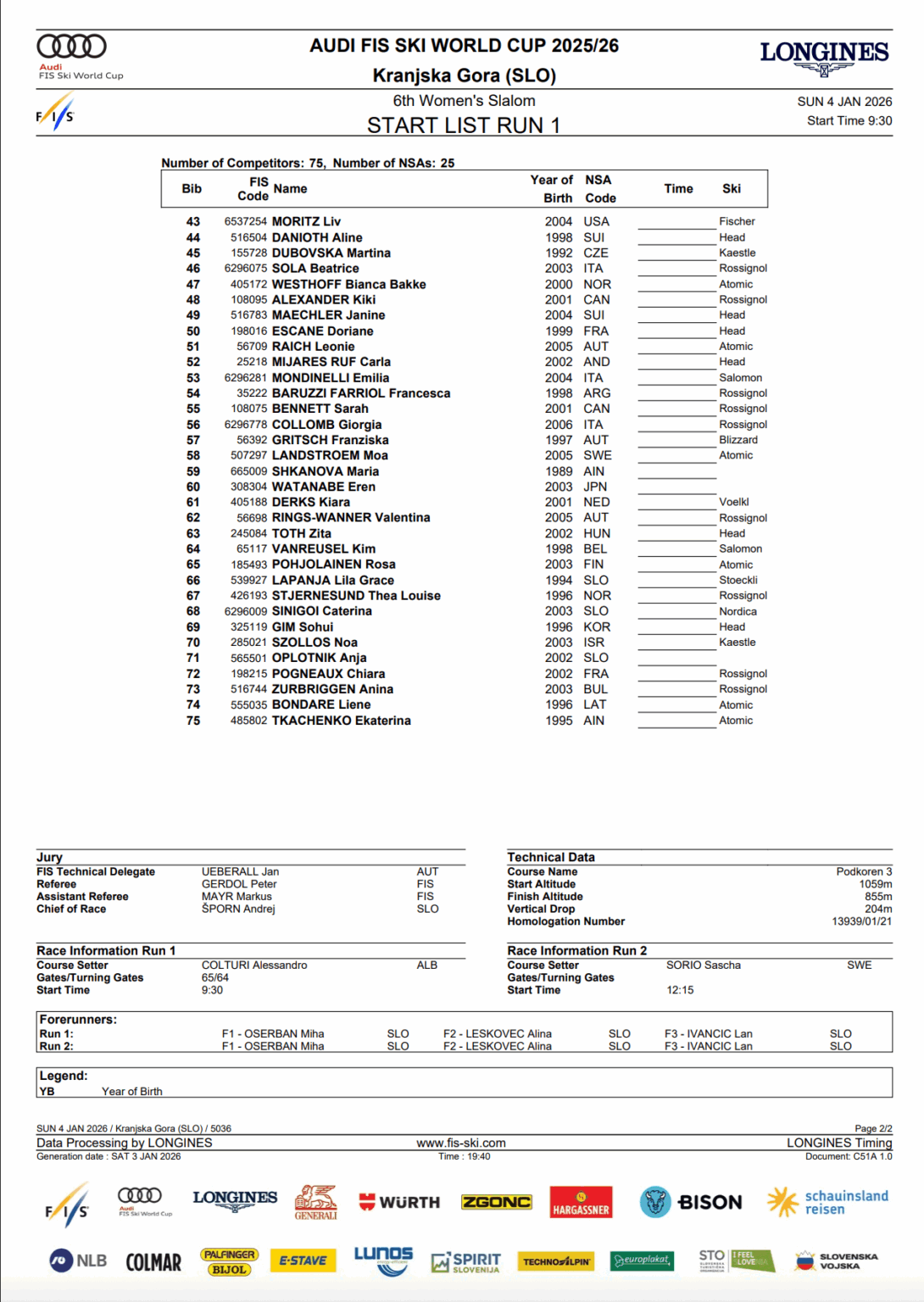
The opening group at Kranjska Gora reflects both depth and unpredictability. With Shiffrin drawing bib three, the tempo of the race will be established early on a slope that demands commitment and punishes hesitation.
The top seven starters include a mix of seasoned veterans and rising stars:
- Bib 1: Lena Dürr (Germany), currently sixth in the slalom standings
- Bib 2: Zrinka Ljutić (Croatia), a young talent still seeking consistency
- Bib 3: Mikaela Shiffrin (USA), the season leader
- Bib 4: Wendy Holdener (Switzerland), one of the most reliable slalom skiers on tour
- Bib 5: Paula Moltzan (USA), enjoying a strong campaign
- Bib 6: Camille Rast (Switzerland), fresh off major success this season
- Bib 7: Lara Colturi (Albania), one of the breakout performers of the year
With Shiffrin starting early, the pressure will immediately shift to those chasing her time. On Podkoren 3, a course known for rewarding precision and punishing mistakes, early benchmarks can shape the entire race.
United States entries highlight depth and youth
The Stifel U.S. Ski Team enters six athletes in the women’s slalom, led by Shiffrin and Moltzan. While only three American women have scored slalom points this season, several younger racers have demonstrated flashes of elite speed, underscoring how narrow the margins are at this level.
The U.S. start list includes:
- Mikaela Shiffrin (bib 3)
- Paula Moltzan (bib 5)
- A.J. Hurt (bib 31)
- Elisabeth Bocock (bib 36)
- Nina O’Brien (bib 42)
- Liv Moritz (bib 43)
For the younger skiers, Kranjska Gora represents an opportunity to gain experience and potentially break through, especially with Olympic selection pressure intensifying.
Canadian squad seeks momentum
Canada fields a smaller but competitive group, led by Laurence St-Germain, who remains one of the nation’s strongest slalom performers. She is joined by Amelia Smart, Kiki Alexander, and Sarah Bennett.
Notably absent is Ali Nullmeyer, who continues her recovery with hopes of returning to World Cup racing before the Olympics. Her potential return would be a significant boost for Alpine Canada as the season enters its decisive phase.
Course and technical details
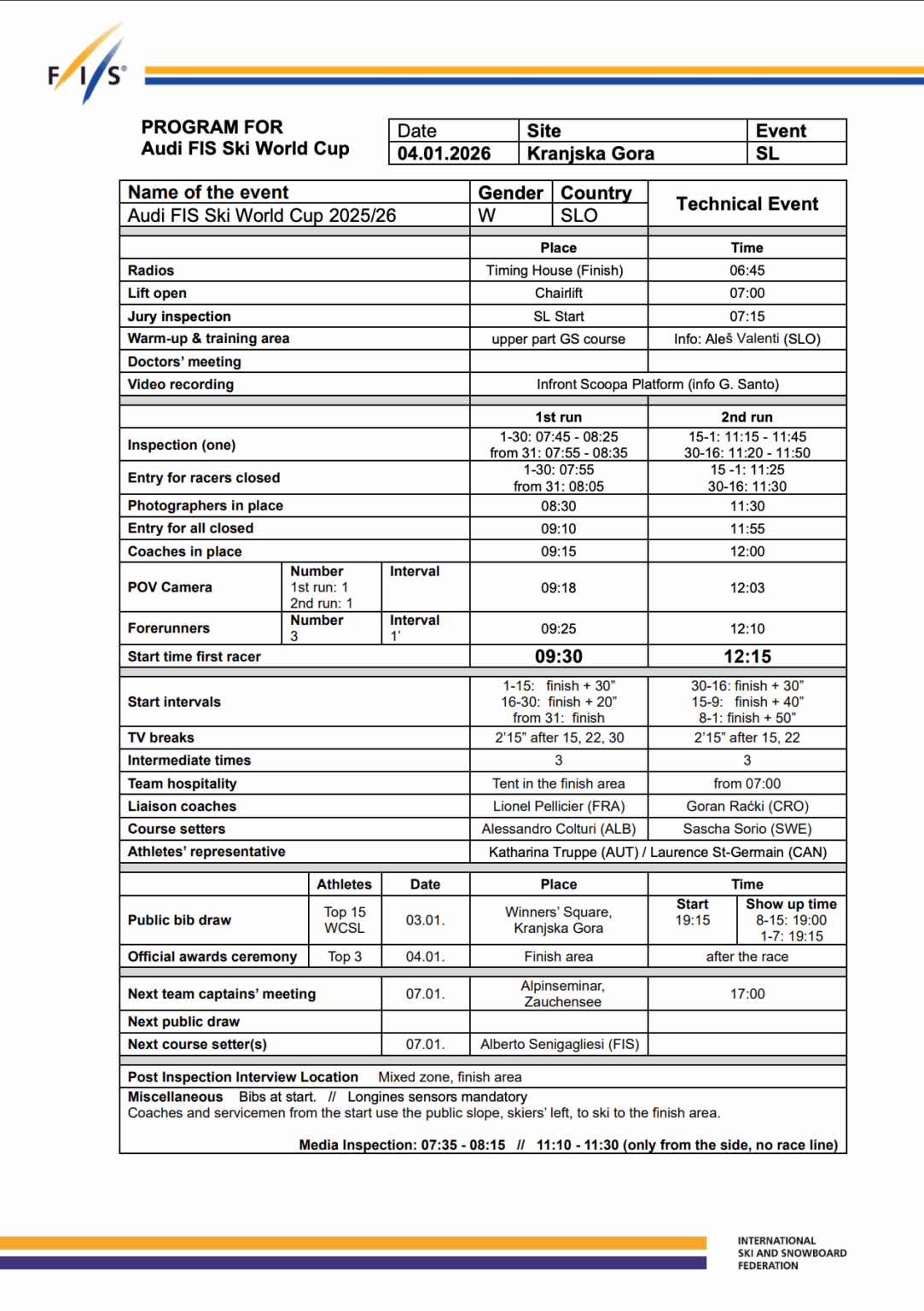
The women will race on Podkoren 3, one of Kranjska Gora’s most demanding slopes. Sunday’s first run is set with 65 gates, including 64 turning gates, requiring sustained technical precision.
Course setting responsibilities are split between Alessandro Colturi of Albania for the first run and Sascha Sorio of Sweden for the second. With different setters shaping each run, adaptability will be crucial — another area where Shiffrin has consistently excelled.
Watching history unfold
As the season reaches its midpoint, the broader reality becomes impossible to ignore. Mikaela Shiffrin is not just winning races — she is redefining what sustained excellence looks like in Alpine skiing. Fans are witnessing the most successful ski racer the sport has ever seen, competing at the height of her powers.
Whether anyone can disrupt her streak in Kranjska Gora remains to be seen. But until that moment arrives, each race becomes part of a larger narrative — one that continues to unfold run by run, gate by gate.
How to watch
The women’s slalom takes place on Sunday, January 4.
- Run one: 3:30 a.m. ET / 12:30 a.m. PT
- Run two: 6:15 a.m. ET / 3:15 a.m. PT
Broadcast options include Ski and Snowboard Live in the United States, CBC Sports in Canada, and Discovery+ in Great Britain.
As the gates drop in Kranjska Gora, the question remains the same — and increasingly urgent: who, if anyone, can stop Mikaela Shiffrin?

‘This Is Not OK’: Shiffrin Wins Again but Tears Into Slalom Course
Mikaela Shiffrin extended her remarkable run in women’s slalom racing on Sunday night, claiming a sixth consecutive World Cup victory in the discipline at Semmering. Yet while the American once again stood on the top step of the podium, her dominant performance was accompanied by strong criticism of what she described as unsafe and unfair course conditions that, in her view, put many competitors at unnecessary risk.
Shiffrin delivered another trademark comeback to secure the win, overturning a modest first run to post the fastest time under the lights. Her combined time was just 0.09 seconds quicker than Switzerland’s Camille Rast, the reigning world champion, who pushed the American all the way to the finish line. Teenage sensation Lara Colturi, the Italian-born Albanian skier who has rapidly emerged as a genuine title contender, finished third, 0.57 seconds adrift.
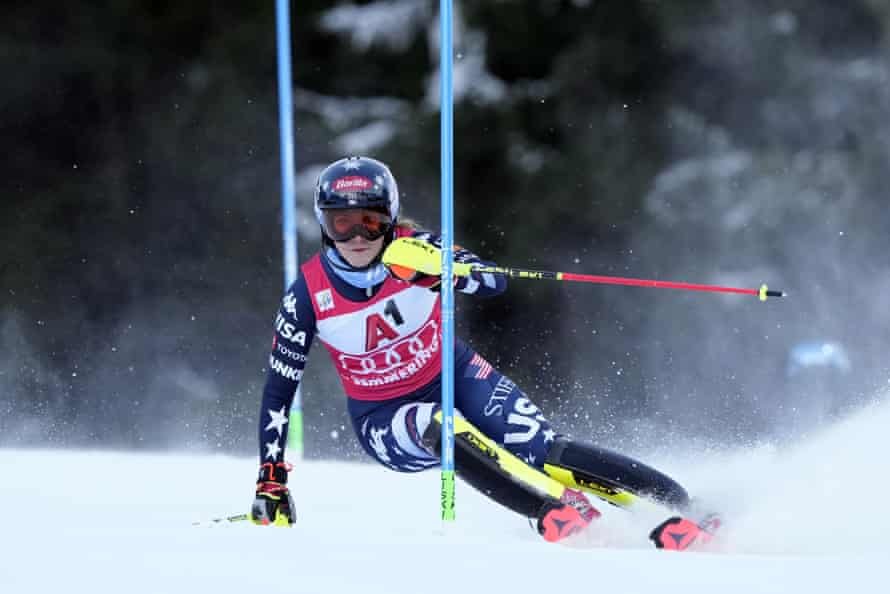
Mikaela Shiffrin was fastest in the second run to edge Swiss skier Camille Rast by 0.09sec. Photograph: Millo Moravski/Agence Zoom/Getty Images
Despite celebrating her 106th career World Cup victory, Shiffrin made it clear afterward that she was deeply unhappy with how the race had unfolded. Speaking to Austrian television, she did not hold back in her assessment of the conditions on the Panorama course. While acknowledging that her early starting position on the first run spared her the worst of the deteriorating surface, she stressed that many of her fellow competitors were not so fortunate.
“For me, starting with a low bib, it wasn’t a huge problem,” Shiffrin explained. “But for the women who had to start later, with bib numbers in the teens, twenties, or even higher, it simply wasn’t OK. The snow was breaking apart badly, and that’s not something athletes should have to deal with at this level.”
Warm temperatures throughout the day forced race organizers to inject water and salt into the snow in an attempt to stabilize the surface. However, those measures proved insufficient. As the afternoon session progressed, large sections of the course began to crumble, particularly in the lower half, making it increasingly difficult—and potentially dangerous—for the later starters to ski aggressively.
The scale of the problem was reflected in the statistics. Only 40 of the 77 athletes who started the opening run managed to make it to the finish. A time deficit of nearly six seconds was still enough to qualify for the second run, underlining just how extreme the conditions had become. Such a high attrition rate is highly unusual in World Cup slalom racing and immediately raised concerns across the field.
Conditions did improve slightly for the night session, which took place several hours later as temperatures dropped. Still, the damage had already been done. Shiffrin described the entire day as mentally draining and emotionally frustrating, not only for herself but for the wider group of competitors.
“It was a very challenging and distracting day,” she said. “I’m thankful that there were no serious injuries, but when you see how the surface was breaking apart, especially in the first run, it’s hard not to be upset. The second run was better, but the overall situation shouldn’t have happened in the first place.”
On the sporting side, Shiffrin’s victory once again demonstrated her resilience and technical mastery. She started the race fourth and was more than half a second off the lead after the first run, having lost significant time in the lower section of the course. Later, she admitted that she had made mistakes by pushing too hard and skiing too round in places where a more direct line was possible.
“It’s a tough slope,” she said. “I probably overskied a bit in the first run. I was trying too hard to make something happen instead of letting the course come to me.”
Under pressure in the second run, however, Shiffrin corrected those errors. She attacked with greater precision, controlled her line more effectively, and stopped the clock with a time that ultimately proved unbeatable. Even then, she admitted she was surprised by the result.
“It didn’t feel good out there,” she said. “It felt like a fight all the way down. I honestly didn’t expect to see the green light when I crossed the line.”
The win marked her fifth straight victory at the start of the season and continued a stretch of dominance that dates back to the end of last winter. Shiffrin closed the previous campaign with a slalom victory and then opened the current Olympic season by winning the first four races, doing so by an average margin of around 1.5 seconds. Sunday’s narrow success was far less comfortable, but no less significant.
With the result, Shiffrin further extended her lead in the slalom standings. She now holds a 220-point advantage over Colturi, with five races still to come—three scheduled for January and two in March—before the Milan–Cortina Winter Olympics. Given that a single World Cup win is worth 100 points, the American has put herself in a commanding position as the season progresses.
Elsewhere, Croatia’s Zrinka Ljutic, last season’s winner at Semmering and the reigning slalom globe holder, finished eighth, more than three and a half seconds behind Shiffrin. It was a solid but unspectacular result for the Croatian, who has struggled to match her best form so far this winter.
For the United States team, the race brought mixed fortunes. Paula Moltzan, who had been seventh after the first run, failed to finish the second after straddling a gate. Her exit came just a day after she suffered a heavy crash in the giant slalom on the same hill, adding to concerns about the demanding conditions at the venue.
Attention now turns to Slovenia, where the women’s World Cup circuit moves next for a giant slalom and slalom in Kranjska Gora. The hope among athletes and coaches alike is that the focus will return to performance rather than course safety.
Beyond the racing itself, Shiffrin’s comments reignited a broader debate about how competitions are staged in increasingly unpredictable weather conditions. As winters grow warmer and snow management becomes more complex, athletes are increasingly vocal about the need for organizers and governing bodies to prioritize safety and fairness over rigid scheduling.
Shiffrin’s frustration was not rooted in self-interest, but in concern for the integrity of the sport and the wellbeing of her competitors. Her message was clear: World Cup racing should challenge the best skiers in the world, but it should never do so at the expense of safety.
-

 Blog1 month ago
Celtic issues a fiery VAR statement after Trusty’s red card appeal is dismissed, as furious chiefs release referee audio publicly.
-

 Blog1 month ago
Celtic informed their January signing under Martin O’Neill that he wouldn’t play a single minute this season.
-

 Blog1 month ago
Celtic issued an £83 million warning amid looming UEFA threats.
-

 Blog4 weeks ago
SFA Expected to Review Missed Penalty in Rangers v Celtic Clash
-

 Blog10 months ago
“Courtside to Aisle-Side: Tyrese Haliburton and Jade Jones Set New Wedding Date”
-

 Blog1 month ago
£6m star is looking to leave Rangers this summer and has already announced his next club publicly.
-

 Blog7 days ago
Rangers victory overshadowed by refereeing controversy
-

 Blog1 month ago
Auston Trusty under intense Celtic red card investigation amid new Hibs ‘punch’ claims and Rangers’ appeal review.