
Blog
Lindsey Vonn Wins in Zauchensee as Her Father Shows Pride with Humorous Comment

Lindsey Vonn has once again proved why she remains one of the most formidable figures in alpine skiing. The American star claimed victory in the downhill event at Zauchensee, securing her 84th World Cup win. This remarkable achievement not only demonstrates her enduring skill on the slopes but also brought an emotional moment with her father, Alan Kildow, whose reaction reflected both pride and humor. Upon hearing of her victory, he jokingly remarked, “That’s not bad for an old woman,” a comment that made both father and daughter laugh.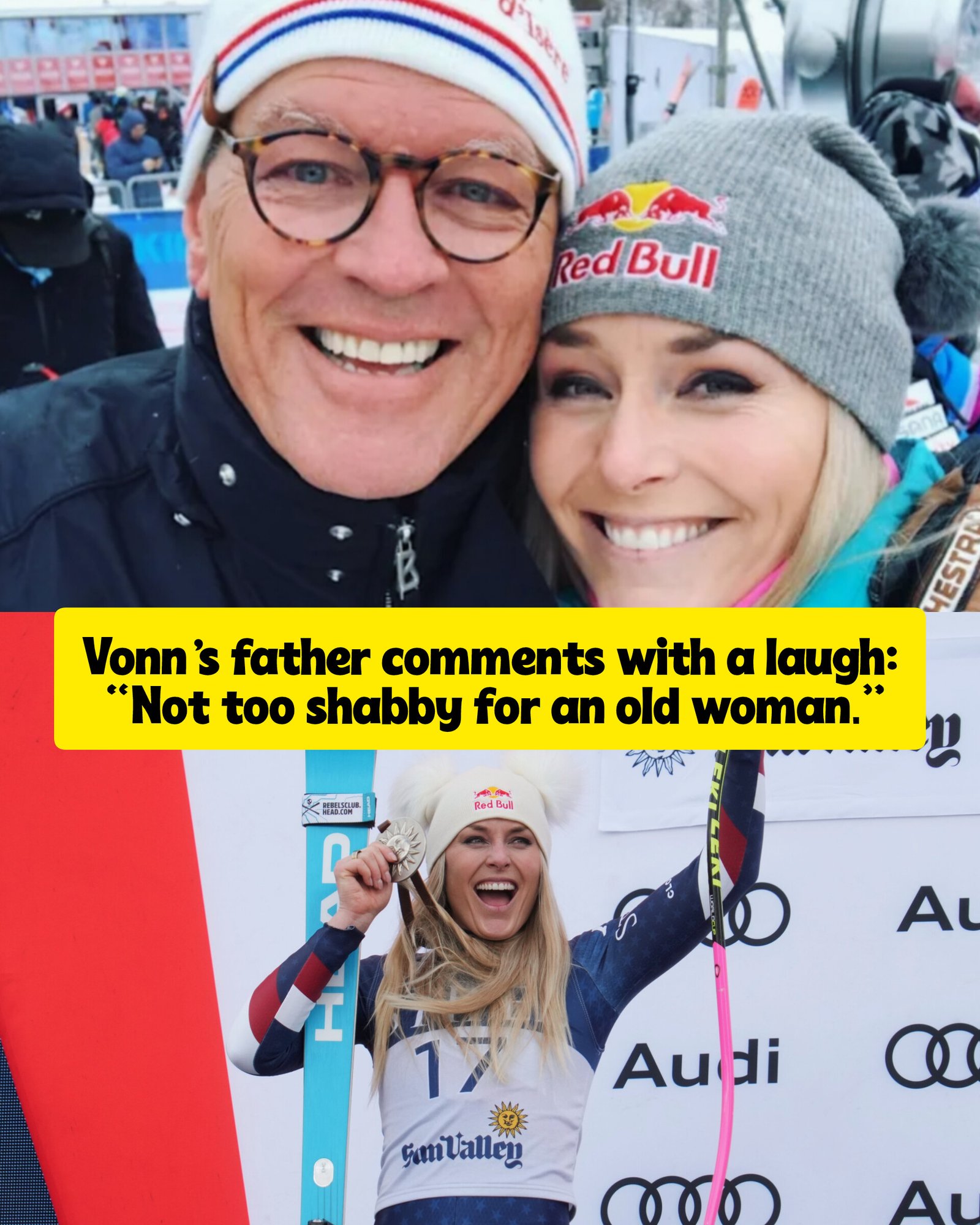
The Zauchensee downhill triumph marks Vonn’s second win of the current winter season. She had previously claimed victory at the speed season opener in St. Moritz in December, setting the tone for what promises to be a strong season for the 41-year-old skier. Following the race, Vonn shared that she had spoken with her father, who had been in touch to offer encouragement. During an interview with SRF, she recounted that her father had wished her all the best and had even provided motivation the night before her race. Vonn described the interaction as special, saying it was meaningful to be able to speak with her father directly, particularly at a time when her mother was not present.
Vonn’s relationship with her father has been complex over the years. In past interviews, she admitted that Alan Kildow’s focus on performance had sometimes placed immense pressure on her from a young age. At times, this pressure led to a complete breakdown in communication between father and daughter. Yet, in recent years, their relationship has clearly improved. After Vonn’s victory in St. Moritz, she revealed that her father had been moved to tears, something she said she had never witnessed before. The father-daughter bond has grown stronger through shared experiences on and off the slopes, and moments like Zauchensee serve as a testament to their renewed connection.
Despite the humorous remark about her age, Alan Kildow is deeply proud of what Lindsey continues to achieve. He understands the level of dedication, discipline, and resilience required to compete at the highest level, especially at her age. Vonn herself acknowledged the importance of her father’s support, noting that it helps her maintain her performance during such a competitive and physically demanding season. She explained that starting strong is crucial, but sustaining this level requires continual effort and focus. Knowing that she has her father’s encouragement provides her with an additional layer of confidence and motivation, making the challenges of professional skiing slightly easier to navigate.
Vonn’s ultimate goal for this season remains the Olympic Games in Cortina. While she continues to race in the World Cup circuit and demonstrates consistent excellence, she is mindful of the need to manage risk. Maintaining her health is a top priority, particularly given the physically demanding nature of downhill skiing. Even so, her performance in Zauchensee showed remarkable intensity and skill. She admitted that while she gave a strong performance, she did not reach the absolute limit of her abilities. Vonn revealed that during the short, reserve-start race, she had to push herself significantly, skiing at perhaps 90 percent of her potential. This suggests that she still has more strength and precision to tap into as the season progresses.
The race itself was a test of both technical ability and mental focus. Vonn demonstrated aggression and control, navigating the course with precision despite challenging weather conditions. She acknowledged that skiing with high intensity requires taking calculated risks, particularly on a course like Zauchensee. Even though she performed admirably, she emphasized that she had more reserves to draw upon, highlighting her strategic approach to racing. Vonn’s mindset shows her long-term planning: she is not just aiming to win individual races but is pacing herself for peak performance at the Olympics.
Emotions play a critical role in Vonn’s approach to skiing. After the race, she explained to SRF that her performance was not only about physical effort but also about emotional investment. Skiing without passion or emotional engagement diminishes the enjoyment and satisfaction of competing for her. In Zauchensee, she acknowledged that she had given a lot emotionally but had not yet tapped into her full emotional potential, reserving some of it for the Olympics. This insight reveals the depth of her professional mindset: she balances competitive ambition with careful management of both physical and emotional resources to optimize her performance when it matters most.
Vonn’s comment on the unfinished nature of her effort—stating that today was not the limit—highlights her confidence and self-awareness. She recognizes that she is skiing at a high level now but is capable of even more. This perspective not only underscores her dedication to the sport but also serves as an inspiration to younger athletes who see that even at 41, one can continue to push boundaries and achieve extraordinary results. Her ability to compete at the top level for such a prolonged period is a testament to her meticulous training, resilience, and mental fortitude.
Looking ahead, Vonn is strategically conserving her energy and skills for the most important events, particularly the Olympic Games. Her current lead in the Downhill World Cup standings reflects both consistency and high performance. However, she remains focused on incremental improvement, mindful that the season is long and demanding. Vonn’s careful balance of intensity and risk management allows her to perform optimally while minimizing the potential for injury, which is critical as she continues to compete against younger rivals in a physically taxing sport.
Her father’s playful comment, while lighthearted, also encapsulates the pride he feels in watching his daughter excel. It is a reflection of both love and admiration, as well as the unique bond shared between a parent and child who have navigated a complex history. This moment of levity underscores the human side of professional sports, reminding fans that behind the victories and statistics are personal stories, family relationships, and emotional connections that drive athletes forward.
Vonn’s reflections on the race and her broader goals reveal a careful balance of confidence, caution, and ambition. She is aware of the physical and emotional demands of the sport and is methodically preparing herself for the most critical moments of her career. By managing her energy, maintaining focus, and continuing to strengthen her relationships—particularly with her father—she is setting herself up for sustained success. Her victory in Zauchensee is both a continuation of her remarkable career and a prelude to what she hopes will be an exceptional performance at the Olympics.
In conclusion, Lindsey Vonn’s win in Zauchensee is more than just another World Cup victory. It is a celebration of her enduring skill, strategic mindset, and the strength of her personal relationships. Her father’s reaction, combining pride and humor, adds a touching human element to the story, reflecting the emotional journey that accompanies such high-level achievement. Vonn herself continues to emphasize that while she skied very well, she has even more to give, keeping her sights firmly set on the ultimate goal of Olympic success. Her combination of talent, experience, and thoughtful preparation continues to inspire both fans and fellow athletes around the world, proving that excellence in sports is as much about strategy, emotion, and support as it is about raw skill.
Lindsey Vonn delivers another masterclass with World Cup downhill victory at Zauchensee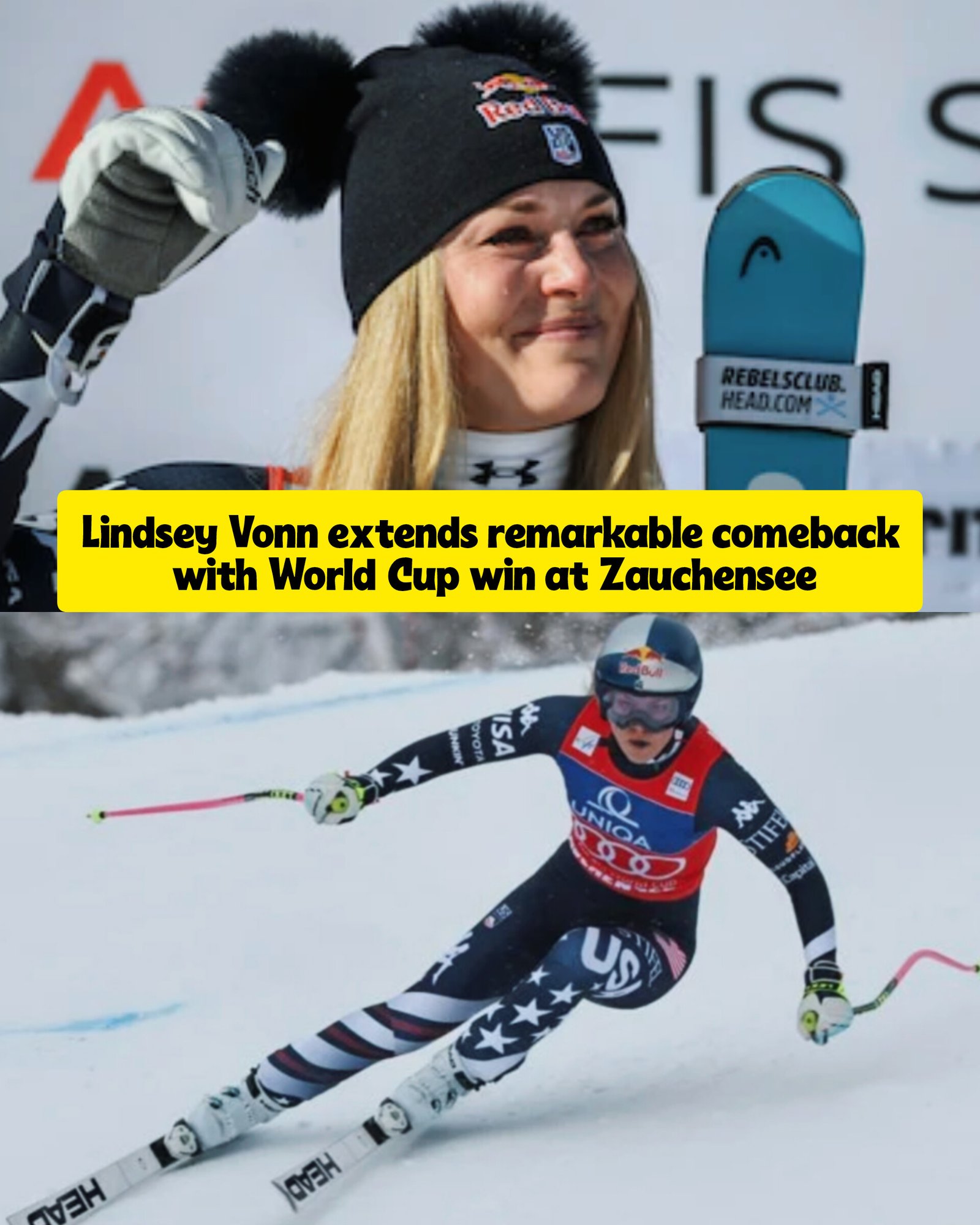
Lindsey Vonn has done it again, delivering another emphatic reminder of her greatness by claiming victory in the World Cup downhill at Zauchensee. The win marked yet another remarkable chapter in a career that continues to defy expectations long after many believed it had reached its conclusion.
It took 2,830 days for Vonn to secure her first World Cup victory after coming out of retirement, ending a long wait that stretched back to her final pre-retirement triumph in 2018. This latest success, however, came far quicker. Less than a month after her previous win, the American star powered her way down the snowy Austrian slopes to clock a winning time of 1:06.24, proving once again that she remains a dominant force in alpine skiing.
Conditions at Zauchensee were far from straightforward. Heavy snowfall and a developing track made early start numbers particularly challenging, and Vonn admitted afterward that she initially felt her chances were slim. Starting sixth, she believed the lack of a clear racing line would force her into taking significant risks. Ultimately, that aggressive approach paid off. Vonn committed fully to her chosen line, attacked the course with confidence, and executed her run exactly as planned—an achievement she later described as the most satisfying part of the day.
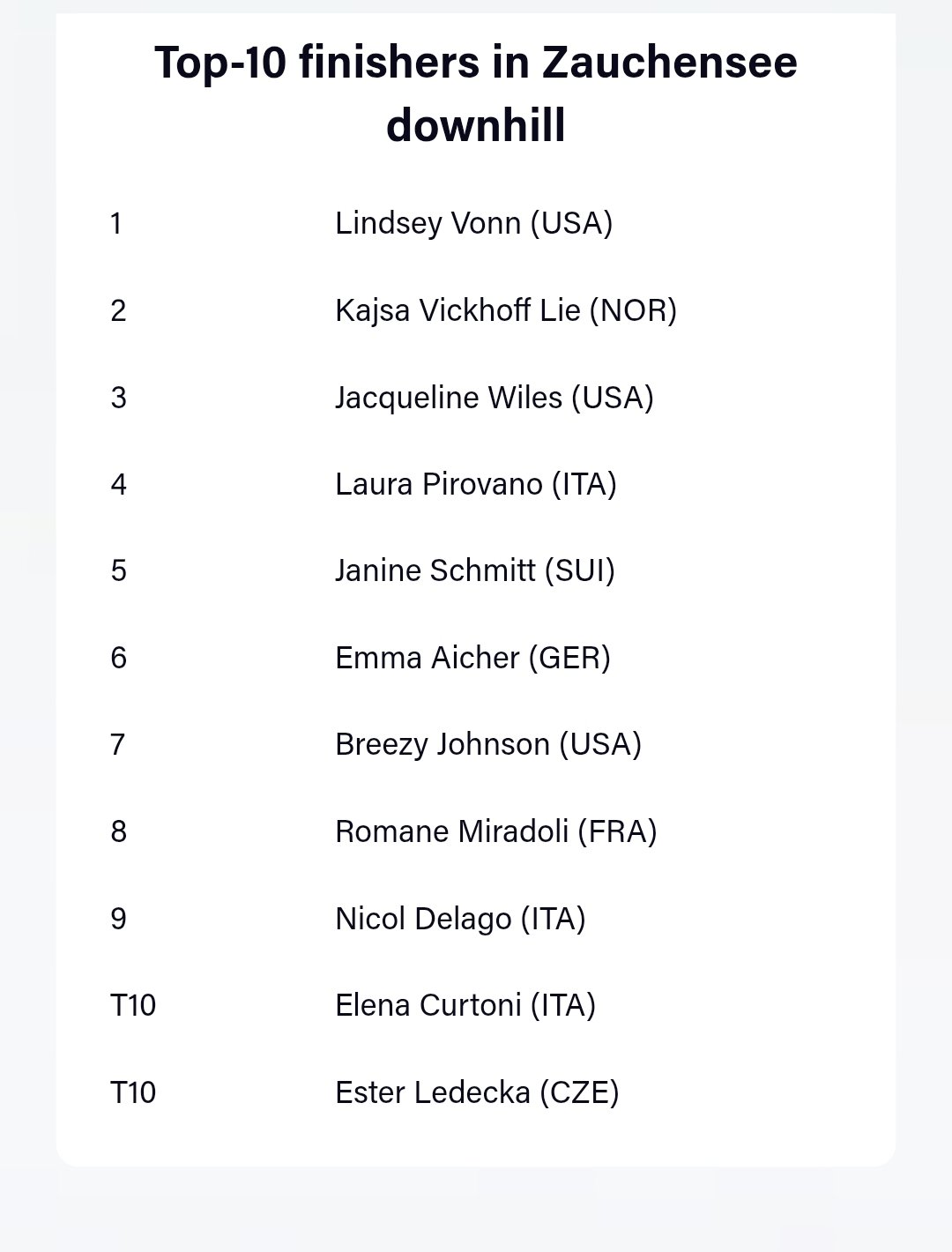
Norway’s Kajsa Vickhoff Lie finished second, just 0.37 seconds behind Vonn, securing her ninth career World Cup podium and her second at Zauchensee. American Jacqueline Wiles completed the podium in third place, finishing 0.48 seconds off the lead. It marked Wiles’ fourth career World Cup podium and her second at the Austrian venue, following a similar result back in 2017. The timing of the performance could hardly have been better, as it strengthens her case for Olympic selection.
The race was an outstanding day overall for the United States team. Three American skiers finished inside the top 10, four placed in the top 15, and five ended the day in the top 20. Notably, it was the first time since 2018 that two U.S. athletes shared a World Cup downhill podium. Fittingly, that last occasion also featured Vonn and Wiles standing together among the top three. The result carried added significance given that the race was held at a venue connected to the 2026 Winter Olympics in Cortina d’Ampezzo.
Breezy Johnson, the reigning downhill world champion, finished seventh despite continuing to manage a back injury that has hampered her training since October. Limited preparation time has made it difficult for Johnson to find peak form, but her performance suggested steady progress. Fellow Americans Allison Mollin and Keely Cashman also produced solid efforts, finishing 14th and 18th respectively.
For Vonn, the victory was yet another milestone in a career filled with them. It was her 84th World Cup win, moving her within just two victories of Ingemar Stenmark’s legendary total of 86. Should she surpass that mark, Vonn would sit second on the all-time World Cup wins list, behind only Mikaela Shiffrin. Her dominance in downhill racing is already unmatched, with 45 career downhill victories—more than any skier, male or female, in history.
The 41-year-old’s resurgence has been one of the sport’s most compelling stories. Last season, Vonn struggled to produce the consistent results she wanted, but a second-place finish at the 2024–25 World Cup finals in Sun Valley hinted that something special might still be possible. That promise turned into reality at the start of the 2025–26 season in St. Moritz, where she stunned the skiing world by standing atop the podium once again, overcome with emotion as she celebrated a triumphant return.
Vonn carried that momentum forward, finishing second the following day and fourth the day after. Her form remained strong a week later in Val d’Isère, where she collected third- and fourth-place finishes in a pair of speed events. A four-week break between Val d’Isère and Zauchensee raised questions about whether time away from racing might dull her sharpness, but instead it seemed to enhance it. Any concerns about rust were quickly erased by her commanding performance in Austria.
The win allowed Vonn to retain the red bib as the leader of the downhill standings, extending her advantage in the discipline. She also climbed to sixth place in the overall World Cup rankings, with the possibility of moving as high as third should she deliver another strong showing in the super-G.
When Vonn decided to return to competitive skiing following successful knee-replacement surgery, her main objective was clear: to compete at the 2026 Winter Olympics in Cortina d’Ampezzo. The Tofane Alpine Skiing Centre holds special significance for her, as it is the site of 12 World Cup victories—more than any other skier has achieved there. Based on her performances so far this season, it is increasingly clear that Vonn will be far more than a ceremonial participant at those Games.
Through six races this winter, she has demonstrated that she is not only capable of contending for medals, but is arguably the clear favourite for downhill gold—and potentially more. Vonn herself has spoken confidently about her physical condition, explaining that her body is responding exactly as she hoped it would. She described feeling strong, versatile, and in control, capable of adapting her turns and lines as needed. For an athlete who has battled injuries throughout her career, that sense of physical freedom has been transformative.
While Vonn celebrated, the race also brought heartbreak. Austrian skier Magdalena Egger crashed after the second sector, prompting a lengthy interruption as medical teams attended to her. Although she initially attempted to ski away, she was ultimately transported down the mountain by ski patrol. Later reports confirmed severe knee injuries that will require surgery, ending her season and extinguishing her Olympic hopes. The injury was another blow for the Austrian team, already dealing with the absence of Katharina Liensberger.
The focus now shifts to Sunday’s super-G at Zauchensee, where Vonn and the rest of the world’s top speed skiers will be back in action. With her confidence soaring and her form undeniable, Lindsey Vonn continues to show that her remarkable story is far from finished.
-

 Blog2 months ago
Celtic issues a fiery VAR statement after Trusty’s red card appeal is dismissed, as furious chiefs release referee audio publicly.
-

 Blog2 months ago
Celtic informed their January signing under Martin O’Neill that he wouldn’t play a single minute this season.
-

 Blog2 months ago
Celtic issued an £83 million warning amid looming UEFA threats.
-

 Blog1 month ago
SFA Expected to Review Missed Penalty in Rangers v Celtic Clash
-

 Blog1 week ago
Police respond after reported disorder following Middlesbrough vs Millwall clash
-

 Blog10 months ago
“Courtside to Aisle-Side: Tyrese Haliburton and Jade Jones Set New Wedding Date”
-

 Blog2 months ago
£6m star is looking to leave Rangers this summer and has already announced his next club publicly.
-

 Blog3 weeks ago
Rangers victory overshadowed by refereeing controversy