
Blog
Martin O’Neill appears irritated while explaining Celtic changes for Rangers Scottish Cup clash

Former Celtic boss Martin O’Neill looked visibly frustrated as he responded to questions about his starting lineup for Celtic’s Scottish Cup encounter against Rangers F.C. at Ibrox Stadium.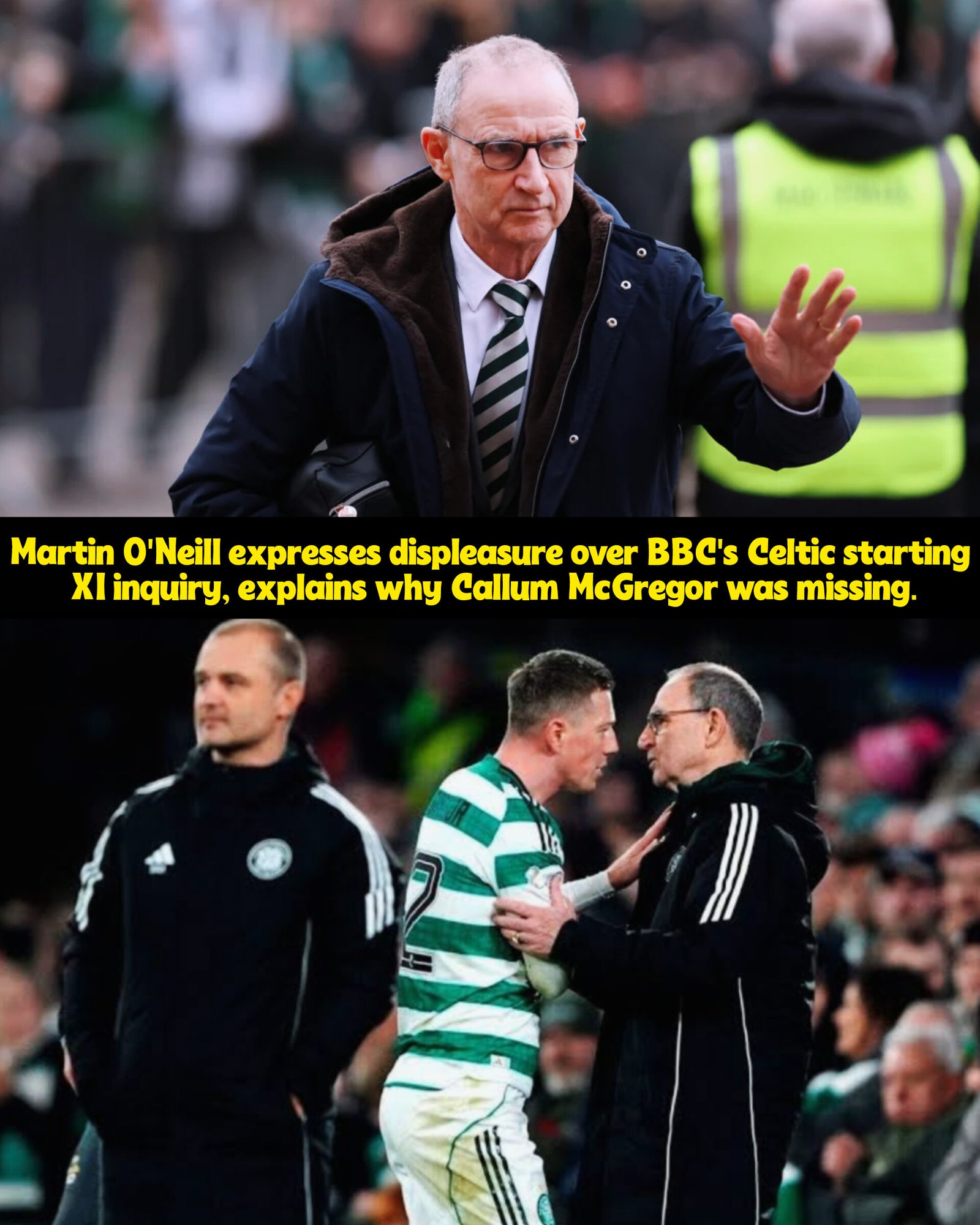
The Celtic manager faced a series of probing questions from reporters after revealing a team selection that surprised many supporters ahead of the high-profile derby clash.
Several notable names were missing from the starting XI and even from the matchday squad, prompting journalists to seek clarification on the decisions. Among those absent were captain Callum McGregor, defender Kieran Tierney, left-back Marcelo Saracchi, and goalkeeper Kasper Schmeichel.
O’Neill explained that while injuries and illness accounted for some of the omissions, two of the decisions were simply tactical choices based on how he wanted the team to approach the match.
Captain Callum McGregor ruled out after picking up soreness
One of the most surprising developments was the complete absence of Celtic captain Callum McGregor from the matchday squad.
The midfielder had featured in Celtic’s previous match against Aberdeen F.C., but according to O’Neill, he struggled physically after that game and had not recovered in time to take part in the derby.
Speaking to BBC Radio Scotland, the manager explained that McGregor was still dealing with the effects of the previous match and was unable to reach the level required to participate.
O’Neill admitted the absence of his captain was a major setback for the team. He emphasised that McGregor’s importance extends far beyond his on-field performances, describing him as a leader both in the dressing room and during matches.
Losing such an influential figure was clearly disappointing for the manager, but he also acknowledged that injuries are an unavoidable part of football. O’Neill added that the team simply had to accept the situation and move forward despite the setback.
Kasper Schmeichel missing due to illness recovery
Another notable absentee was veteran goalkeeper Kasper Schmeichel.
When asked about the Danish international’s absence, O’Neill confirmed that the goalkeeper had recently been dealing with illness and was still in the process of recovering.
He explained that Schmeichel had also received an injection as part of his treatment, and the club felt it was best to give him additional time before returning to action.
The manager suggested that rushing the experienced shot-stopper back into the squad would not have been the right decision, particularly given the intensity of a derby fixture against Rangers.
Tactical choices leave Marcelo Saracchi and Daizen Maeda in unusual roles
While injuries explained some of the changes, others were the result of deliberate tactical decisions.
During the interview, a BBC reporter attempted to analyse the reshuffled defensive setup and asked whether Liam Scales would be deployed at left-back in the absence of Kieran Tierney, who was also unavailable due to injury.
O’Neill responded somewhat sarcastically, suggesting that such a conclusion might appear logical given Tierney’s absence. However, he also hinted that predicting tactics in modern football is not always straightforward.
The questioning then turned to why Marcelo Saracchi had not been selected to step in at left-back.
At this point, O’Neill appeared increasingly irritated by the line of questioning. He reiterated that the decision was simply part of his overall team selection and hinted that Saracchi could still feature later in the match.
The journalist also raised the issue of the attacking setup, noting that Daizen Maeda appeared to be leading the line while other attacking options were absent.
O’Neill again responded curtly, repeating that the choice was purely down to team selection.
Manager insists Celtic have a plan despite surprise lineup
As the interview continued, the reporter asked whether the unusual lineup suggested the manager had a specific tactical plan for the match.
O’Neill replied that the team always tries to prepare with a clear strategy, although he admitted that plans in football do not always unfold exactly as intended once the game begins.
Drawing on his long career as both a player and a manager, O’Neill reflected that unpredictability is part of the sport.
Nevertheless, he emphasised that Celtic intended to approach the match positively and with confidence.
The manager also said he wanted his side to start the game more strongly than they had in their previous outing against Rangers the week before. Delivering a strong performance from the opening minutes was clearly one of his main objectives for the tie.
Celtic fans concerned about weakened lineup
The intense questioning from the BBC reporter reflected the level of curiosity and concern surrounding Celtic’s team selection.
With so many key players missing, some supporters felt the lineup looked significantly weaker than usual for such an important match.
For many fans, it was one of the most unfamiliar Celtic starting XIs they had seen in recent memory.
As a result, there is understandable anxiety among supporters about whether the manager’s decisions will ultimately prove successful.
However, O’Neill remains confident that his selections were made with the best possible approach to the game in mind.
Ultimately, the outcome of the match at Ibrox will determine whether the bold lineup choices are viewed as a tactical masterstroke or a gamble that failed to pay off.
Green Brigade provide an update on Celtic ban, confirming progress achieved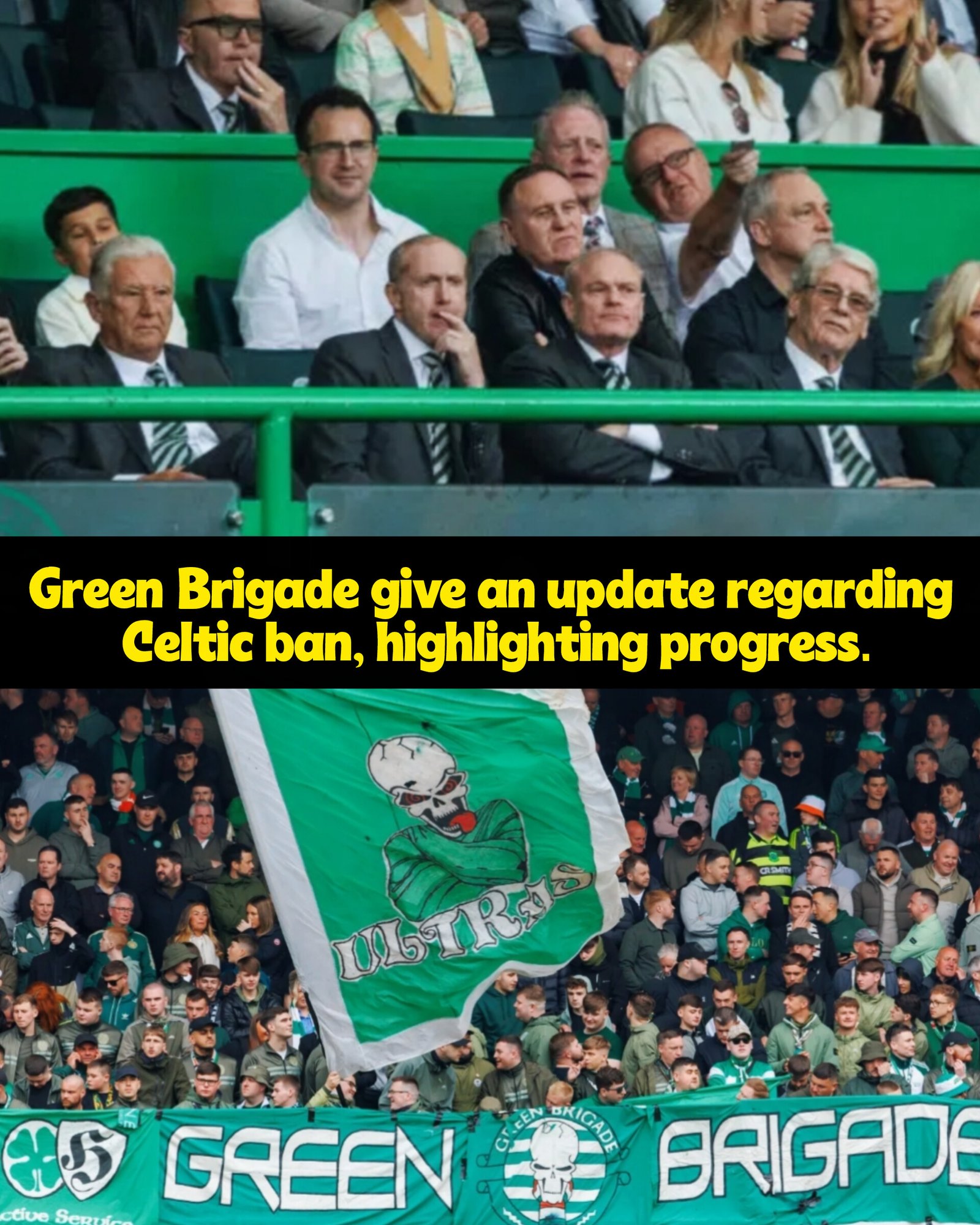
The supporters’ group known as the Green Brigade has released a new statement addressing their continuing ban from fixtures involving Celtic FC.
The situation has been ongoing since November, when hundreds of supporters associated with the group were barred from attending both home and away matches. As part of the restrictions, a section of the Safe Standing area at Celtic Park has also remained closed.
Over the months that followed, discussions between the club and the fan group have yet to produce a final resolution. The absence of the Green Brigade has been widely noticed during matchdays, with many supporters feeling that the atmosphere inside the stadium has suffered during a crucial stage of the season as Celtic compete in the title race.
Now, roughly three weeks after the most recent meeting between representatives of the group and the club, the Green Brigade have shared another update outlining the current situation.
Green Brigade Criticise the Suspension Process
In a statement released through the North Curve Celtic account on X, the group described the scale and duration of the suspension affecting their members.
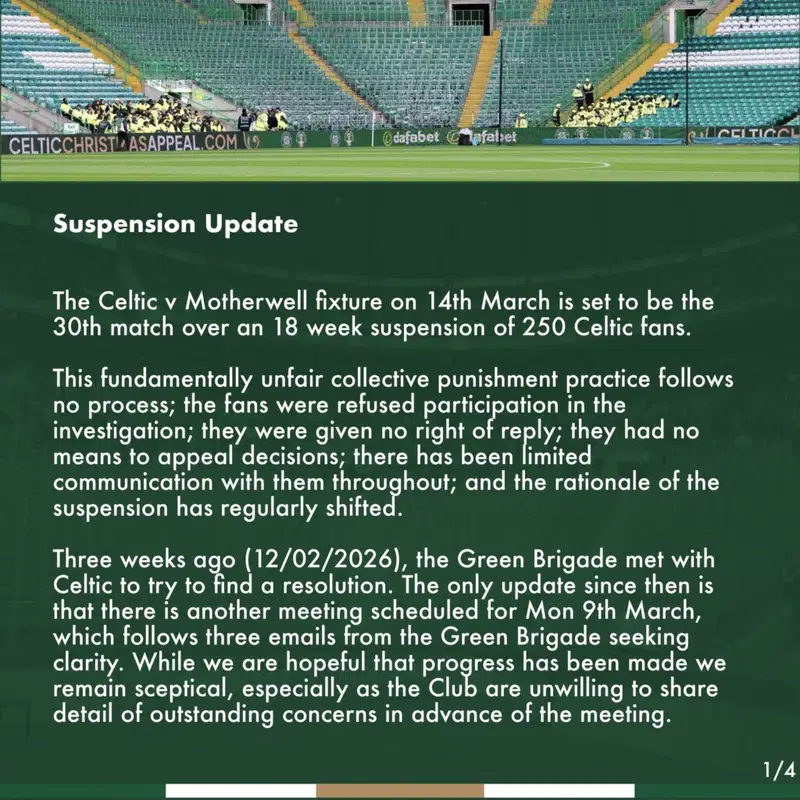
According to the Green Brigade, the upcoming match between Celtic and Motherwell FC scheduled for March 14 is expected to mark the 30th fixture impacted by the sanctions. The group noted that the suspension has already lasted for approximately 18 weeks and involves around 250 Celtic supporters.
The statement strongly criticised the disciplinary action taken against them, describing it as a form of collective punishment that they believe is fundamentally unfair.
They argued that the process leading to the ban lacked transparency and proper procedure. Among their complaints were claims that supporters affected by the suspension were not allowed to take part in the investigation into the incident that triggered the disciplinary action.
The group also stated that those involved were not provided with an opportunity to respond to the allegations made against them. In addition, they claimed that no formal mechanism was available for them to appeal the decisions taken by the club.
Another issue highlighted by the Green Brigade was the limited level of communication they say they have received throughout the dispute. They also suggested that the reasoning behind the suspension has changed several times since it was first imposed, which has added to their frustration.
Talks Continue Between the Group and the Club
Despite their criticism of the process, the Green Brigade confirmed that discussions with the club are still ongoing.
The statement revealed that representatives of the group met with Celtic officials on February 12 in an attempt to find a way forward and potentially resolve the dispute.
Since that meeting, however, the group said there has been very little new information shared with them. According to the statement, the only update provided by the club has been the scheduling of another meeting.
That meeting is expected to take place on Monday, March 9. The Green Brigade explained that the date was arranged after they sent three separate emails to the club requesting further clarification about the situation and the issues still preventing a resolution.
While the group expressed some cautious optimism that progress might have been made during the recent discussions, they also acknowledged that they remain doubtful.
Their scepticism largely stems from the claim that the club has been unwilling to provide details about the concerns that remain unresolved prior to the next meeting. The Green Brigade suggested that this lack of transparency makes it difficult for them to fully understand what still needs to be addressed.
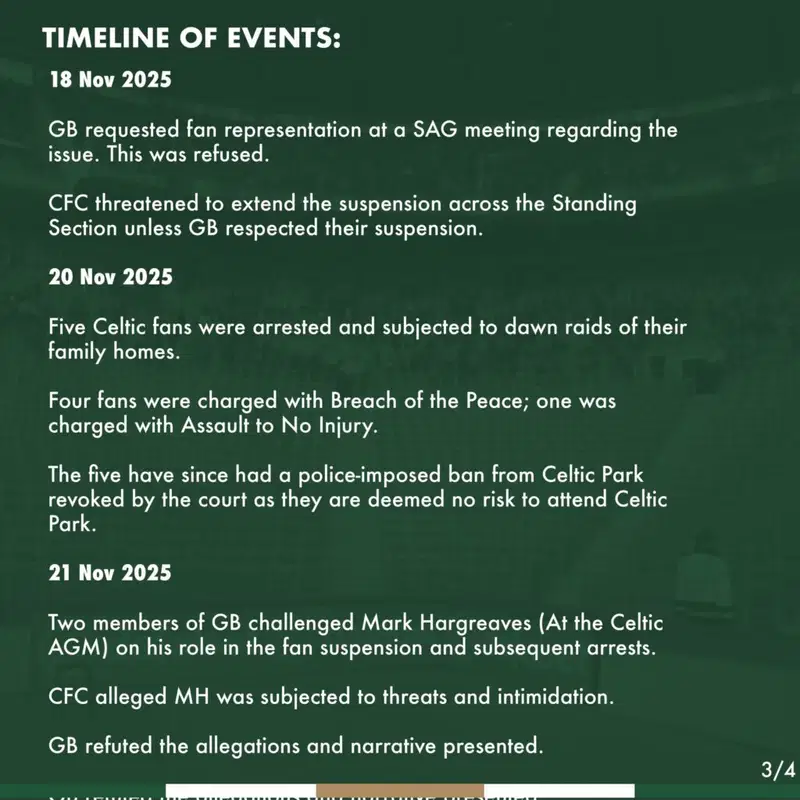
Timeline of Events and Initial Concerns
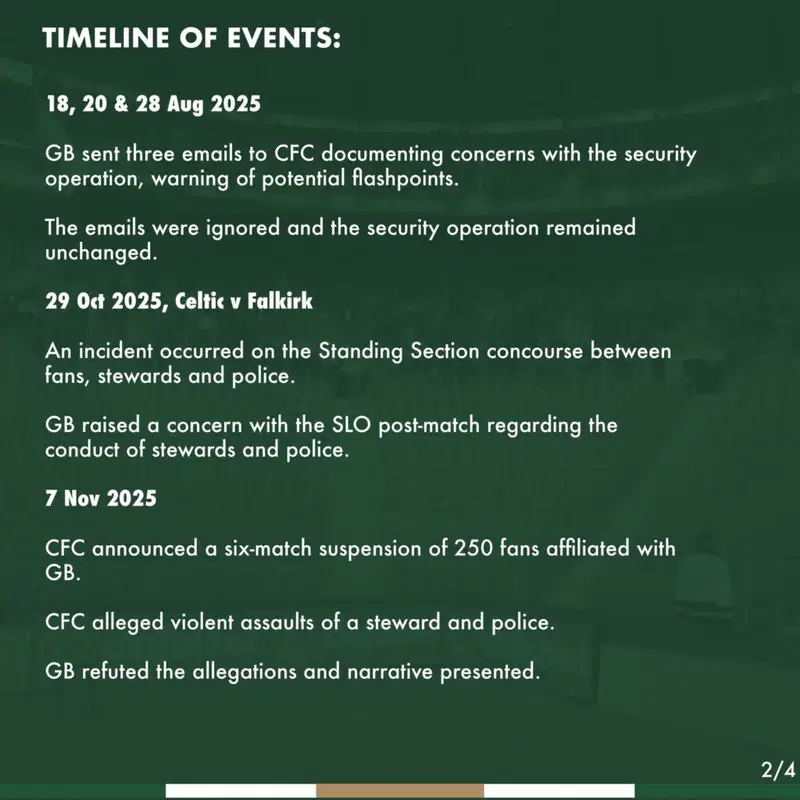
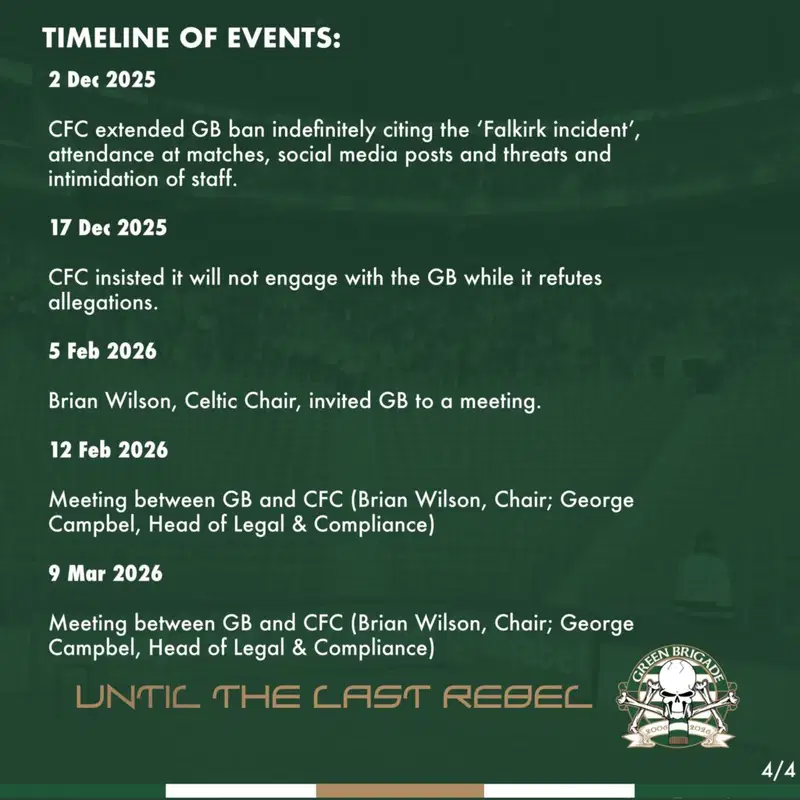
In addition to the update on negotiations, the statement included a timeline outlining the events surrounding the suspension.
The Green Brigade emphasised that they raised concerns with the club immediately after the incident that led to the ban. According to the group, they contacted Celtic’s Supporter Liaison Officer shortly after the events in question to express their worries about what had happened.
By presenting this timeline, the group appears to be reinforcing its argument that it attempted to communicate with the club early in the process.
The ongoing dispute has drawn attention from across Scottish football, with a number of commentators and media outlets suggesting that the issue should be resolved soon.
Many observers believe the Green Brigade’s return could play a role in boosting the atmosphere at Celtic Park during the closing weeks of the season, particularly as the club pushes for the Premiership title.
Celtic Fans Collective Highlight Importance of the Group
The topic of the Green Brigade’s absence was also addressed during a recent meeting between the club and the Celtic Fans Collective.
Minutes from that meeting were later released publicly, revealing that the group discussed the situation directly with Celtic director Brian Wilson.
Representatives of the Fans Collective reportedly stressed the significance of the Green Brigade’s presence on matchdays. They argued that the group plays an important role in creating the atmosphere inside Celtic Park.
According to the minutes, members of the collective suggested that the absence of the Green Brigade has had a noticeable negative effect on the environment during games. Some even indicated that the change in atmosphere could be impacting the team’s performance on the pitch.
Club Acknowledges Dialogue and Ongoing Discussions
During the discussion, Brian Wilson reportedly acknowledged that communication between Celtic and the Green Brigade is continuing.
He explained that conversations between the two sides remain active and suggested that there has been some progress in certain areas of the dispute.
However, Wilson also indicated that other aspects of the issue are more complicated and may take longer to resolve.
Despite the challenges, he recognised that the Green Brigade’s presence in the stadium would likely have a positive influence on the matchday atmosphere and potentially benefit the team as well.
Wilson also addressed speculation about the decision-making process surrounding the ban. He stated that the club’s Head of Security, Mark Hargreaves, does not have sole authority or a veto over the final outcome of the situation.
As discussions continue and another meeting approaches, many supporters will be watching closely to see whether a breakthrough can finally be achieved and whether the long-running dispute between the club and the Green Brigade can be brought to an end.
Green Brigade releases troubling statement regarding Friday night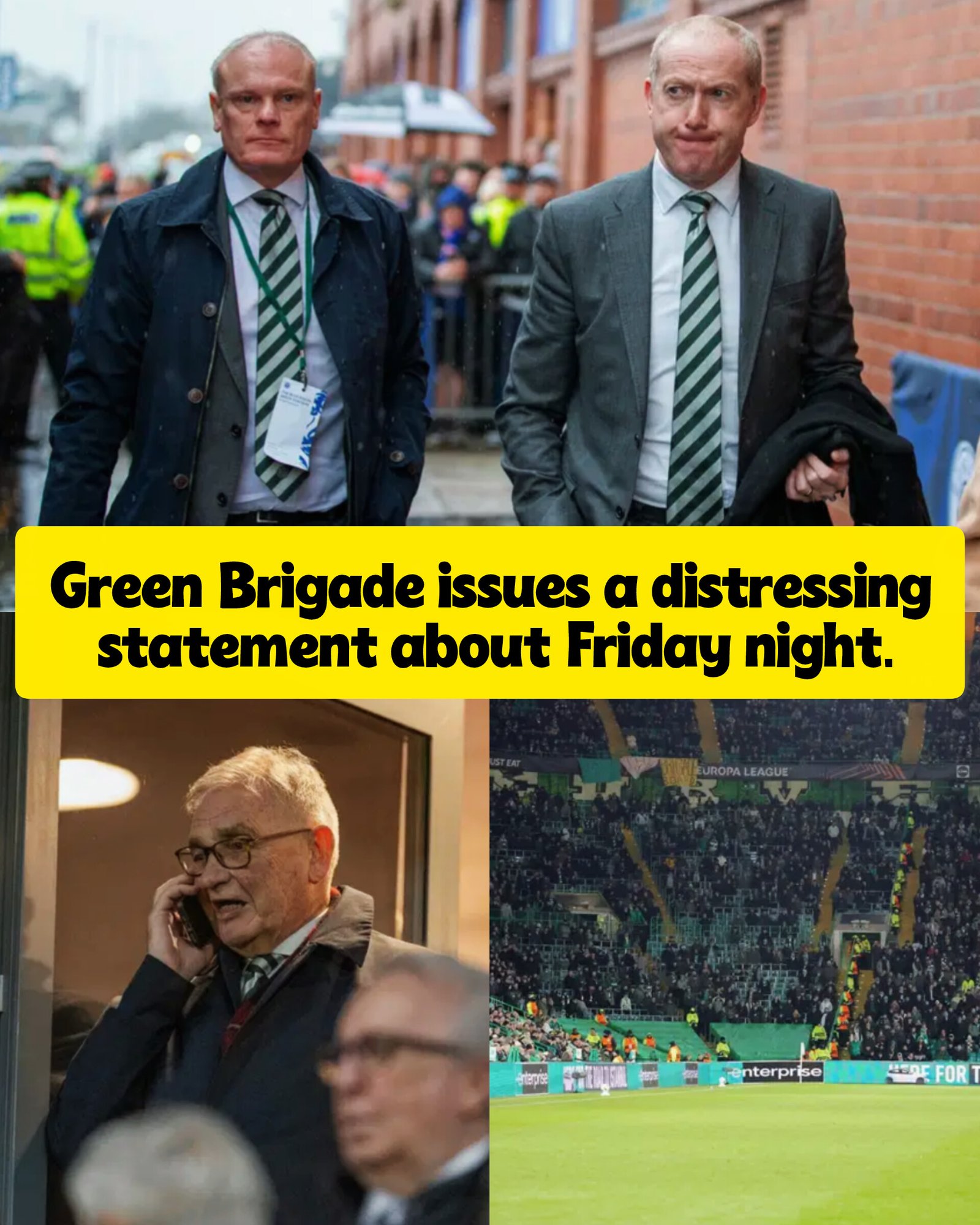
The Green Brigade have once again spoken publicly, and their statement released on Friday night highlights just how serious and troubling their dispute with Celtic FC has become.
With the supporters’ group still banned from attending matches and the upcoming game against Motherwell FC on March 14 expected to be the 30th fixture affected by the suspension, the ultras used their latest statement to present their own version of events. They outlined a timeline explaining how the situation developed, while also expressing frustration about what they believe has been an unfair and inconsistent process.
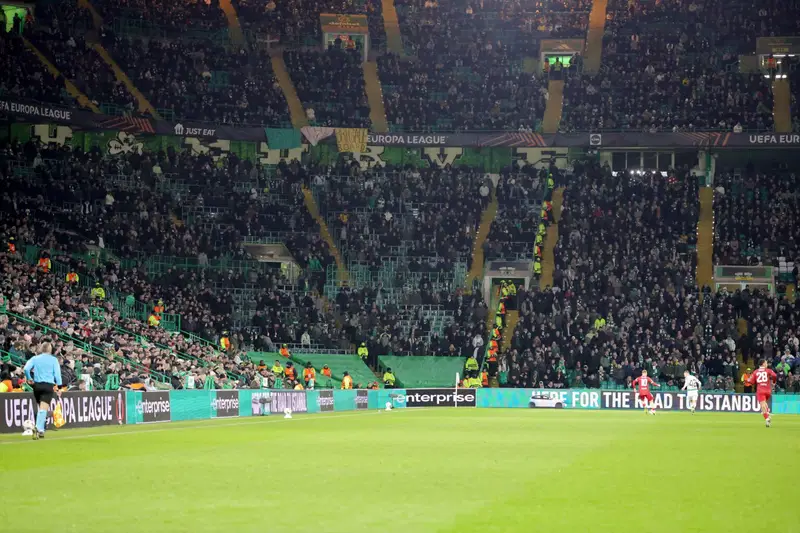
Celtic fans during the UEFA Europa League, knockout phase play offs, first leg match at Celtic Park, Glasgow. Picture date: Thursday February 19, 2026.
For several months now, the club’s official stance has been that the conflict stems from an incident during the match against Falkirk FC on October 29. Following that game, Celtic stated that a steward and police officers were assaulted. According to the club, that incident triggered a disciplinary measure which had previously been suspended and was then activated against the Green Brigade. The sanction was formally confirmed on November 7.
However, the issue did not remain limited to that original explanation. In subsequent updates, the club expanded its reasoning for the punishment. Celtic cited additional concerns including alleged intimidation of staff members, certain activity on social media, and broader issues relating to matchday safety and security at Celtic Park.
The Green Brigade have strongly disputed the club’s account and insist they will not accept it without challenge. In their most recent statement, the group argued that approximately 250 supporters have been subjected to what they describe as collective punishment. They claim those individuals were sanctioned without being given a proper opportunity to defend themselves. According to the group, there has been no clear disciplinary process, no right to formally respond to accusations, and no realistic route for appeal. They also criticised the level of communication from the club, suggesting that information has been limited and inconsistent throughout the dispute.
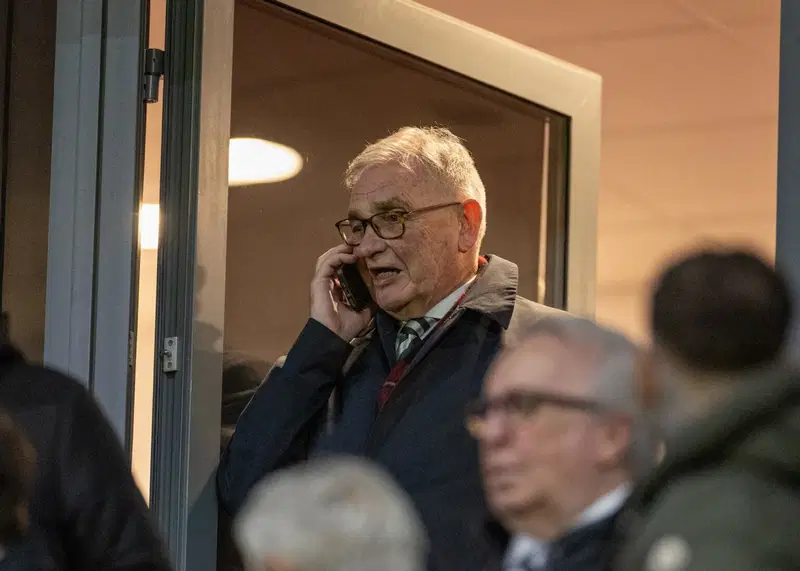
22nd November 2025; St Mirren Park, Paisley, Renfrewshire, Scotland, Scottish Premiership Football, St Mirren versus Celtic; Celtic director Brian Wilson
Another key grievance raised in the statement concerns what the group believes is a shifting justification for the ban. The Green Brigade claim that the reasoning behind the suspension has changed multiple times since the issue first emerged.
To support their position, the supporters outlined a detailed timeline of events. They state that concerns about the security arrangements on matchdays were first raised as early as August with the Celtic Fans Collective. According to the group, these concerns existed well before the incident at the Falkirk match in late October.
The statement goes on to say that after the October 29 events, the group once again raised concerns about the matchday security operation. This time the matter was reportedly brought to the attention of the club’s Supporter Liaison Officer. Despite that communication, the Green Brigade say that 250 fans were issued with a six-match suspension on November 7.
Several later developments have further intensified tensions between supporters and the club. One of the points highlighted by the group relates to a Safety Advisory Group meeting that took place on November 18. The Green Brigade claim that representatives of the fanbase were not allowed to participate in that meeting, which they argue prevented supporters from properly presenting their perspective.
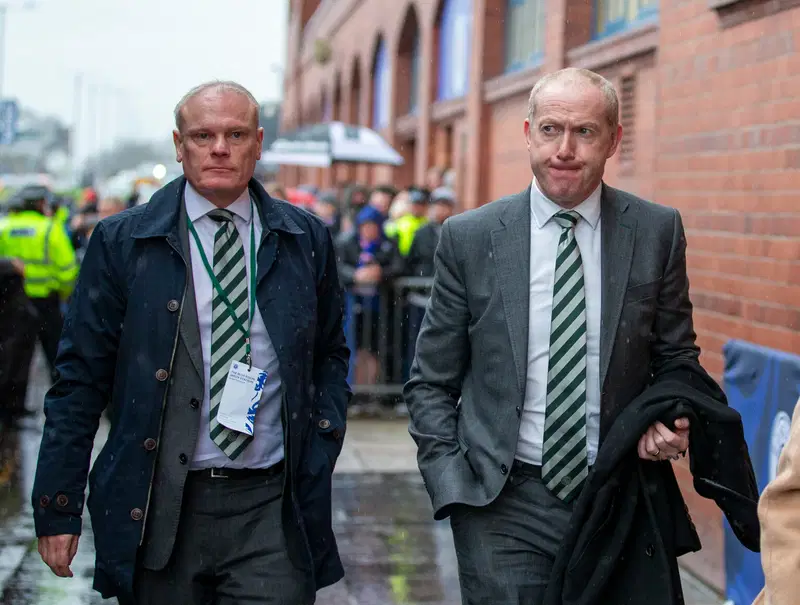
1st March 2026; Ibrox Stadium, Glasgow, Scotland; Scottish Premiership Football, Rangers versus Celtic; Chris McKay and Michael Nicholson of Celtic
Two days later, on November 20, five Celtic supporters were arrested. The Green Brigade say this incident became another element of the dispute. However, they point out that a police-imposed ban preventing those individuals from attending matches at Celtic Park was subsequently overturned in court. According to the group, that outcome undermines claims that those supporters posed an ongoing safety risk.
Overall, the situation has evolved into a dispute over competing narratives as much as anything else. On one side, the club maintains that the disciplinary measures were necessary because of serious concerns surrounding safety and behaviour. On the other side, the Green Brigade argue they have been excluded without due process and without fair consideration of their position.
From the outside, it is increasingly difficult to ignore the length of time the conflict has been allowed to continue. What began as a six-match suspension has now extended far beyond that timeframe. If the Green Brigade remain excluded for the upcoming match against Motherwell, it will mark the 30th fixture affected by the sanctions.
The ongoing dispute also arrives at a crucial stage of the football season. Celtic FC currently sit second in the Scottish Premiership table, trailing Heart of Midlothian FC by five points with nine matches remaining. With the title race still open, the atmosphere inside Celtic Park could play an important role during the final weeks of the campaign.
Regardless of where supporters stand on the argument itself, there is a growing sense that the situation has reached a point where a resolution is needed. The dispute has lasted months and has created significant tension between the club’s hierarchy and a section of its support.
Many observers believe it would be in the best interests of everyone involved—including the club’s leadership, its broader fanbase, and the Green Brigade themselves—to find a workable solution before the end of the season. With nine games remaining and the championship still within reach, having the full backing of the supporters could be vital.
If Celtic are to close the five-point gap on Hearts, the atmosphere at Celtic Park during the run-in may prove crucial. For that reason, there are increasing calls for the club to reconsider its approach and bring an end to what critics describe as collective punishment.
Ultimately, the situation has reached a stage where sensible decisions and meaningful dialogue appear necessary if the long-running dispute is to be resolved.
Full Green Brigade statement below
SFA panel delivers verdict on major Rangers and Celtic decisions, along with Hearts vs. Aberdeen grievances
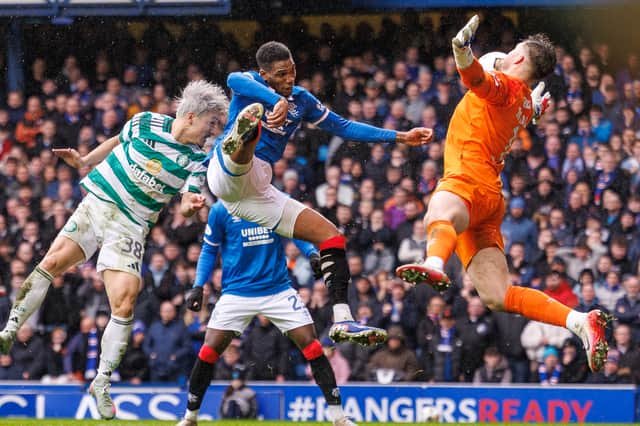
Celtic were awarded a penalty when Daizen Maeda’s header was deflected by the arm of Rangers defender Dujon Sterling onto Jack Butland. | Getty Images
The Scottish Football Association’s Key Match Incident (KMI) panel has released its latest review of refereeing decisions from the past week in the Scottish Premiership, assessing a number of controversial moments involving clubs including Rangers, Celtic, Heart of Midlothian and Aberdeen.
The three-person panel, which meets every week and is made up of experienced figures from within the Scottish game, examined ten incidents from matches played between February 28 and March 4. After reviewing each situation, the panel concluded that the match officials handled every one of them correctly.
One of the most discussed incidents came during last Sunday’s Old Firm clash between Rangers and Celtic at Ibrox. Late drama unfolded in the 89th minute when Celtic appealed for a penalty after a header from Daizen Maeda struck the arm of Rangers defender Dujon Sterling before diverting toward goalkeeper Jack Butland. At that stage of the match, Rangers were leading 2–1.
Referee John Beaton was advised by VAR official Steven McLean to review the incident on the pitchside monitor. After watching the replay, Beaton determined that the ball had struck Sterling’s arm and awarded Celtic a penalty.
Celtic midfielder Reo Hatate stepped up to take the spot kick, but Butland initially denied him with a save. The goalkeeper also managed to block the rebound attempt, yet Hatate eventually forced the ball across the line at the third attempt, ensuring Celtic secured a dramatic late equaliser. Following its review, the KMI panel unanimously agreed that the decision to award the penalty was correct.
Another talking point involving Celtic occurred in their 2–1 victory over Aberdeen on Wednesday. The Glasgow side believed they should have been awarded a penalty when a cross from Sebastian Tounekti appeared to strike the arm of Aberdeen defender Jack Milne inside the penalty area.

Celtic’s Liam Scales fouls Aberdeen’s Toyosi Olusanya inside the box conceding a penalty during the Premiership match at Pittodrie on Wednesday. (Photo by Paul Devlin / SNS Group) | SNS Group
Despite strong appeals from Celtic players, referee Nick Walsh decided against awarding a spot kick. VAR official Chris Graham checked the footage but concluded that the situation did not warrant an on-field review.
Celtic manager Martin O’Neill expressed frustration after the match, stating that the incident appeared to be a clear handball and that his team should have been given a penalty. However, the KMI panel disagreed with that assessment. After examining the footage, the panel confirmed that the referee’s original call was correct and unanimously supported the on-field decision not to award a penalty.
The same match also featured a penalty awarded to Aberdeen when Celtic defender Liam Scales was judged to have fouled Toyosi Olusanya inside the box. Walsh awarded the penalty during the game, and the decision was subsequently checked and upheld by Graham on VAR. The KMI panel reviewed the challenge and agreed that the officials had made the correct call in awarding the spot kick.
Another point of contention from the match concerned Celtic’s winning goal, scored by substitute Benjamin Nygren after a cutback from James Forrest. Aberdeen interim manager Peter Leven argued afterwards that Nygren appeared to be in an offside position when the pass was delivered. However, that particular incident was not included in the KMI panel’s list of cases reviewed for the week.
Meanwhile, Aberdeen also had complaints during their 1–0 defeat against Hearts at Tynecastle the previous Saturday. In that match, midfielder Stuart Armstrong went down in the penalty area following a challenge from Hearts defender Michael Steinwender. Leven insisted after the game that the incident should have resulted in a penalty for Aberdeen, claiming it was an obvious foul.
The KMI panel, however, reached a different conclusion. After studying the challenge, all three members agreed that the referee had made the correct decision in allowing play to continue. Aberdeen also appealed for a separate penalty in the same match for an alleged handball by a Hearts player, but that claim was also rejected by the panel.
In total, the KMI panel reviewed ten key incidents from the Scottish Premiership fixtures played across the specified dates. Their final verdict was that match officials made the correct decisions in every case examined, meaning no errors were recorded for the period under review.
-
 Blog1 month ago
Celtic issues a fiery VAR statement after Trusty’s red card appeal is dismissed, as furious chiefs release referee audio publicly.
-

 Blog2 months ago
Celtic informed their January signing under Martin O’Neill that he wouldn’t play a single minute this season.
-

 Blog1 month ago
Celtic issued an £83 million warning amid looming UEFA threats.
-
 Blog1 month ago
SFA Expected to Review Missed Penalty in Rangers v Celtic Clash
-

 Blog3 days ago
Police respond after reported disorder following Middlesbrough vs Millwall clash
-

 Blog10 months ago
“Courtside to Aisle-Side: Tyrese Haliburton and Jade Jones Set New Wedding Date”
-

 Blog1 month ago
£6m star is looking to leave Rangers this summer and has already announced his next club publicly.
-

 Blog2 weeks ago
Rangers victory overshadowed by refereeing controversy