
Blog
The Suns’ shortcomings are evident in their reduced lineup, culminating in a loss to the Celtics.


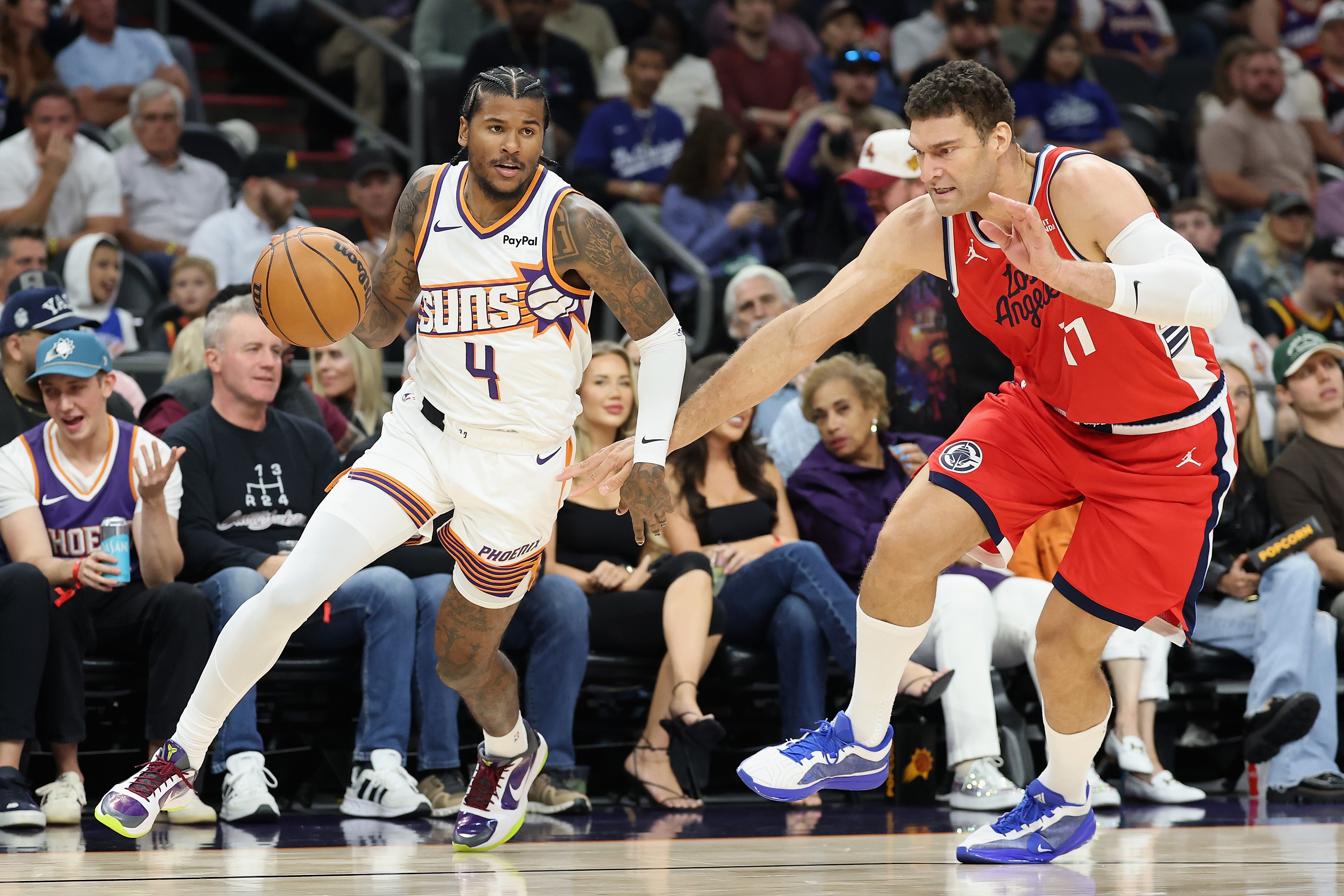


PHOENIX — The short-handed stretch the Phoenix Suns are currently enduring has become increasingly revealing, exposing cracks that injuries appear to have widened enough to destabilize what once looked like a firm foundation. Tuesday’s 97-81 defeat to the Boston Celtics offered another example of a group that previously showed resilience in difficult circumstances now struggling to resemble that same competitive unit.
With Devin Booker (right groin strain), Dillon Brooks (left hand fracture) and Jordan Goodwin (left calf strain) sidelined for a second consecutive game, Phoenix looked nothing like the squad that had worked to establish itself among the Western Conference’s stronger teams. Instead, they resembled one of the league’s weakest outfits. The loss marked their seventh in the past 10 contests, a troubling trend at a critical juncture of the season.
This matchup did not present an insurmountable challenge on paper. Boston, now 38-19, remains one of the NBA’s elite teams. However, without Jaylen Brown (right quad contusion) and Jayson Tatum (right Achilles), the Celtics’ rotation was not overwhelmingly superior in talent. In fact, the available personnel arguably tilted slightly in Phoenix’s favor. The contest seemed destined to hinge on execution and collective cohesion — an equation the Suns would typically welcome.
Instead, the game slipped away decisively.
Phoenix opened with promise, taking a 26-21 lead after the first quarter. The second unit expanded the advantage to 11 points, providing early optimism. But as starters filtered back into the rotation, the offense deteriorated dramatically. Over the final 6:40 of the first half, the Suns managed only five points. The third quarter proved even more alarming, with just 11 points scored. That amounted to a meager 16 points over an 18-minute stretch, allowing Boston to transform an 11-point deficit into a commanding 23-point lead entering the fourth quarter.
The offensive collapse reignited questions about Booker’s value. Is he truly indispensable? Does his absence elevate him into Most Valuable Player consideration? Earlier in the season, Phoenix demonstrated an ability to remain competitive without him. Prior to the All-Star break, they posted a 5-7 record in games Booker missed, with three narrow defeats and four lopsided losses coming against elite opponents like Oklahoma City (twice), Houston and the Clippers.
Perhaps the difference now lies in the compounded absences. Without both Booker and Brooks, the void may simply be too large. Yet that explanation feels incomplete, especially considering the Suns had scrapped their way to a gritty win just days earlier. The abrupt disappearance of that fight raises concerns beyond personnel.
Rebounding was another glaring issue. Despite matching the Suns’ small-ball approach, Boston secured 22 offensive rebounds compared to Phoenix’s nine. Head coach Jordan Ott did not hide his frustration afterward, describing it as particularly aggravating to lose the possession battle on their home floor.
Ott emphasized that winning the possession game is non-negotiable, especially when key players are unavailable. He acknowledged that the team’s identity has been built around controlling those margins, and without Booker and Brooks, that responsibility only intensifies.
Looking ahead, much of Phoenix’s postseason outlook hinges on the contributions of Jalen Green and Mark Williams. If Green can invigorate the offense and Williams can anchor the defense effectively, a late push toward the sixth seed remains plausible once Booker returns. If only one meets expectations, the team may hover around mediocrity. If neither elevates their play, the Suns’ current struggles may persist.
Green’s performance Tuesday underscored the concern. He finished 5-of-18 from the field for 13 points, adding three rebounds, one assist and one turnover. Across 11 games with Phoenix, he is shooting just 36.9%. There is hope he is still regaining full health, because his inability to create separation on drives has been worrisome. It is not solely elite defenders stifling him — even role players like Baylor Scheierman and Payton Pritchard managed to contain him at times.
When Green did penetrate, decision-making faltered. He often attacked directly into rim protectors rather than adjusting mid-drive. After Sunday’s loss, Green admitted he felt close to regaining his rhythm but was not entirely there yet. His struggles to turn the corner have led to an overreliance on contested jump shots, diminishing the quality of offensive possessions.
Ott, however, did not sound alarmed. He cited a mixture of factors, including subpar screening, limited advantages created in sets, increased physicality as the season progresses and Green’s ongoing process of returning to form. According to Ott, these fluctuations are normal, even if Green himself wishes the timeline were shorter.
Williams’ stat line — two points, five rebounds, one assist, two turnovers and two blocks in 18 minutes — reflected another uneven outing. His recent regression has grown noticeable enough that rookie Ighodaro has frequently closed games. The possibility of reducing Williams’ minutes further or even starting Ighodaro looms.
Since Dec. 20, a 31-game sample entering Tuesday, Phoenix’s defensive rating has been 115.5 with Williams on the floor compared to 105.7 when he sits. Earlier in the season, that split favored Williams, suggesting a significant shift over time. While on-off numbers are imperfect evaluators, they align with what observers have noted for months.
Williams’ drop coverage has lacked consistency, and his rim protection and rebounding presence have not met expectations. Though he occasionally disrupts passing lanes with his length, opponents have increasingly targeted him inside. Despite frequently contesting shots, he has just 10 blocks over his last 16 games, averaging 0.9 per contest.
Offensively, his limitations compound the issue. Williams’ skill set depends heavily on playmakers attacking downhill and leveraging him as a lob threat. Yet Phoenix lacks consistent downhill creators in Booker’s absence. Additionally, he has not developed the screening effectiveness or two-man chemistry that Ighodaro has shown. While more post touches are an option, his refinement there remains limited, making it a forced solution rather than a sustainable one.
Complicating matters, Tuesday marked Williams’ 54th game this season — 10 more than his prior career high. Fatigue could be a factor, but if so, it raises concerns about durability over a full campaign.
Ott faces a delicate balancing act moving forward. Expanding back to a three-center rotation, potentially involving rookie Khaman Maluach, may warrant consideration. Alternatively, embracing small-ball lineups could provide a different dynamic.
For Boston, Derrick White led the way with 22 points, eight rebounds and eight assists. Phoenix’s lone bright spot was Ryan Dunn, who contributed 10 points, six rebounds and two assists in 25 minutes — a much-needed solid outing.
Grayson Allen struggled from the field, going 2-of-12 overall and 1-of-9 from three-point range. He did convert nine of 10 free throws to finish with 14 points, but efficiency remained elusive.
Injury updates offered mixed news. Brooks is expected to be re-evaluated in four to six weeks, while Goodwin’s timeline is listed at one to two weeks. Calf strains often linger, so optimism surrounding Goodwin’s quicker return may prove ambitious unless the injury is mild.
Ultimately, the Suns’ current slide has illuminated how fragile their margin for error has become. Until reinforcements return — and until Green and Williams elevate their impact — Phoenix risks solidifying the troubling impression they have recently conveyed.
-

 Blog4 weeks ago
Celtic issues a fiery VAR statement after Trusty’s red card appeal is dismissed, as furious chiefs release referee audio publicly.
-

 Blog1 month ago
Celtic informed their January signing under Martin O’Neill that he wouldn’t play a single minute this season.
-
 Blog4 weeks ago
Celtic issued an £83 million warning amid looming UEFA threats.
-

 Blog3 weeks ago
SFA Expected to Review Missed Penalty in Rangers v Celtic Clash
-

 Blog10 months ago
“Courtside to Aisle-Side: Tyrese Haliburton and Jade Jones Set New Wedding Date”
-

 Blog1 month ago
£6m star is looking to leave Rangers this summer and has already announced his next club publicly.
-

 Blog3 days ago
Rangers victory overshadowed by refereeing controversy
-

 Blog4 weeks ago
Auston Trusty under intense Celtic red card investigation amid new Hibs ‘punch’ claims and Rangers’ appeal review.