
Blog
Uncovering the hidden angles behind the crucial Aberdeen vs Celtic VAR offside call.

The crucial unseen angles behind the major Aberdeen vs Celtic VAR offside decision
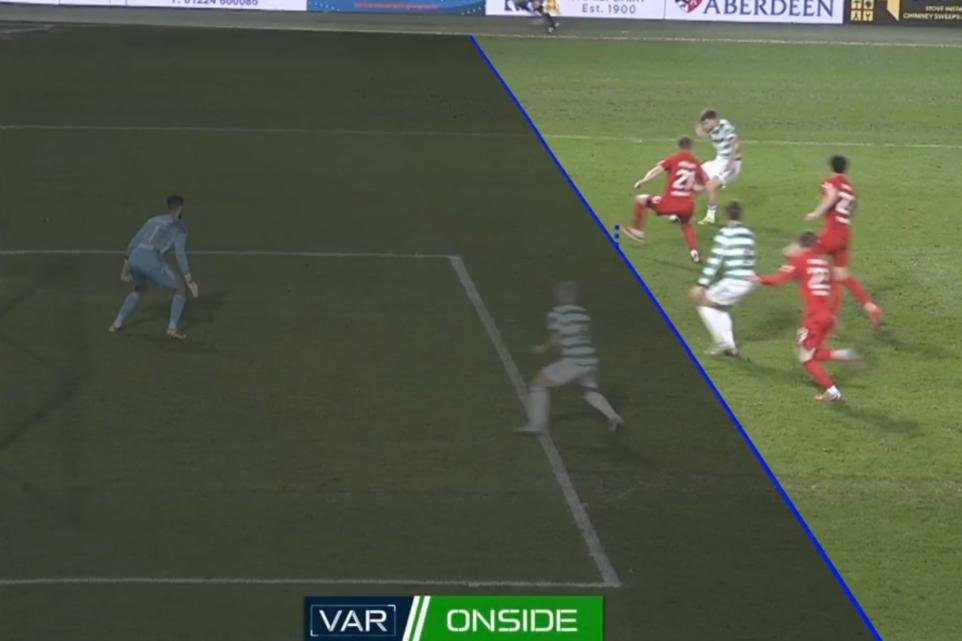
Benjamin Nygren was deemed onside after a VAR review of a possible offside in Aberdeen vs Celtic (Image: Sky Sports)
Benjamin Nygren’s decisive strike for Celtic against Aberdeen has reignited debate surrounding the application of VAR in offside rulings.
The Parkhead midfielder converted a cross from James Forrest in the 67th minute at Pittodrie on Wednesday evening, sealing a 2-1 triumph for Martin O’Neill’s side.
Yet the awarding of the goal has once again placed the spotlight on VAR decisions in the Scottish Premiership this term. On first viewing, Nygren appeared marginally offside to the naked eye, prompting immediate discussion among supporters and pundits alike.
A VAR still image shown during the live Sky Sports broadcast displayed a single line drawn from the leg of Aberdeen defender Gavin Molloy. Nygren was positioned just behind that line, meaning he was deemed onside and the goal was allowed to stand.
However, the image sparked questions regarding the exact moment of contact between Forrest and the ball. An Aberdeen player partially blocked the camera angle at the key instant, leading to uncertainty among viewers. Aberdeen caretaker manager Peter Leven also queried why only one line was shown, rather than the two lines that are often displayed in televised VAR graphics.
Despite the confusion created by the single screenshot aired during the broadcast, it is understood that the frame presented to viewers represents only a fraction of the process undertaken by VAR officials.
🗣️ “He’s clearly onside… the finish is so clever”
Kris Boyd and Chris Sutton discuss the importance of Benjamin Nygren, who scored Celtic’s 12th goal by a substitute in the Premiership this season ⤵️ pic.twitter.com/gZnlKedmkq
— Sky Sports Scotland (@ScotlandSky) March 4, 2026
In reality, VAR official Chris Graham and his team would have adhered to established protocol before reaching their final verdict. The first step involves pinpointing the precise moment the ball leaves the passer’s foot — in this case, identifying the exact kick point from Forrest’s boot.
To achieve that, officials review the best available broadcast angles to determine the correct frame. Once that specific frame is selected and locked in, they then consult the calibrated offside cameras. From that identical time frame, they are able to apply the necessary digital lines to assess the relative positions of attacker and defender.
Therefore, the image shown to the public — which appeared partially obscured — would not have been the sole basis for the judgement. The critical kick point would have been confirmed using clearer angles before any lines were drawn.
Leven, though, remained unconvinced when discussing the incident after the match. He remarked that the goal looked offside from his perspective and questioned the presentation of the decision. Specifically, he pointed out that only one line was visible on the screen, when traditionally viewers expect to see lines drawn from both the attacking and defending players for clarity.
His comments reflected a broader frustration shared by many observers, who felt the graphic did not fully explain the conclusion reached by the officials.
On the other side, O’Neill admitted the lengthy delay during the VAR review made for an anxious wait on the touchline. He revealed that the fourth official informed him that two separate images were being examined during the process, which only heightened the tension as the check continued.
O’Neill acknowledged that his “heart was in his mouth” while awaiting confirmation, given the significance of the moment in a tightly contested match. Ultimately, though, the decision went in Celtic’s favour and the goal stood, ensuring they left Pittodrie with all three points.
The incident has once more highlighted the complexities of VAR in offside scenarios. While the final broadcast image may appear straightforward — or even questionable — the actual procedure involves multiple camera feeds, frame-by-frame analysis and calibrated technology designed to eliminate guesswork.
Nonetheless, as this episode demonstrates, transparency in how those decisions are communicated remains a key talking point. When only a single still image is shown, without the full context of the process behind it, controversy can quickly follow — especially in high-stakes encounters such as Aberdeen versus Celtic.
In the end, Nygren’s goal proved decisive. Yet the debate surrounding how it was validated ensures that VAR, once again, remains firmly at the centre of Scottish football discussion.
Chris Sutton deviates from Celtic protocol by stating, “I never disagree with Martin O’Neill — but he’s wrong.”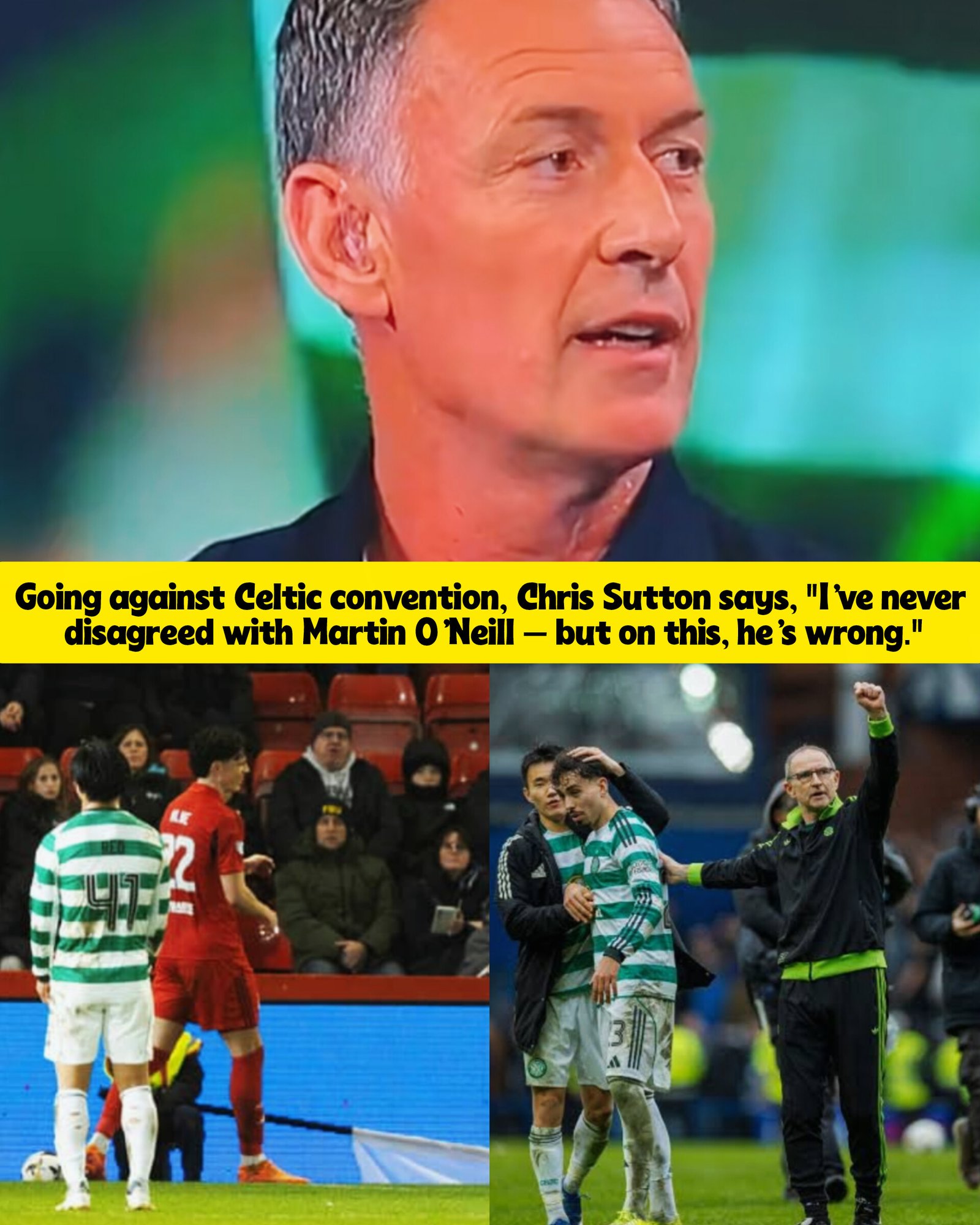
Chris Sutton admits it is rare for him to publicly challenge the opinion of his former Celtic manager Martin O’Neill.p
Yet on this occasion, the ex-striker felt compelled to break from that unwritten rule when assessing O’Neill’s reaction to a controversial penalty appeal during Celtic’s 2-1 victory over Aberdeen at Pittodrie.
The Hoops secured all three points thanks to a second-half strike from substitute Benjamin Nygren. His goal restored Celtic’s advantage after Kevin Nisbet had converted from the penalty spot to cancel out an early opener from Kieran Tierney.
That result in their game in hand lifted Celtic above Rangers into second place in the Scottish Premiership standings. It also moved them to within five points of league leaders Hearts, with nine fixtures left to play in the campaign.
Despite the positive outcome, one key moment in the first half sparked debate. O’Neill believed Celtic were denied a clear penalty when a cross from Sebastian Tounekti appeared to strike the arm of Aberdeen defender Jack Milne inside the box. Referee Nick Walsh waved away the appeals, and after a check by VAR official Chris Graham, it was decided that there was no need for an on-field review.
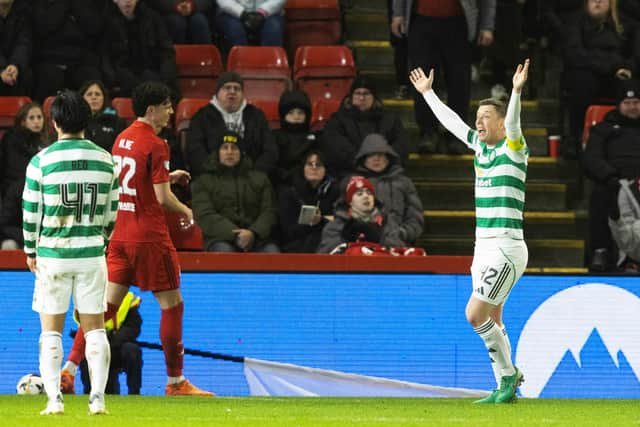
Celtic’s Callum McGregor appeals for a penalty during the 2-1 win over Aberdeen at Pittodrie. (Photo by Ross Parker / SNS Group) | SNS Group
O’Neill did not hide his frustration when reflecting on the incident. Speaking after the match, he insisted he felt the ball had clearly hit Milne’s arm and that a spot-kick should have been awarded. In his view, the decision not to penalise the defender was incorrect.
However, Sutton, who was working as a pundit for Sky Sports, could not bring himself to agree with his former boss. Appearing alongside ex-Rangers striker Kris Boyd, Sutton instead sided with the officials.
Boyd was quick to stress that not every instance of the ball striking a player’s arm automatically constitutes a foul. He argued that Milne was attempting to pull his arm back behind his body and had little opportunity to move it elsewhere. From his perspective, the defender’s arm was in a natural position and there was no deliberate action to handle the ball. Boyd even praised both the referee and VAR for resisting pressure to award a penalty, stating that such decisions require careful judgement rather than automatic punishment.
Sutton echoed that sentiment, albeit with a touch of humour regarding his long-standing respect for O’Neill. He acknowledged that he rarely finds himself at odds with the 74-year-old, given their shared history and the success they enjoyed together at Celtic. Nonetheless, he made it clear that he felt O’Neill had misread this particular situation.
Sutton pointed out that Milne’s arm appeared to be by his side when the ball struck him and highlighted the speed at which the cross was delivered. In his assessment, the pace of the ball reduced any realistic chance for the defender to react differently. As a result, he did not believe the incident met the threshold for a handball offence under current interpretations of the law.
In a light-hearted aside, Sutton joked that he hoped O’Neill would not see his comments disagreeing with him. Still, he stood firm in his conclusion that, on this occasion, his former manager had got it wrong.
The debate once again underlined the ongoing complexities surrounding handball decisions in modern football. While O’Neill viewed the contact as clear and punishable, both Sutton and Boyd felt the officials had applied the rules correctly. Ultimately, despite the controversy, Celtic left Pittodrie with a crucial win that strengthened their position in the title race.
SFA Expected to Review Missed Penalty in Rangers v Celtic Clash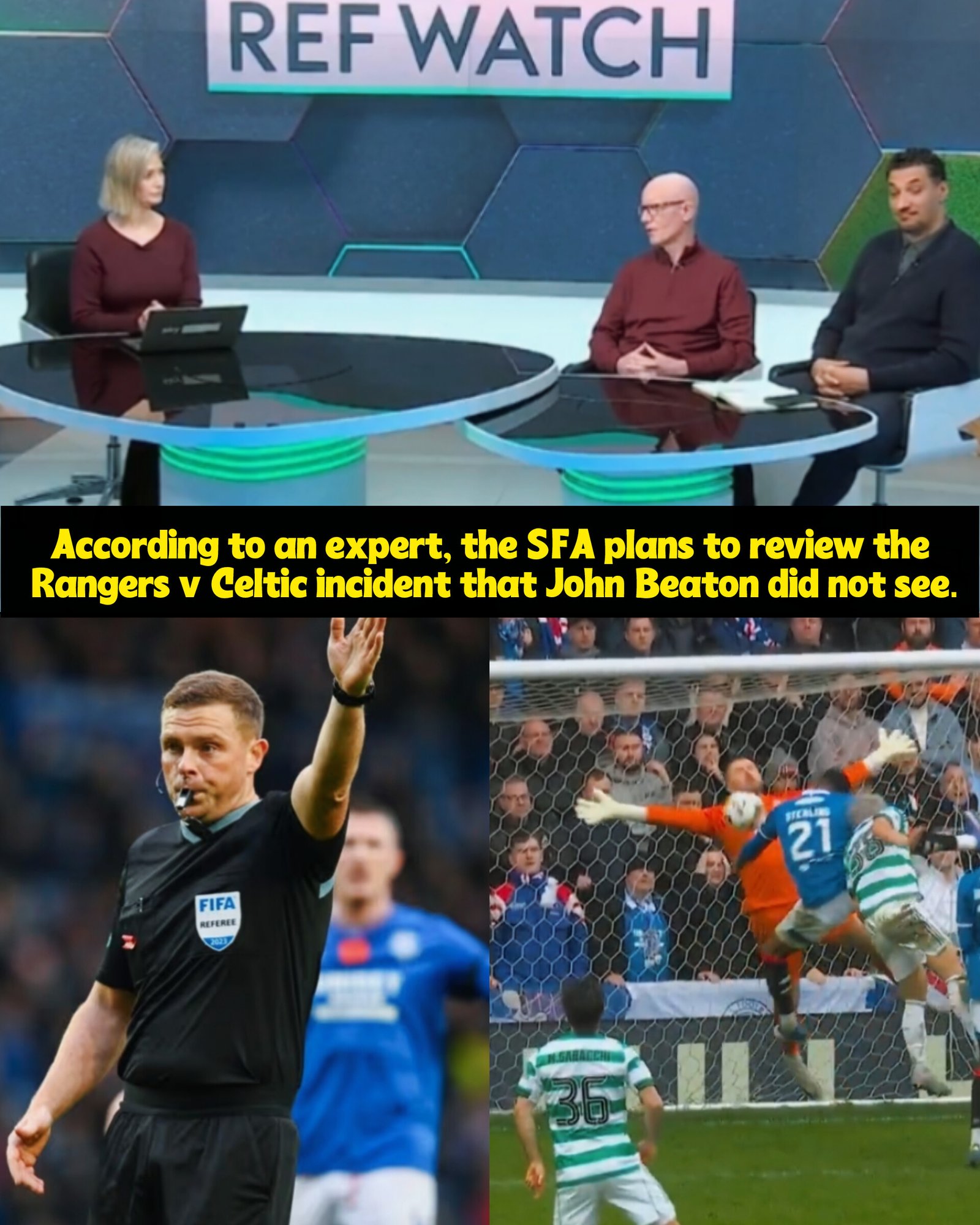
Former PGMOL chief Keith Hackett believes the Scottish FA will investigate a controversial penalty incident that referee John Beaton failed to award during Rangers’ 2-2 draw with Celtic at Ibrox on Sunday.
While much of the post-match discussion centred on the penalty that was given—eventually converted after a dramatic sequence involving Reo Hatate—attention has now shifted to another moment that went unpunished. Hackett has suggested that Willie Collum, the Scottish FA’s Head of Referees, will likely examine why a separate challenge inside the box did not result in a spot-kick.
McGregor Praises Celtic’s Character in Derby Fightback
Celtic captain Callum McGregor expressed pride in his team’s resilience after they recovered from a two-goal deficit to secure a 2-2 draw in the latest Glasgow derby.
Martin O’Neill’s side endured a torrid first half as Rangers stormed into control. The home side were ruthless, with 21-year-old Portuguese striker Youssef Chermiti netting twice to give Rangers a commanding advantage. At that stage, Celtic appeared to be facing an uphill battle, and the atmosphere inside Ibrox suggested a long afternoon for the visitors.
However, the match took a dramatic turn after the break. Celtic returned with renewed intensity and gradually clawed their way back into contention.
Second-Half Revival Turns the Tide
The comeback began in the 56th minute when left-back Kieran Tierney rose to head home, cutting the deficit and restoring belief among his teammates. The goal injected momentum into Celtic’s performance and unsettled Rangers, who had previously looked comfortable.
As the match edged toward its conclusion, Celtic pushed forward in search of an equaliser. Deep into stoppage time, substitute Reo Hatate became the central figure in chaotic scenes. Rangers goalkeeper Jack Butland initially saved Hatate’s penalty, then denied him again on the rebound. Yet amid the scramble, Hatate managed to bundle the ball over the line to level the score.
The late equaliser secured a valuable point for Celtic, though the result arguably favoured William Hill Premiership leaders Hearts. With nine games remaining, Rangers sit six points behind the Edinburgh club and two ahead of Celtic. Crucially, the Hoops have a game in hand, which they will play away to Aberdeen on Wednesday night.
Late Goals Highlight Growing Resilience
Celtic’s dramatic equaliser continued a recent pattern of late heroics. The Hoops have also scored crucial goals in the closing stages against Dundee, Livingston, and Kilmarnock in recent weeks. McGregor pointed to this trend as evidence of the squad’s growing mental strength.
He acknowledged that over the past month the team’s fighting spirit has become increasingly clear. Football rarely unfolds according to plan, he noted, and teams must often respond to unexpected adversity. Preparation can only take a side so far; in challenging moments, character and personality become decisive.
According to McGregor, situations like the one at Ibrox demand leaders willing to take responsibility, demand the ball, and guide the team back into the contest. Doing so in such a hostile environment made the achievement even more significant.
He stressed that the draw demonstrated Celtic remain firmly in the title race. With a game in hand offering the chance to close the gap, the captain believes his side can attack the final nine fixtures with renewed confidence and purpose.
Sending a Psychological Message
McGregor also suggested that Celtic’s refusal to surrender sends a powerful message to their rivals. While he admitted the team would prefer not to fall two goals behind, he emphasised that no match is ever perfect.
The crucial factor, he explained, is maintaining belief and resilience. Sunday’s equaliser underlined the squad’s determination and reinforced their ambition to retain the title. On the surface, the draw may appear to be a single point gained, but psychologically it could prove far more significant.
At full-time, a couple of thousand Celtic supporters celebrated the comeback. Next Sunday’s Scottish Gas Scottish Cup quarter-final at Ibrox will see an even greater away presence, with around 7,500 travelling fans allocated seats in the Broomloan stand in line with competition regulations.
McGregor believes that enhanced backing, combined with the siege mentality shown on Sunday, could influence the cup tie. He stated that the squad wants to build on the momentum generated in the league encounter and carry it into the knockout fixture.
Having a full stand of supporters behind them could provide the marginal gains required in a high-pressure match. Small details, he suggested, can shift momentum and tilt outcomes in tightly contested games. Above all, he reiterated that the players displayed immense character and that the draw ultimately represented a strong result given the circumstances.
Hackett Urges Review of Missed Spot-Kick
Despite the focus on the penalty that was awarded to Celtic, Hackett has called attention to an earlier incident involving Dujon Sterling and Sebastian Tounekti. Sterling appeared to grab Tounekti’s shirt before bringing him down inside the area, yet no penalty was given.
Hackett has told Football Insider that he expects Willie Collum to review the matter. In his view, the defender’s actions constituted holding and impeding an opponent with contact—an offence that should have resulted in a penalty kick.
He expressed hope that Collum would question both the on-field referee and the VAR officials to understand how such an incident went unpunished. According to Hackett, the evidence suggests a clear foul that warranted a spot-kick.
Title Race Implications
The draw leaves both Rangers and Celtic chasing Hearts at the top of the table. While neither side claimed maximum points, Celtic’s game in hand means the balance of the title race could still shift dramatically.
Had either side secured victory at Ibrox, it might have had season-defining consequences. Instead, the derby delivered controversy, drama, and a renewed sense of belief for Celtic.
As the campaign enters its decisive phase, scrutiny of refereeing decisions is likely to intensify. For Celtic, the focus will be on sustaining their resilience and capitalising on their game in hand. For the Scottish FA, attention may turn to reviewing contentious moments to ensure confidence in officiating remains intact.
Seething Scottish Premiership manager blames VAR for encouraging playacting after a ‘ridiculous’ ruling

Dundee United manager Jim Goodwin during a press conference at the The University of St Andrews Sports Centre, on March 02, 2026, in St Andrews, Scotland. (Photo by Ross Parker / SNS Group) | SNS Group
Dundee United manager Jim Goodwin has intensified his criticism of Scottish Premiership officiating after what he described as a “ridiculous” VAR decision handed Motherwell a decisive advantage in Saturday’s 2-0 defeat at Fir Park. The United boss insists a penalty was awarded for “nothing” and claims the current use of VAR is fuelling frustration throughout the game, even encouraging players to exaggerate contact in the hope of winning decisions.
The flashpoint came late in the first half of the Premiership encounter when referee Nick Walsh was instructed to review an incident on the pitchside monitor. Motherwell forward Tawanda Maswanhise had fallen to the ground following apparent contact from Vicko Sevelj’s elbow inside the penalty area. After reviewing the footage, Walsh pointed to the spot and cautioned Sevelj. Maswanhise converted the penalty to put Motherwell ahead before going on to score again early in the second half, taking his tally for the season to 21 goals and sealing a comfortable victory for the hosts.
Goodwin was outspoken immediately after the match, branding the decision “ridiculous,” and he remained equally forthright when addressing the issue ahead of Tuesday night’s home clash with St Mirren. Having had time to reflect, the United manager showed no sign of softening his stance.
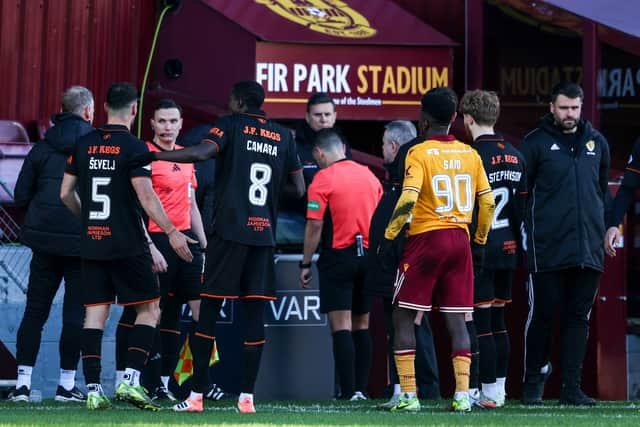
Referee Nick Walsh checks with VAR before awarding a penalty to Motherwell in their 2-0 win over Dundee United at Fir Park. (Photo by Craig Foy / SNS Group) | SNS Group
He stressed that the debate over officiating and VAR involvement has been a recurring theme throughout the campaign. According to Goodwin, the sense of dissatisfaction extends well beyond his own club. Managers, players and supporters alike are growing weary of what they perceive to be excessive interference and inconsistent judgments, whether from on-field officials or those operating the VAR system from Glasgow.
In Goodwin’s view, the penalty incident at Fir Park exemplified the problem. He argued that VAR need not have intervened at all, maintaining that Sevelj’s action did not warrant a spot-kick. The defender, he suggested, was merely attempting to fend off an opponent who had been grappling with him moments earlier. Goodwin contended there was no meaningful force in Sevelj’s movement and described the decision as a pivotal moment that dramatically altered the course of a challenging away fixture.
The United manager also pointed to what he believes was missing from the replay footage considered by VAR. He claimed that in the six or seven seconds leading up to the incident, Maswanhise had been tugging and pulling at Sevelj, provoking the reaction. That context, Goodwin implied, was overlooked when officials reviewed the slowed-down images. He suggested that when incidents are freeze-framed and examined in isolation, they can appear more severe than they seemed in real time, leading to judgments that do not reflect the overall passage of play.
Expanding on his broader concerns, Goodwin warned that the current approach risks encouraging players to go to ground too easily. If footballers know that minimal contact could be scrutinised repeatedly on video, he argued, they may be tempted to exaggerate situations in order to draw attention from VAR officials. In his opinion, this trend undermines the spirit of the game and contributes to widespread discontent about how matches are being controlled.
Despite the setback at Motherwell, Goodwin insisted he stands firmly by his initial reaction. He reiterated that he does not believe the challenge met the threshold for a penalty and lamented the timing of the decision in what was already a demanding contest. Travelling to Fir Park is never straightforward, he noted, and conceding under such circumstances made an uphill task even steeper.
The defeat leaves Dundee United facing a significant challenge in their pursuit of a top-half finish before the league split. With five matches remaining, they sit 12 points behind sixth-placed Falkirk, albeit with a game in hand over the Bairns. Results elsewhere at the weekend did little to aid United’s cause, and Goodwin acknowledged that the margin has widened once more.
Even so, the manager refused to concede defeat in the race for the top six. He accepted that the situation is far from straightforward and recognised that Falkirk require only one more victory from their remaining four fixtures to guarantee their position. Nonetheless, Goodwin emphasised that as long as qualification remains mathematically achievable, his side will continue to battle.
While the arithmetic may be daunting, he insisted there is no room for surrender. The squad’s focus, he suggested, must remain on their own performances and accumulating as many points as possible in the run-in. For Goodwin, the controversy surrounding VAR is a separate but pressing issue, one he believes must be addressed for the good of Scottish football.
In the meantime, Dundee United must quickly regroup ahead of their next assignment. With emotions still running high after the events at Fir Park, Goodwin will hope his players channel their frustration into a positive response on the pitch. Whether or not the debate over VAR subsides, United’s immediate priority is clear: keep fighting for every point while a top-half finish remains within reach.
-
 Blog1 month ago
Celtic issues a fiery VAR statement after Trusty’s red card appeal is dismissed, as furious chiefs release referee audio publicly.
-

 Blog2 months ago
Celtic informed their January signing under Martin O’Neill that he wouldn’t play a single minute this season.
-
 Blog1 month ago
Celtic issued an £83 million warning amid looming UEFA threats.
-
 Blog1 month ago
SFA Expected to Review Missed Penalty in Rangers v Celtic Clash
-

 Blog3 days ago
Police respond after reported disorder following Middlesbrough vs Millwall clash
-

 Blog10 months ago
“Courtside to Aisle-Side: Tyrese Haliburton and Jade Jones Set New Wedding Date”
-
 Blog1 month ago
£6m star is looking to leave Rangers this summer and has already announced his next club publicly.
-
 Blog2 weeks ago
Rangers victory overshadowed by refereeing controversy