
Blog
Former Premier League referee weighs in on overlooked Celtic-Rangers incident as Hoops player is called “reckless.”

Former Premier League referee Mark Clattenburg has given his assessment of a largely overlooked incident from the latest Old Firm derby, with Celtic striker Camilo Duran described as “reckless” for a challenge on Rangers midfielder Nicolas Raskin.
The incident occurred only seconds after the match began at Celtic Park and came immediately after Rangers had taken the kick-off. While the challenge did not receive significant attention during the live broadcast, Clattenburg believes referee John Beaton could have produced a yellow card for Duran.
However, despite describing the Celtic forward’s challenge as reckless, the former Premier League official does not believe it reached the threshold required for a red card or further disciplinary action.
Duran’s Early Challenge
The incident happened as Raskin attempted to move the ball forward following Rangers’ opening kick.
Duran attempted to block the midfielder’s action, but as he challenged, he left his leg extended and made contact with the Rangers player on his way down.
It was the kind of challenge that can sometimes be seen during the opening moments of an Old Firm match, when players immediately attempt to establish their physical presence.
Beaton awarded Rangers a free-kick following the challenge, but no card was shown.
The incident was not prominently featured by the Sky Sports cameras, meaning it escaped much of the immediate attention that surrounded other controversial moments during the match.
Nevertheless, Clattenburg was asked to assess the challenge and believes Duran was fortunate not to receive a booking.

Incident involved Rangers’ Nico Raskin. | Getty Images
Clattenburg’s Assessment
Speaking to Rangers News, Clattenburg explained that he considered Duran’s tackle reckless and said it could reasonably have resulted in a yellow card.
However, he also explained why he did not believe the challenge warranted a red card.
According to the former referee, Duran jumped towards Raskin with his studs low, but the manner and location of the contact meant it did not satisfy the necessary requirements for serious foul play.
Clattenburg also suggested that VAR would have checked the incident and determined that there was insufficient evidence for a red-card intervention.
His assessment therefore distinguishes between a challenge that deserves disciplinary action and one that reaches the much higher threshold required for a sending-off.
In his view, Duran’s tackle belonged in the former category.
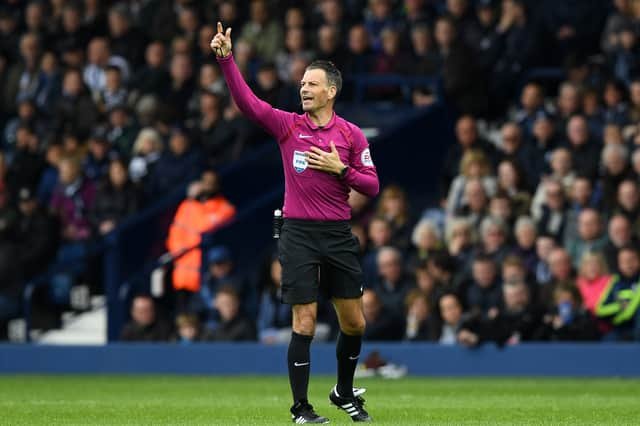
Former Premier League referee assessed Old Firm incidents. | Getty Images
What The Laws Say
The debate surrounding the incident centres on the distinction between reckless play and serious foul play.
Under Law 12 of the International Football Association Board’s Laws of the Game, serious foul play applies when a challenge endangers an opponent’s safety or involves excessive force or brutality.
A player can be sent off when a tackle or challenge uses excessive force or puts an opponent’s safety at significant risk.
The law also covers lunges made from different directions when excessive force is involved or when the opponent’s safety is endangered.
Clattenburg’s interpretation was that Duran’s challenge did not reach that standard.
While the Celtic striker’s actions were reckless enough to potentially justify a yellow card, there was not sufficient evidence, in Clattenburg’s assessment, to suggest that excessive force had been used.
That distinction is important because VAR is not expected to intervene simply because a referee may have missed a possible booking.
For a review to lead to a red card, the incident must meet the required threshold for serious foul play.
Why No VAR Intervention?
The lack of a lengthy VAR review has also attracted attention because of the nature of the challenge.
The incident was not subjected to the type of detailed on-field review that accompanies potential red-card offences.
Clattenburg’s explanation suggests that VAR would have examined the challenge but concluded that it did not represent a clear and obvious red-card offence.
If the challenge had involved significantly greater force, a higher point of contact or clearer danger to Raskin, the situation could have been different.
Instead, the former referee believes the appropriate outcome would have been a booking rather than a dismissal.
That means the controversy surrounding the incident is primarily about whether Beaton should have shown Duran a yellow card rather than whether Celtic should have been reduced to ten players.
Makhanya’s Disallowed Goal
The Duran-Raskin incident was not the only refereeing talking point from the Old Firm clash.
Rangers defender Olwethu Makhanya also found himself at the centre of controversy after appearing to double his side’s advantage in the 74th minute.
The South African defender produced a well-struck volley which went into the net after coming off the upright.
Initially, it appeared to be an outstanding goal, but the celebrations were short-lived.
Replays showed that the ball had made contact with Makhanya’s arm immediately before he struck it towards goal.
The goal was subsequently ruled out, with VAR supporting the decision.
Clattenburg believes the decision was correct under the existing handball laws.
Clattenburg Explains Handball Decision
The former Premier League referee explained that the law is straightforward when a player touches the ball with their hand or arm immediately before scoring.
In such circumstances, the goal must be disallowed, regardless of whether the contact was deliberate.
Therefore, because the ball touched Makhanya’s arm before his shot found the net, the officials were correct to cancel the goal.
However, Clattenburg believes the wider law could benefit from further discussion by football’s lawmakers.
He argued that IFAB should consider addressing the wording or application of this particular aspect of the handball law at its next meeting.
The reason is that similar incidents have generated increasing debate in both England and Scotland.
Growing Handball Debate
Handball decisions have become one of the most controversial areas of football officiating, particularly when an accidental touch immediately precedes a goal.
The Makhanya incident is another example of a situation where the outcome is relatively clear under the current wording, but the wider principle continues to generate disagreement.
A recent Scottish example involved Hearts midfielder Laurent Mendy during his team’s 1-1 draw with Kilmarnock.
Mendy appeared to score, but VAR intervened after determining that the ball had touched his arm before he struck his shot.
The decision became controversial because there was an argument that the original shot may have been heading wide before taking a deflection from Kilmarnock defender Cathal McCarthy.
Some pundits therefore questioned whether the goal should have been allowed despite the handball occurring before the final contact.
The debate highlights the difficulty surrounding the current rule.
Another Old Firm Refereeing Debate
The latest Old Firm meeting therefore produced two separate refereeing discussions.
Duran’s early challenge on Raskin raised questions about whether a yellow card should have been shown, with Clattenburg describing the tackle as reckless but not serious enough for a red card.
Meanwhile, Makhanya’s disallowed goal highlighted the strict application of the handball law.
Clattenburg’s comments suggest that both decisions can be understood through the existing laws, although he believes there is room for lawmakers to reconsider aspects of the handball regulations.
For Celtic and Rangers supporters, such incidents are inevitably likely to generate debate long after the final whistle.
The Duran challenge in particular may attract renewed attention because it occurred almost immediately after kick-off and was largely missed by the television coverage.
Clattenburg’s assessment provides some clarity: he believes a yellow card would have been justified, but there was no basis for a red card.
On the handball incident, meanwhile, his position is that the officials applied the current law correctly, while IFAB may need to examine whether the rule itself requires further clarification.
The two incidents demonstrate once again how small decisions during major matches can become significant talking points, particularly when the fixture is an Old Firm derby and every refereeing call is placed under intense scrutiny.
-
 Blog7 months ago
Celtic issues a fiery VAR statement after Trusty’s red card appeal is dismissed, as furious chiefs release referee audio publicly.
-

 Blog2 weeks ago
Former official calls on SFA to contact Rangers over fan scenes during Celtic match, labeling them “completely unacceptable.”
-

 Blog7 months ago
Celtic informed their January signing under Martin O’Neill that he wouldn’t play a single minute this season.
-

 Blog7 months ago
Celtic issued an £83 million warning amid looming UEFA threats.
-
 Blog7 months ago
SFA Expected to Review Missed Penalty in Rangers v Celtic Clash
-

 Blog6 months ago
Police respond after reported disorder following Middlesbrough vs Millwall clash
-

 Blog1 year ago
“Courtside to Aisle-Side: Tyrese Haliburton and Jade Jones Set New Wedding Date”
-

 Blog7 months ago
£6m star is looking to leave Rangers this summer and has already announced his next club publicly.