
Blog
Hull City might face a points deduction due to their Premier League status.

Promotion Glory Brings New Financial Concerns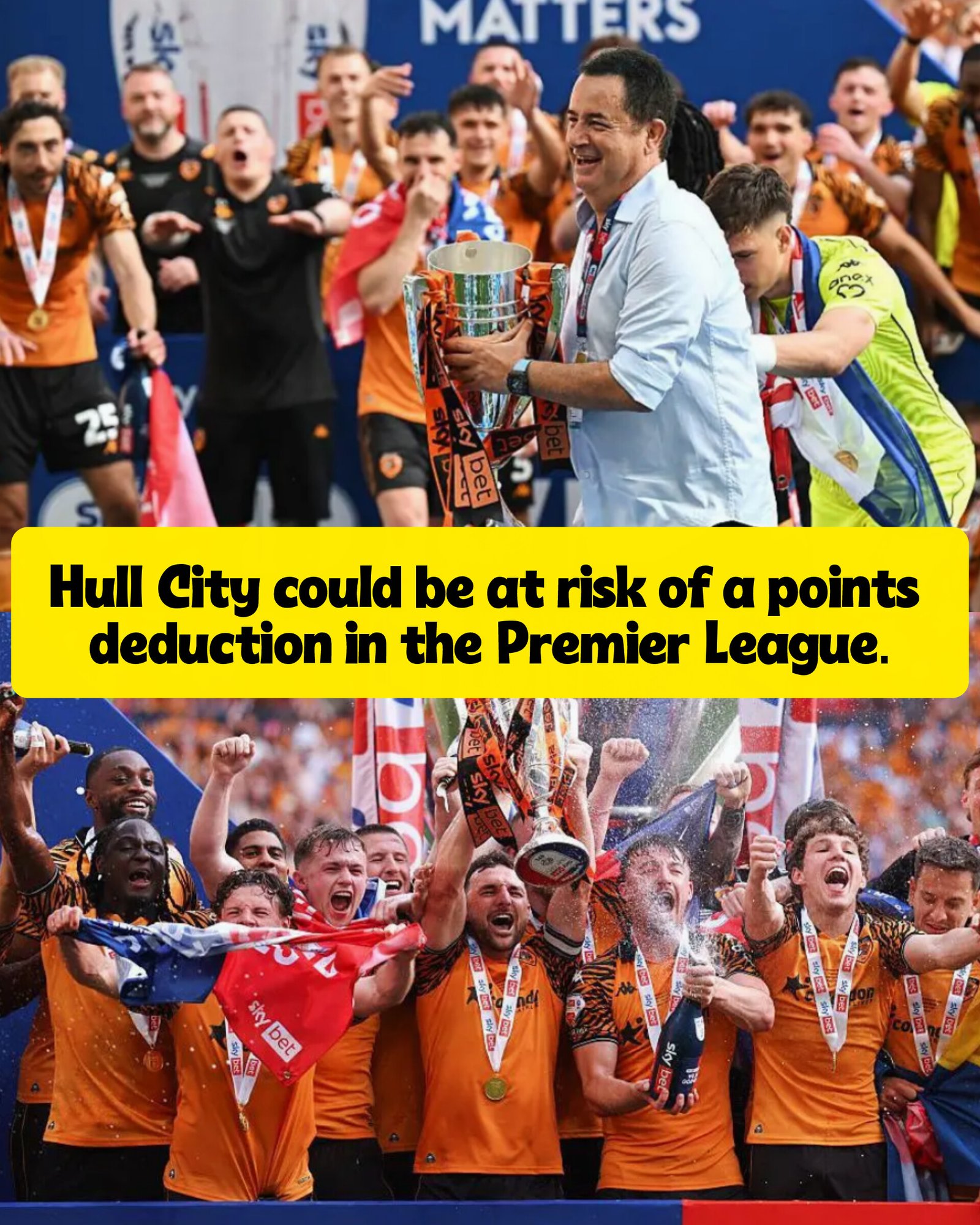
Hull City’s return to the Premier League should have been a moment of unbridled celebration after securing promotion through the Championship play-offs. The Tigers achieved their dream by defeating Middlesbrough 1-0 at Wembley, earning a place back among English football’s elite and unlocking the enormous financial rewards that accompany Premier League status.

Hull City were promoted to the Premier League for the fourth time in their history after beating Middlesbrough at Wembley
Promotion is expected to generate revenues worth around £200 million through broadcasting income, commercial opportunities, sponsorship growth, and parachute-related protections. Such a financial boost would ordinarily place a club in a strong position ahead of a new campaign.
However, despite securing a lucrative return to the top flight, Hull now find themselves facing an entirely different challenge. The club must raise funds through player sales before the end of the month in order to avoid falling foul of profit and sustainability regulations.
Failure to address the issue could result in a points deduction in the Premier League before the new season even gathers momentum.
The situation has created an unusual backdrop to what should be one of the most exciting summers in the club’s recent history.
Overspending Creates Immediate Pressure
At the centre of Hull’s concerns is an estimated overspend of approximately £6 million under profit and sustainability regulations, commonly known as PSR.

Acun Ilicali became owner of Hull City in 2022
According to current English Football League rules, exceeding permitted financial limits can trigger sporting sanctions, including points deductions.
The Tigers’ financial position means they are currently in danger of breaching the relevant thresholds, placing them at risk of entering the Premier League with a significant handicap.
Early assumptions suggested that promotion bonuses paid following the play-off final victory over Middlesbrough had contributed heavily to the overspend.
Those bonuses were activated as a direct consequence of Hull’s promotion and were initially believed to be a major factor in the club’s financial predicament.
However, further examination of the accounting treatment has revealed that those payments are effectively excluded from the PSR calculations for the season in which promotion is achieved.
As a result, Hull’s financial concerns were not created by Wembley success alone.
Instead, the club would have faced regulatory challenges regardless of whether they had secured promotion.
Premier League Fixture Release Comes Amid Uncertainty
When the Premier League fixtures are released, most promoted clubs will focus entirely on the excitement of discovering their opening opponents and mapping out the campaign ahead.
Hull City, however, have another issue demanding their attention.
Alongside anticipation about life back in the top division, there remains significant concern regarding their financial position and the possibility of sanctions.
The club’s leadership team must now balance preparations for Premier League football with the urgent need to improve their PSR position.
This creates a difficult situation in which financial management becomes just as important as football planning.
The coming weeks are therefore crucial.
Financial Expert Explains Hull’s Position
Football finance specialist Kieran Maguire has provided insight into how Hull arrived at their current situation.
According to Maguire, the club’s recent losses appeared relatively manageable on the surface.
However, that apparent stability was heavily dependent on successful transfer activity.
Hull generated approximately £33 million through the sales of winger Jaden Philogene and defender Jacob Greaves, transactions that played a significant role in balancing the books.
Without those sales, the financial picture would have looked considerably worse.
Maguire explained that Hull recorded losses of just under £19 million during the 2023-24 financial period.
This was followed by losses of around £10 million in 2024-25.
Although those figures might seem substantial, they become even more concerning when projected forward into the most recent cycle.
After accounting for the allowable exclusions relating to infrastructure projects, academy investment, and community programmes, Hull’s overspend for 2025-26 is estimated to be in the region of £17 million.
That figure places the club in a difficult position regarding compliance with spending regulations.
Acun Ilicali Admits Sales Are Necessary
Hull owner Acun Ilicali has been unusually open about the challenge facing the club.
Rather than downplaying the issue, he publicly acknowledged that action must be taken before the start of July.
Speaking during a question-and-answer session at the MKM Stadium earlier this month, Ilicali made it clear that player sales are required.
He admitted that the club has exceeded the permitted limits and must generate income through transfers before the financial deadline arrives.
Despite the seriousness of the situation, Ilicali struck a confident tone.
He insisted that the challenge is manageable and pointed to the increased market value of Hull’s players following promotion to the Premier League.
According to the owner, top-flight status has significantly enhanced the worth of several squad members, creating opportunities to raise the necessary funds.
His confidence suggests that the club believes solutions are available, although time remains a significant factor.
Public Admission May Have Reduced Negotiating Power
While Ilicali’s honesty was appreciated by many supporters, it may have come at a cost.
By openly stating that Hull must sell players before a specific deadline, he effectively informed potential buyers that the club is under pressure.
In transfer negotiations, urgency can weaken a seller’s position.
Interested clubs may now feel they have greater leverage, knowing Hull are working against the clock.
This could make it more difficult for the Tigers to secure maximum value for their players.
The owner’s comments have therefore created a delicate situation.
Hull need sales, but they also need those deals to generate sufficient profit to address their PSR concerns.
Achieving both objectives simultaneously will require careful negotiation.
Promotion Achieved Despite Restrictions
Hull’s promotion campaign was already remarkable given the circumstances under which it was achieved.
The club entered the season operating under significant recruitment restrictions.
As punishment for late transfer payments owed to other clubs, Hull were limited to signing free agents and loan players throughout the 2025-26 campaign.
Those restrictions made squad building considerably more challenging.
Despite the limitations, the Tigers managed to defy expectations and secure promotion back to the Premier League.
The achievement was widely praised and demonstrated the effectiveness of both the coaching staff and recruitment team.
However, the success has not removed the financial consequences of previous decisions.
Instead, those issues continue to linger despite the club’s return to the top flight.
Not Every Sale Would Solve the Problem
One complication facing Hull is that only the profit generated from player sales contributes positively toward PSR calculations.
Selling a player does not automatically eliminate financial concerns.
The club must ensure that any transfer produces sufficient accounting profit to improve its regulatory position.
This narrows the range of options available.
Several influential players who contributed to promotion were on loan and therefore cannot be sold.
That group includes Joe Gelhardt, Amir Hadziahmetovic, John Lundstram, and Lewis Koumas.
Because they were not permanent members of the squad, their departures provide no financial benefit regarding PSR compliance.
Hull must therefore focus on players they own outright.
Key Players Hull Would Prefer to Keep
The club would naturally prefer not to lose some of the individuals most responsible for promotion.
Among them is Regan Slater, the midfielder who enjoyed an outstanding season and was voted both Players’ Player of the Year and Supporters’ Player of the Year.
At 26 years of age, Slater remains a central figure within the squad and would be difficult to replace.
Another important asset is central defender Charlie Hughes.
The 22-year-old has established himself as one of the brightest young talents at the club and has won consecutive Young Player of the Year awards.
Hull have previously rejected approaches for Hughes, underlining how highly they value him.
Goalkeeper Ivor Pandur is another player attracting attention.
The Croatian international has enhanced his reputation significantly and currently forms part of Croatia’s World Cup squad.
Interest in Pandur has grown accordingly, although Hull have shown reluctance to sell.
Potential Sales Could Ease Financial Pressure
While the club would prefer to retain its key performers, other players may be available.
Forward Kyle Joseph has attracted interest from several Championship clubs.
A successful transfer involving the 24-year-old could generate a substantial portion of the £6 million required to improve Hull’s PSR position.
The Tigers are also reportedly willing to consider offers for several other members of the squad.
David Akintola, Abu Kamara, and Kasey Palmer are among those who could depart if suitable proposals arrive.
Kamara and Palmer both spent the latter stages of the season away from Hull on loan at Getafe and Luton Town respectively.
Their futures remain uncertain, making them potential candidates for permanent exits.
The club hopes that a combination of such sales can generate the required funds without weakening the core of the squad.
Understanding the Points Deduction System
Current PSR regulations operate according to a structured penalty framework.
Any club exceeding the permitted spending threshold risks receiving a points deduction.
The severity of the punishment depends on the scale of the breach.
An overspend of less than £2 million triggers a three-point deduction.
Breaches between £2 million and £4 million result in four points being deducted.
Overspending between £4 million and £6 million leads to a five-point penalty.
Meanwhile, clubs exceeding the limit by between £6 million and £8 million face a six-point deduction.
Hull’s current position places them within the range that could trigger the maximum six-point sanction under this framework.
Mitigation Appears Unlikely
Clubs can sometimes reduce the severity of penalties through mitigation.
If financial records demonstrate improving trends and responsible management, one or two points can occasionally be restored.
Unfortunately for Hull, this route appears unavailable.
The club’s projected losses for 2025-26 are higher than those recorded in 2024-25.
As a result, their financial trajectory does not support arguments for leniency.
This means Hull must focus on preventing a breach rather than relying on mitigation after the fact.
Leicester Case Created New Precedent
Leicester City’s recent experience provides a clear warning.
In 2024, Leicester successfully avoided punishment by arguing that the Premier League lacked jurisdiction over certain financial breaches.
That legal challenge exposed weaknesses within the regulatory framework.
In response, both the Premier League and EFL introduced reciprocal clauses designed to prevent similar loopholes.
The effectiveness of those changes was demonstrated earlier this year.
Leicester were subsequently punished for overspending, with the EFL applying a six-point deduction during the Championship season.
That penalty ultimately contributed to the club’s relegation.
The precedent suggests Hull cannot expect to avoid sanctions through technical arguments.
New Financial System on the Horizon
Adding another layer of complexity is the imminent replacement of PSR.
From 1 July, football authorities will introduce a new financial framework known as the Squad Cost Ratio system.
Rather than examining losses over a rolling three-year period, the new model focuses on annual spending.
Clubs will be permitted to allocate up to 85 percent of the income they generate toward squad costs.
The system is intended to provide greater clarity and encourage sustainable spending.
However, Hull must still resolve their existing PSR issues before transitioning to the new framework.
Possibility of Legal Challenges From Rivals
Even if Hull secure promotion and avoid sanctions, further complications could emerge.
Recent legal developments have shown that clubs adversely affected by financial breaches may seek compensation.
Everton were recently ordered to pay Burnley £35 million following a case connected to spending rule violations.
Meanwhile, Leeds United are exploring legal options relating to Leicester’s historic breaches.
Hull’s promotion rivals could potentially examine similar avenues.
Middlesbrough lost to the Tigers in the play-off final.
Millwall were eliminated in the semi-finals.
Wrexham and Derby County narrowly missed out on a play-off place altogether.
Should Hull eventually be found in breach of regulations, questions may arise regarding the impact on those clubs.
Race Against Time for Hull City
The reality is simple.
Hull City have only a short period in which to raise the necessary funds and improve their financial position.
Failure to do so could result in a points deduction, potential legal scrutiny, and a cloud hanging over their long-awaited Premier League return.
Promotion delivered enormous rewards and excitement.
Now the challenge is ensuring that financial difficulties do not overshadow one of the greatest achievements in the club’s recent history.
The next few weeks may prove just as important as anything that happened at Wembley.
-
 Blog7 months ago
Celtic issues a fiery VAR statement after Trusty’s red card appeal is dismissed, as furious chiefs release referee audio publicly.
-

 Blog1 week ago
Former official calls on SFA to contact Rangers over fan scenes during Celtic match, labeling them “completely unacceptable.”
-

 Blog7 months ago
Celtic informed their January signing under Martin O’Neill that he wouldn’t play a single minute this season.
-

 Blog7 months ago
Celtic issued an £83 million warning amid looming UEFA threats.
-

 Blog7 months ago
SFA Expected to Review Missed Penalty in Rangers v Celtic Clash
-

 Blog6 months ago
Police respond after reported disorder following Middlesbrough vs Millwall clash
-

 Blog1 year ago
“Courtside to Aisle-Side: Tyrese Haliburton and Jade Jones Set New Wedding Date”
-

 Blog7 months ago
£6m star is looking to leave Rangers this summer and has already announced his next club publicly.