
Blog
Keith Hackett comments on the crucial penalty dispute in the Celtic versus Hearts match, related to the Celtic points deduction.

Hackett Backs Celtic Penalty Decision Against Hearts
Former PGMOL chief and ex-FIFA referee Keith Hackett believes referee Don Robertson and the VAR team made the correct decision in awarding Celtic a first-half penalty during the dramatic Premiership clash against Hearts at Celtic Park.
The controversial incident became one of the major talking points from Saturday’s title-deciding encounter on 16 May, with Hearts supporters furious after the officials pointed to the spot following a handball by Alexandros Kyziridis.
Hackett, however, insists the decision was fully justified under the current interpretation of the handball laws and explained why the officials had little option but to award the penalty kick.
The former referee shared his verdict while speaking exclusively to Football Insider, where he analysed the controversial moment and Robertson’s overall performance during a hugely emotional afternoon at Celtic Park.
Hearts Strike First Through Lawrence Shankland
The atmosphere inside Celtic Park had already reached fever pitch before the key handball incident occurred.
Hearts captain Lawrence Shankland stunned the home support in the 43rd minute when he headed the visitors into the lead.
The striker rose above the Celtic defence to power home the opener and temporarily silence the packed stadium, leaving Hearts dreaming of a famous result that could potentially disrupt Celtic’s title celebrations.
For several minutes, the visitors looked in control and confident as Celtic attempted to respond before the break. However, the momentum of the contest shifted dramatically just six minutes later following the controversial penalty award.
Kyziridis Penalised For Handball
The decisive moment arrived when Kyziridis attempted to slide across and block a dangerous Celtic cross inside the penalty area.
As he moved to stop the delivery, the ball struck his arm, prompting Robertson to immediately point toward the penalty spot.
The decision instantly divided opinion among supporters and pundits, with Hearts players protesting furiously while Celtic fans celebrated the opportunity to level the match before half-time.
VAR conducted a review of the incident but ultimately agreed with Robertson’s on-field decision, confirming the penalty for the home side.
While many Hearts supporters argued the defender was unlucky because he was attempting to block the cross naturally, Hackett insisted the officials had interpreted the law correctly.
Keith Hackett Explains Why The Officials Were Correct
Hackett stated that the handball law continues to create controversy because of the amount of subjectivity involved in interpreting incidents.
According to the former FIFA referee, officials must consider several important questions before deciding whether a handball offence has taken place.
Hackett explained that referees are required to determine whether a player’s body shape has become unnaturally larger and whether there has been any movement of the hand or arm toward the ball.
In Kyziridis’ case, Hackett believed both criteria were met.
He explained that Robertson judged the Hearts defender’s arm to be positioned unnaturally while also identifying movement of the arm toward the path of the ball.
Although Hackett acknowledged the defender was attempting to close down the attacker and prevent the cross from entering the area, he still felt the referee had made the right call based on the current laws of the game.
The former official admitted the incident highlighted why handball decisions continue to spark fierce debate across football, but he stressed that the final outcome was correct in his opinion.
Hackett also pointed out that defenders often find themselves unfortunate in these situations because split-second movements can still lead to punishments even without clear intent to handle the ball deliberately.
Nevertheless, he maintained that the laws are designed to penalise players whose arm positions create a larger blocking area, and that is ultimately why the penalty was awarded.
Handball Law Still Causing Debate
The controversial moment once again reignited discussions surrounding the interpretation of handball offences in modern football.
Hackett has repeatedly spoken about the confusion surrounding the law and believes the wording still leaves too much room for interpretation by officials.
Supporters, players and managers frequently disagree over what should or should not constitute punishable handball because different incidents are interpreted differently depending on arm position, movement and body shape.
The former referee suggested that Kyziridis was unfortunate because the action happened naturally while attempting to block the cross, but he stressed that referees are instructed to judge whether the player’s arm creates an unfair barrier.
In this situation, Robertson decided it did, and Hackett supported that judgement completely.
The incident proved hugely significant in the context of the match, as Celtic converted the resulting penalty to level the score before eventually securing a dramatic victory later in the contest.
Robertson Criticised For Other Decisions
Although Hackett backed the referee over the penalty decision, he did not believe Robertson delivered a flawless performance overall.
The former official acknowledged there were several other incidents throughout the match that frustrated both Celtic and Hearts supporters.
One of the main criticisms involved Robertson’s reluctance to issue yellow cards during several heated moments.
Despite the intensity and importance of the title-deciding fixture, the referee attempted to keep his cards in his pocket for much of the game.
Hackett noted that both Alistair Johnston and Callum McGregor were fortunate not to receive earlier bookings before eventually being cautioned later in the contest.
Fans from both clubs questioned the consistency of the referee’s disciplinary approach, particularly during moments when tensions threatened to boil over on the pitch.
Injury Incident Sparked Further Frustration
Another controversial moment arrived following an injury to Hearts midfielder Beni Baningime.
The midfielder appeared to suffer a hamstring injury during the game, prompting Celtic striker Kelechi Iheanacho to stop play so medical staff could enter the field.
After Baningime received treatment, it quickly became obvious that he would not be able to continue playing and required replacing.
Many supporters inside Celtic Park expected Robertson to instruct the injured midfielder to leave the pitch using the nearest exit point in order to restart play as quickly as possible.
Instead, the referee allowed Baningime to slowly walk across a large section of the field before leaving the pitch.
That decision frustrated many Celtic supporters, who loudly voiced their anger as they felt valuable time was being wasted during a tense stage of the match.
The incident added further pressure on Robertson during an already emotionally charged encounter.
Drama Filled Afternoon At Celtic Park
The match itself developed into one of the most dramatic fixtures of the Premiership season.
With the title race reaching its conclusion, every major decision carried enormous importance and scrutiny.
Robertson therefore found himself under intense pressure throughout the afternoon as Celtic chased another league title while Hearts attempted to spoil the celebrations.
Hackett ultimately concluded that, despite some questionable game-management moments, the officials still deserved credit for correctly handling the biggest decision of the match — the handball penalty against Kyziridis.
The former FIFA referee reiterated that the current handball law continues to generate controversy because of the level of interpretation involved, but in this particular case, he felt Robertson and VAR arrived at the correct conclusion.
Even though Hearts supporters may continue to feel aggrieved by the incident, Hackett’s verdict was clear: under the laws of the game as they currently stand, Celtic were rightly awarded their crucial first-half penalty at Celtic Park.
Keith Hackett outlines whether Celtic could face points deduction after Hearts pitch invasion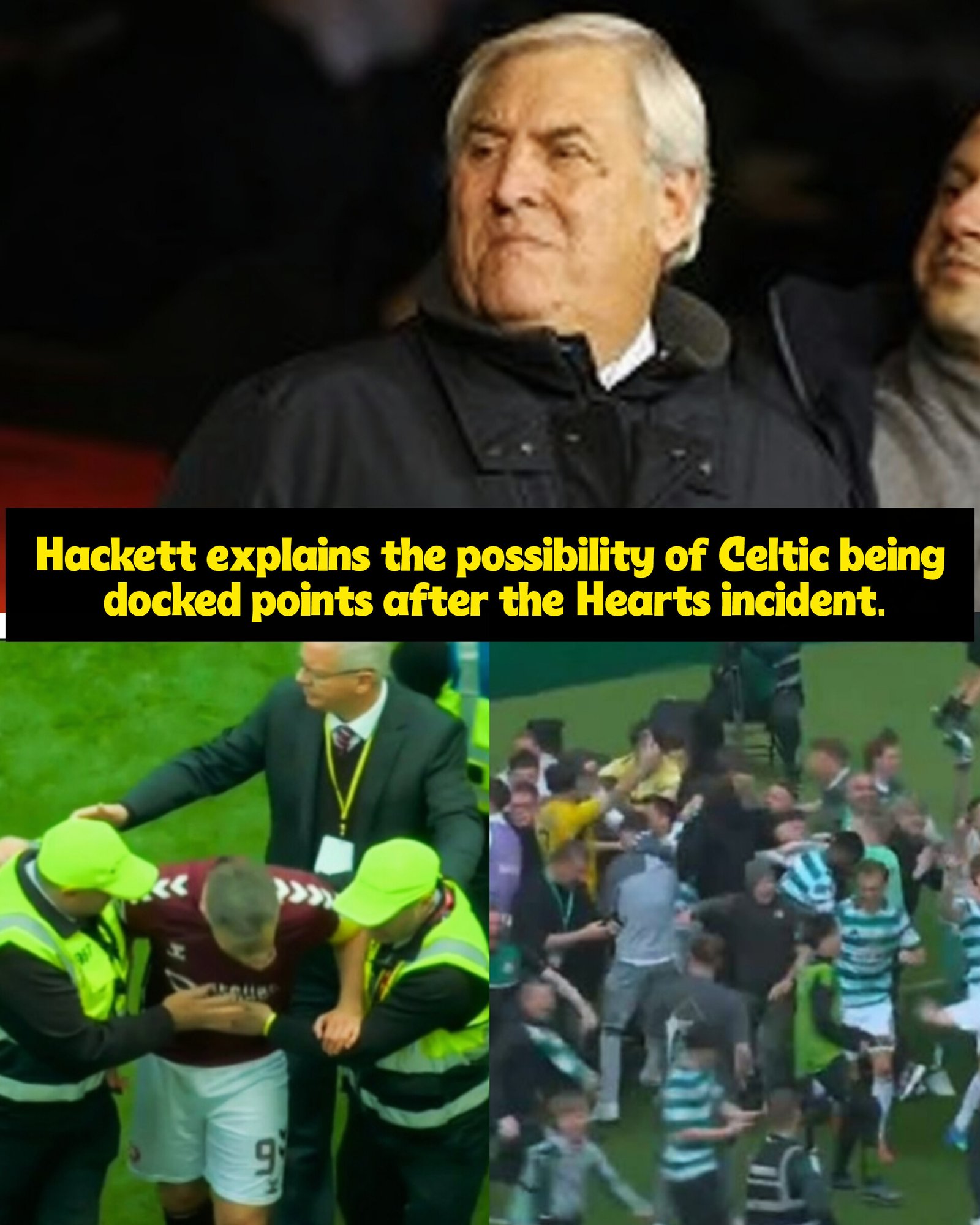
Former PGMOL chief Keith Hackett believes the Scottish FA may eventually be forced to consider harsher punishments — including a possible points deduction — after Celtic supporters invaded the pitch during the dramatic title-clinching clash against Hearts.
Scenes of chaos unfolded at Celtic Park following the late goals that secured the Scottish Premiership title for Celtic, with supporters spilling onto the field before the match had officially concluded.
The controversy has now intensified debate surrounding crowd control in Scottish football, particularly after similar incidents earlier in the season.
Hackett, speaking about the situation, warned that football authorities may soon have little choice but to adopt more serious disciplinary measures if repeated pitch invasions continue taking place.
Celtic supporters sparked chaotic scenes at Celtic Park
The dramatic atmosphere inside Celtic Park reached another level during Saturday’s title decider against Hearts.
With emotions running high and the league championship on the line, supporters erupted when Daizen Maeda appeared to score what many believed was the decisive goal in the closing stages of the match.
The excitement only increased moments later when Callum Osmand added a third goal, effectively sealing the title and triggering wild celebrations throughout the stadium.
As fans celebrated, large numbers surged onto the pitch, creating confusion among players, officials and supporters alike.
The invasion came only weeks after ugly scenes followed Celtic’s Scottish Cup final victory over Rangers back in March.
Following that earlier incident, the club had already been warned that further crowd trouble could lead to stronger disciplinary action from the Scottish FA.
Despite those warnings, the emotional significance of Saturday’s title victory appeared to overwhelm many supporters inside the stadium.
Hackett says financial punishments are no longer enough
Hackett believes football authorities must now examine whether current punishments are actually working as a deterrent.
The former FIFA referee explained that repeated financial penalties have done little to prevent fans from entering the pitch during emotionally charged moments.
According to Hackett, the Scottish FA will now need to carefully review the latest incident and decide whether more forceful action is necessary moving forward.
He suggested that authorities should work closely with Celtic in an attempt to improve stadium security and reduce the likelihood of similar incidents happening again.
One possible solution, Hackett said, would involve increasing the number of security personnel positioned around the perimeter of the pitch during major matches.
The goal would be to strengthen barriers between supporters and the field of play before situations escalate.
However, Hackett also warned that if authorities believe clubs are failing to control repeated invasions, then stronger sanctions may become unavoidable.
Former referee raises possibility of points deduction
Perhaps most significantly, Hackett suggested the Scottish FA may eventually consider imposing sporting punishments rather than relying solely on fines.
He outlined two major sanctions that could potentially be discussed by football authorities in future disciplinary meetings.
The first would involve forcing clubs to play matches behind closed doors with no supporters allowed inside the stadium.
Such punishments have occasionally been used across European football in response to crowd trouble and disorder.
The second possibility, according to Hackett, would be the “ultimate sanction” of a points deduction.
That type of punishment would represent an enormous escalation and could have major sporting consequences in title races or relegation battles.
Hackett stressed that football authorities cannot simply ignore repeated pitch invasions because they create serious safety risks for players, coaching staff and match officials.
In his view, Scottish football must now decide whether current disciplinary measures are sufficiently strong to protect everyone involved.
Confusion surrounded the final whistle
The pitch invasion also created major confusion regarding the actual ending of the match itself.
Many inside Celtic Park were uncertain whether referee Don Robertson had officially blown the final whistle before supporters entered the pitch.
The situation became even more chaotic after Hearts goalkeeper Zander Clark had moved forward in search of a late equaliser, leaving his own goal exposed.
Celtic capitalised by scoring into the empty net, prompting huge celebrations around the stadium.
Almost immediately afterward, supporters flooded onto the field from multiple sections of the ground.
With fans surrounding large parts of the pitch, it quickly became impossible for normal match procedures to continue.
Questions then emerged regarding whether Robertson had officially restarted play before ending the match.
Hackett backs referee Don Robertson’s handling of incident
Despite the confusion, Hackett strongly defended referee Don Robertson and praised the way he handled an extremely difficult situation.
The former official said Robertson had produced an excellent performance throughout the match and would likely have preferred to restart the game properly before blowing for full-time under normal circumstances.
However, Hackett argued that the scale of the pitch invasion left the referee with virtually no realistic options.
With supporters covering large sections of the playing surface, Robertson was unable to safely reposition players for a restart at the halfway line.
Hackett explained that the referee simply had no opportunity to regain control of the environment because of the disorder unfolding around him.
Given the circumstances, he fully supported Robertson’s decision to effectively end proceedings amid the chaos.
The former PGMOL chief also pointed out that Scottish FA officials would have been present at Celtic Park and would now conduct their own review into how events unfolded.
Scottish FA faces difficult decision
The latest controversy leaves the Scottish FA facing an increasingly difficult balancing act.
On one hand, emotional pitch invasions have long been part of football celebrations, particularly during title wins and major cup triumphs.
On the other hand, football authorities remain under growing pressure to prioritise player and official safety following repeated crowd incidents across the game.
Hackett’s comments reflect wider concerns that Scottish football may be approaching a point where existing punishments are no longer viewed as effective deterrents.
The possibility of points deductions or closed-door matches would represent a major shift in how authorities deal with crowd disorder.
For Celtic, the incident threatens to overshadow what should have been a celebratory occasion after another dramatic title triumph.
The club now waits to discover whether the Scottish FA will decide further disciplinary action is necessary following the scenes at Celtic Park.
Meanwhile, debate continues over where football should draw the line between passionate celebrations and unacceptable crowd behaviour.
-
 Blog7 months ago
Celtic issues a fiery VAR statement after Trusty’s red card appeal is dismissed, as furious chiefs release referee audio publicly.
-
 Blog1 week ago
Former official calls on SFA to contact Rangers over fan scenes during Celtic match, labeling them “completely unacceptable.”
-

 Blog7 months ago
Celtic informed their January signing under Martin O’Neill that he wouldn’t play a single minute this season.
-
 Blog7 months ago
Celtic issued an £83 million warning amid looming UEFA threats.
-
 Blog7 months ago
SFA Expected to Review Missed Penalty in Rangers v Celtic Clash
-

 Blog6 months ago
Police respond after reported disorder following Middlesbrough vs Millwall clash
-

 Blog1 year ago
“Courtside to Aisle-Side: Tyrese Haliburton and Jade Jones Set New Wedding Date”
-
 Blog7 months ago
£6m star is looking to leave Rangers this summer and has already announced his next club publicly.