
Blog
Proposed FIS Alpine Ski World Cup calendar could reshape overall title battle for Marco Odermatt and Mikaela Shiffrin

The proposed 2026–27 FIS World Cup calendar introduces subtle but meaningful adjustments that could significantly influence the race for the overall titles, particularly for leading figures like Marco Odermatt and Mikaela Shiffrin. While the fundamental four-discipline structure of alpine skiing remains unchanged, the redistribution of events within that framework has the potential to alter how points are accumulated across the season.
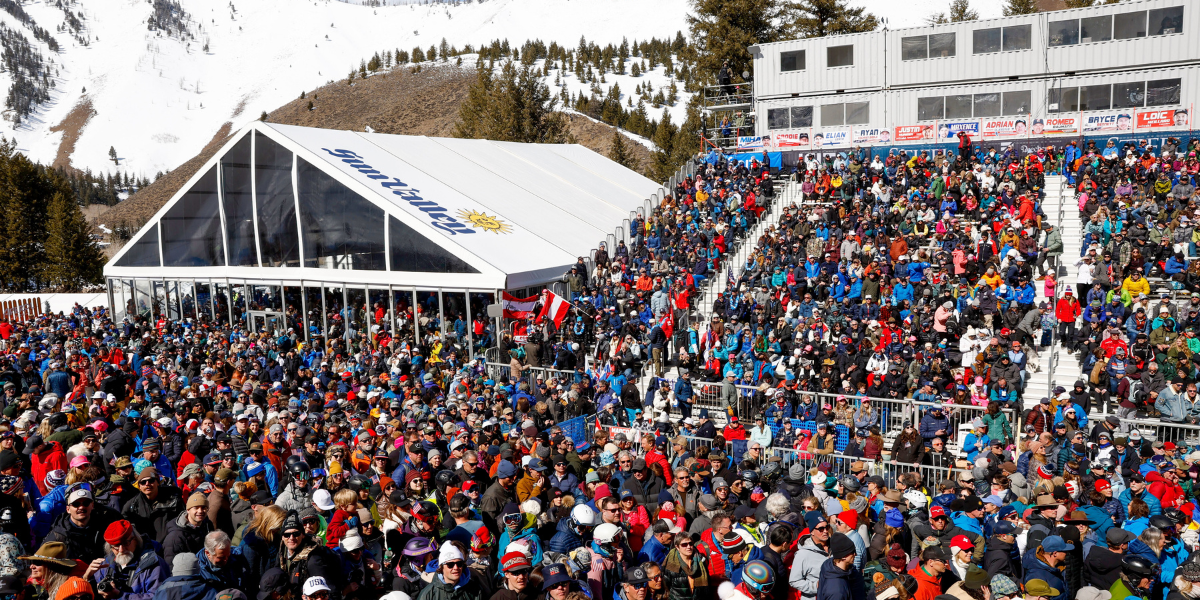
Women’s calendar shifts balance between disciplines
In the draft version of the women’s World Cup schedule, the total number of races stands at 39. Within that number, there is a noticeable shift toward technical events. Specifically, the calendar features 22 technical races, made up of 10 slaloms and 12 giant slaloms, compared to 18 speed races.
This adjustment is largely driven by the addition of two extra giant slalom races, representing a 20 percent increase in that discipline. There is also a smaller increase in super-G races, with one additional event marking a 12.5 percent rise. Slalom, however, remains unchanged at 10 races, which means its relative importance decreases slightly as other disciplines expand.
It is important to note that the calendar is still provisional. Several venues are listed as TBC (to be confirmed), indicating that final approval has not yet been granted and further changes could still occur.
Implications for Shiffrin and Emma Aicher
This redistribution of races creates a new dynamic in the overall standings, particularly for athletes with different strengths across disciplines.
Mikaela Shiffrin continues to stand out as one of the most accomplished technical skiers in the sport. Slalom remains a major component of the calendar with 10 races, but it no longer holds equal weight alongside giant slalom, which now plays a larger role due to its expanded schedule.
As a result, consistent performance in giant slalom becomes increasingly important. While Shiffrin has proven herself as a winner in GS, maintaining that level of excellence across a greater number of races will be essential if she is to remain competitive in the overall standings.
Emma Aicher, meanwhile, enters the equation from a different perspective. The German skier has been developing into a strong competitor in speed events while also earning points in technical disciplines. The increase in both giant slalom and super-G races directly benefits her, providing more opportunities to capitalize on her well-rounded skill set.
Even so, Shiffrin’s ability to win races and build momentum means she remains a formidable contender whenever she is fully fit. Her track record ensures she is never easily discounted, regardless of how the calendar is structured.
Strong North American presence in women’s schedule
The proposed calendar also highlights a significant presence of races in North America, with multiple events scheduled across both the United States and Canada.
The early part of the season is set to begin in Killington Resort, where both giant slalom and slalom races offer immediate opportunities for athletes to collect points. The tour then moves north to Mont-Tremblant Resort, where additional giant slalom races extend the early-season opportunities to build momentum.
Later in the schedule, attention shifts to Beaver Creek Resort, which is listed as TBC. If confirmed, it would host speed races, providing a crucial test in downhill and super-G before the circuit returns to Europe.
Season finale returns to Sun Valley Resort
The season is scheduled to conclude with the World Cup Finals in Sun Valley, requiring athletes to travel back to North America for the closing events.
At that stage, the distribution of races across disciplines becomes particularly significant. Skiers who have made the most of the expanded opportunities in giant slalom and super-G may arrive in a stronger overall position, while others will need to maximize their final starts to remain competitive.
Why the women’s calendar increases competition
If the current structure is maintained, the calendar does not heavily favor a single discipline. Instead, it redistributes importance across the four events, creating a more balanced but demanding competition.
Slalom continues to play a key role, but the expansion of giant slalom and super-G emphasizes the importance of versatility. Athletes who can consistently perform across multiple disciplines are likely to have an advantage.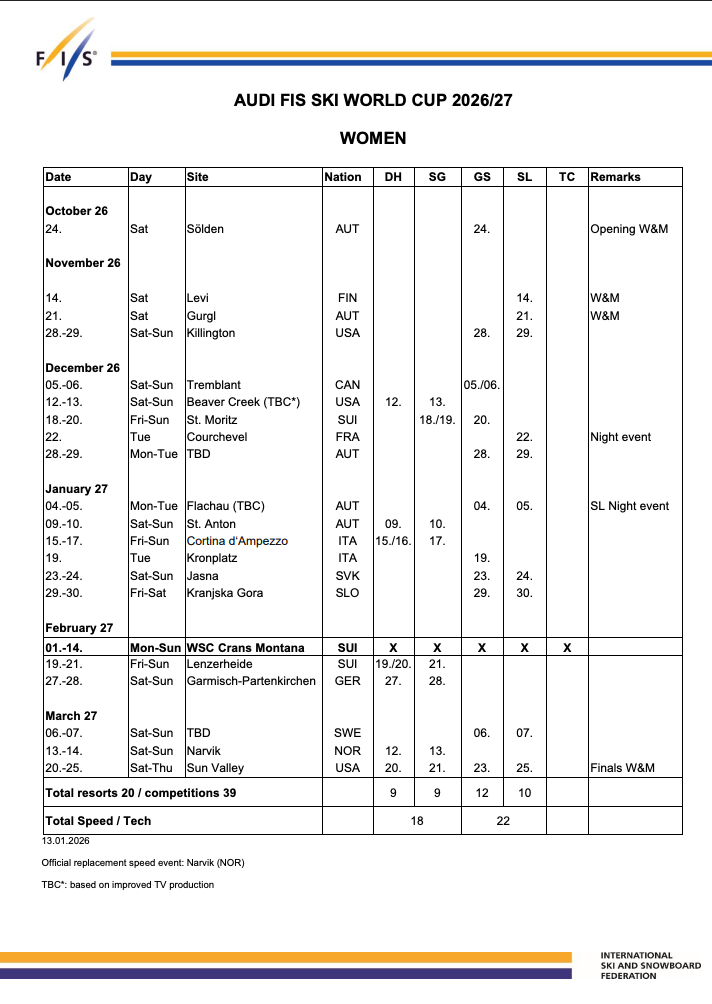
The overall effect is a tighter and more competitive race for the title, where success depends on sustained performance rather than dominance in just one area.
Men’s calendar introduces similar adjustments
The proposed men’s World Cup calendar follows a comparable pattern, introducing a slight shift that could influence how the overall standings develop.
In this case, the balance tilts toward technical races, with more opportunities in slalom and giant slalom compared to speed events. While the change is not drastic, it has important implications over the course of a full season.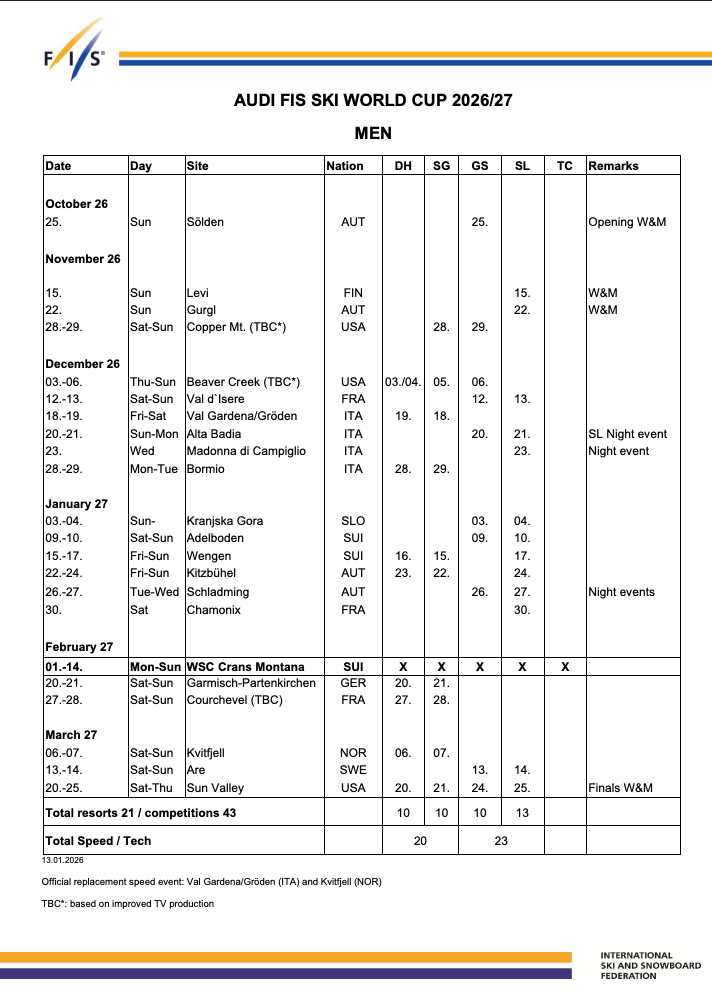
With additional technical races, specialists in those disciplines gain more chances to accumulate points. At the same time, the reduced number of speed races increases the importance of each result in downhill and super-G.
Impact on Marco Odermatt
This shift carries particular significance for Marco Odermatt, who has established himself as one of the dominant figures in alpine skiing.
The Swiss star excels in giant slalom, super-G, and downhill, consistently outperforming his rivals in those disciplines. However, the revised balance means that competitors who participate in slalom will have more opportunities to close the gap.
While this does not place Odermatt at a direct disadvantage, it does reduce the margin that has separated him from the rest of the field in recent seasons. More slalom races allow his challengers to respond more effectively and remain within striking distance in the standings.
As a result, each race becomes more critical for Odermatt, particularly given the reduced number of speed events where he has traditionally built his advantage.
United States plays key role in men’s schedule
The men’s calendar also places considerable emphasis on races in the United States, with up to six events planned across three major venues.
The North American segment begins at Copper Mountain, which is currently listed as TBC. If confirmed, it would provide an additional early-season technical race, offering athletes another chance to score points before the schedule settles into its usual rhythm.
From there, the focus shifts once again to Beaver Creek, where downhill and super-G races form a key part of the early speed season. Given the reduced number of speed events overall, strong performances at this stage become even more important.
Finals return to Sun Valley
As with the women’s schedule, the men’s season is set to conclude with the World Cup Finals in Sun Valley. This requires athletes to make a second trip to the United States late in the season, adding another layer of complexity to the calendar.
Managing travel, recovery, and performance levels becomes crucial at this stage, particularly as the final races often determine the outcome of the overall standings.
Athletes who have capitalized on the increased number of technical races may arrive at the finals with an advantage, while those relying on speed disciplines will need to maximize every remaining opportunity.
A tighter and more demanding overall race
Although the calendar is still subject to change, its current structure points toward a more competitive and closely contested season.
The combination of fewer speed races and more technical events creates a dynamic where consistency across disciplines is increasingly important. Each race carries greater weight, and opportunities to build large leads are reduced.
For athletes like Odermatt and Shiffrin, this means maintaining high performance levels throughout the entire season will be essential. The margin for error becomes smaller, and the ability to adapt to the evolving balance of disciplines could prove decisive.
In summary, the proposed 2026–27 World Cup calendar does not fundamentally alter the structure of alpine skiing, but it does reshape the competitive landscape. By redistributing opportunities across disciplines, it creates a tighter, more demanding race for the overall titles—one that rewards versatility, consistency, and resilience over the course of the season.

About the Author: Peter Lange
Peter Lange currently serves as the Publisher of Ski Racing Media, bringing decades of experience and insight to the role. Over the course of 38 seasons, he built a long and respected career in coaching, working with athletes across all age groups and levels of ability.
Throughout his coaching journey, Lange gained extensive international experience. He led Team America and collaborated with national team athletes from several countries, including the United States, Norway, Austria, Australia, and Great Britain. His work at the elite level gave him a broad understanding of the sport and exposure to different training systems and competitive environments.
In addition to his international roles, Lange also held a key position within the U.S. development pathway. He served as the Head University Coach for the U.S. Ski Team during the two seasons that the program was active, contributing to the progression of young athletes transitioning into higher levels of competition.
Reflecting on his time in the sport, Lange emphasizes that its greatest value extends beyond results or achievements. He believes the relationships formed along the way are what truly matter, describing them as something that cannot be replaced.
-

 Blog7 months ago
Celtic issues a fiery VAR statement after Trusty’s red card appeal is dismissed, as furious chiefs release referee audio publicly.
-

 Blog3 weeks ago
Former official calls on SFA to contact Rangers over fan scenes during Celtic match, labeling them “completely unacceptable.”
-

 Blog8 months ago
Celtic informed their January signing under Martin O’Neill that he wouldn’t play a single minute this season.
-

 Blog7 months ago
Celtic issued an £83 million warning amid looming UEFA threats.
-

 Blog7 months ago
SFA Expected to Review Missed Penalty in Rangers v Celtic Clash
-

 Blog6 months ago
Police respond after reported disorder following Middlesbrough vs Millwall clash
-

 Blog2 weeks ago
Middlesbrough receive a warning following Steve Gibson’s submission of a £1.5bn proposal.
-

 Blog1 year ago
“Courtside to Aisle-Side: Tyrese Haliburton and Jade Jones Set New Wedding Date”