
Blog
Rangers’ striker Shankland is expected to be sidelined for up to four months and may require surgery.

Rangers have suffered a major injury setback with captain Lawrence Shankland facing a potential absence of up to four months after suffering a hamstring tear, while the striker could also require surgery to repair the problem.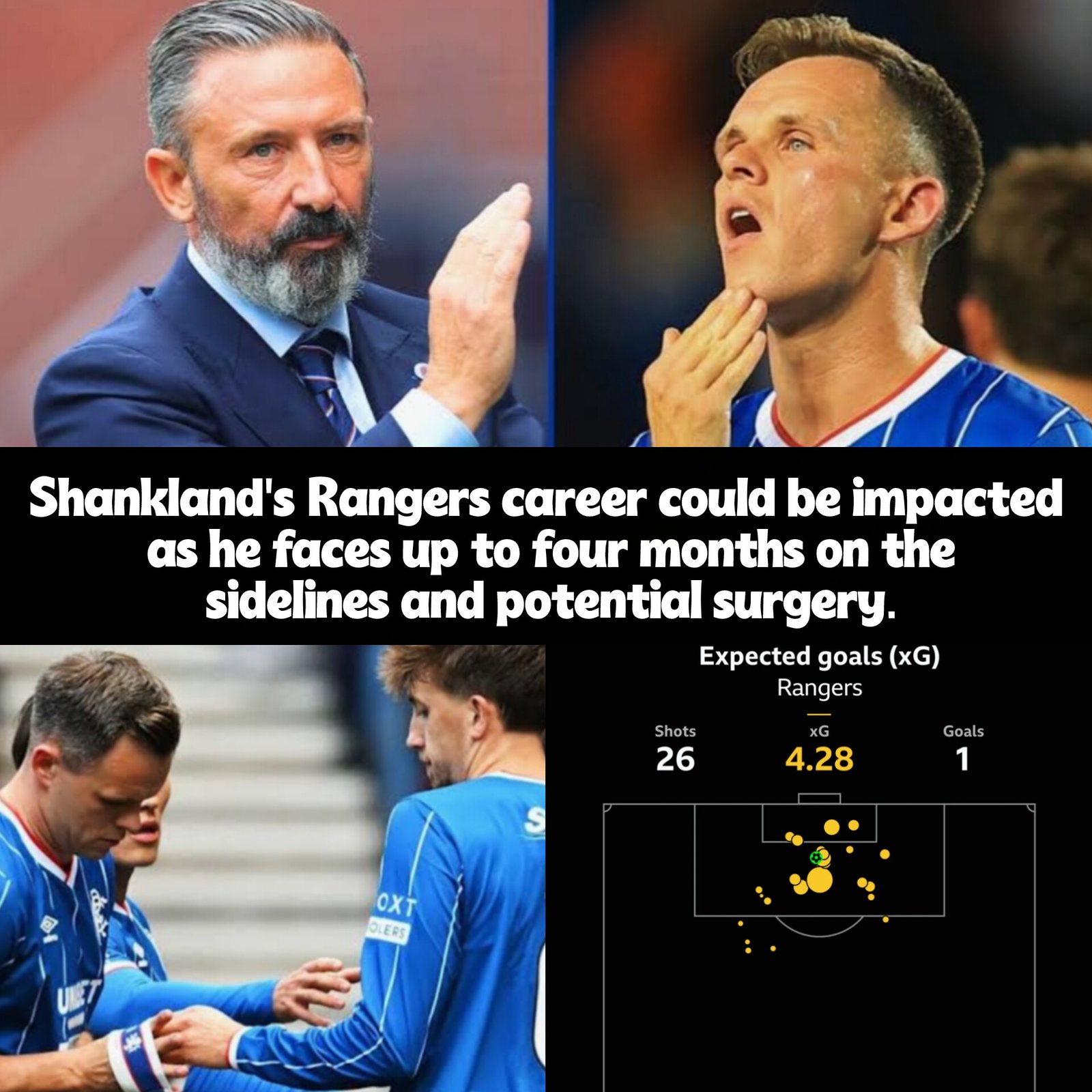
Rangers manager Derek McInnes confirmed the disappointing news ahead of Wednesday night’s Scottish Premiership fixture against St Mirren, revealing that his 31-year-old captain has suffered a recurrence of the hamstring injury he experienced during his time at Hearts last season.
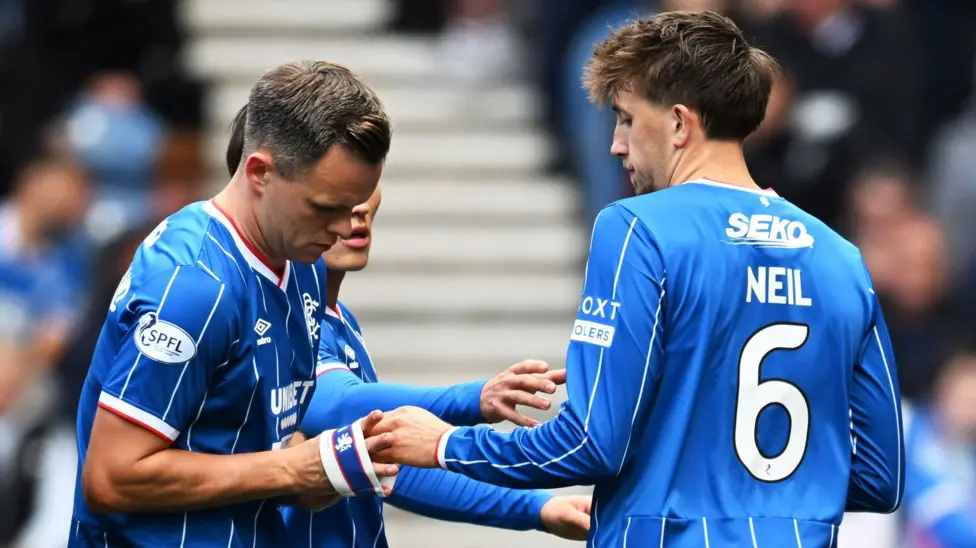
Lawrence Shankland handed the Rangers armband to Dan Neil on Saturday
Shankland previously missed around nine weeks after suffering a similar problem in January, and Rangers are now waiting to discover whether he will require another period of rehabilitation followed by surgery or whether the injury can recover naturally.
The Scotland international has made an encouraging start to his Rangers career this season, scoring four goals in 10 appearances. However, he was forced off early during Saturday’s 1-0 Premiership victory over Motherwell.
Ryan Naderi replaced him during that match and ultimately became the match-winner, scoring the only goal of the game.
McInnes explained that medical examinations had identified a two-centimetre tear in Shankland’s hamstring, which is understood to be very similar to the injury he sustained while at Hearts earlier this year.
“He’s had a tear, it’s a 2cm tear in his hamstring so similar, very similar to the one he did previously at Hearts in January,” McInnes said.
Shankland has subsequently travelled to London to undergo further medical assessment. The additional ultrasound scan is intended to help a specialist determine the best course of treatment.
McInnes explained that Rangers will have to wait for the specialist’s opinion before knowing whether surgery is necessary.
“He’s actually in London now, he’s getting an ultrasound scan, a follow-up scan which is just to determine with the specialist whether he has surgery or whether we just let that heal naturally, as it did the last time,” the Rangers boss explained.
The manager admitted that surgery would potentially extend Shankland’s recovery by another three or four weeks, but there could also be a long-term benefit because an operation might reduce the likelihood of the injury recurring.
“If he has the surgery then he might be an extra three or four weeks but if he has the surgery then it lessens the risk of maybe it happening again,” McInnes said.
A final decision is expected within the next 48 hours.
Regardless of whether Shankland undergoes surgery, Rangers already know that they will be without one of their most important attacking players for a considerable period.
McInnes acknowledged the seriousness of the situation but insisted that the club would provide the striker with all the support he needs throughout his recovery.
“Unfortunately, for us and Lawrence, it’s a significant amount of time out and we just need to support him, as we do with all our injured players,” he said.
The Rangers manager also pointed out that Shankland had been beginning to settle into his role and was producing important goals for the club.
“He was starting to find his stride here and had obviously scored some important goals for us but that is football, unfortunately, the ups and downs of it,” McInnes added.
The initial expectation is that Shankland could be unavailable for around three months, with the longest projected absence stretching to approximately four months.
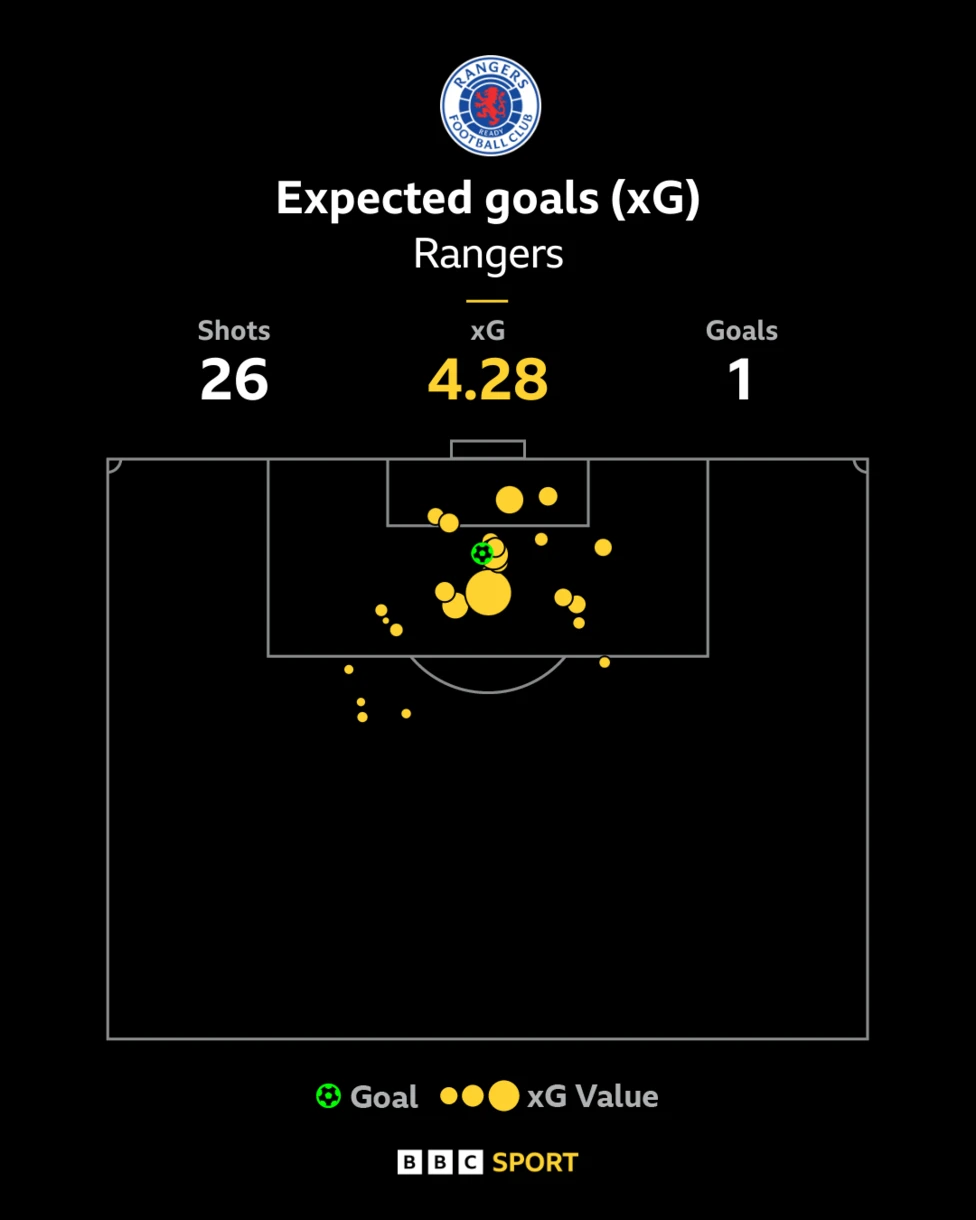
Rangers scored just once from an expected goals rating of 4.28 in Saturday’s win over Motherwell
“Best case scenario three months, probably worst-case scenario in terms of time would be about four months,” McInnes stated.
The injury is particularly unfortunate because Shankland will not only miss domestic fixtures for Rangers but is also likely to be unavailable for Scotland’s Nations League schedule between the end of September and the middle of November.
Scotland’s new head coach Sebastien Pocognoli has a series of important fixtures planned during that period, with his side due to meet North Macedonia, Slovenia and Switzerland both home and away.
Shankland has earned 22 international caps and has scored seven goals for Scotland, including three goals earlier this year.
His absence therefore represents a setback for both Rangers and the national team.
Rangers also have an extremely demanding schedule ahead. Following Wednesday’s game against St Mirren, they will face Celtic at Ibrox in the League Cup before travelling to Parkhead to meet their Old Firm rivals again in the league.
The first international break of the season will then follow, but Rangers face another busy period afterwards, with five matches scheduled for October, three in November and six more in December.
Meanwhile, Shankland is not the only Rangers player who will miss the St Mirren game.
Winger Daisuke Yokota, who appeared from the bench against Motherwell, has also been ruled out because of a groin problem.
There is some positive news on the defensive front, however, with left-back Tuur Rommens back in training and potentially in contention to return later this month.
No Shankland, no Chermiti – who will provide the goals?
Shankland’s injury has come at an especially difficult time for Rangers.
Before being forced off against Motherwell, the striker had scored three goals in his previous two matches, producing decisive contributions during victories over Aberdeen and Falkirk.
His absence would be significant at any stage of the campaign, but it becomes even more problematic because Rangers are already without fellow striker Youssef Chermiti.
Chermiti suffered anterior cruciate ligament damage during Rangers’ match against Hibernian last month and is expected to spend a lengthy period on the sidelines.
That leaves McInnes without the two forwards who were expected to provide a significant proportion of Rangers’ goals this season.
The Rangers boss admitted that losing both players represents a major blow.
“Having [Shankland] and Youssef out, two guys that guarantee you goals at Premiership level, there’s no doubt it’s a blow for us,” McInnes said.
Nevertheless, the manager believes the situation could provide opportunities for other members of his squad.
He pointed to Naderi’s contribution against Motherwell, as well as the introduction of Kevin Kelsy, while also highlighting the experience of Bojan Miovski.
“Their disappointment’s other people’s opportunity as you’ve seen even from Saturday – Ryan getting his goal, Kevin [Kelsy] getting introduced, we’ve got Bojan Miovski, who knows his way about the Scottish Premiership, so it’s not all doom and gloom on that front but it is disappointing news,” McInnes explained.
Rangers deserved their victory over Motherwell, although the scoreline did not fully reflect the number of opportunities created by the home side.
The Ibrox club could have scored more comfortably had they been more clinical in front of goal.
Former Rangers midfielder Andy Halliday suggested that Shankland would likely have benefited from the chances created by his teammates.
“If Lawrence Shankland was on the pitch throughout, he’d be walking away with a couple of goals,” Halliday said on BBC Sportsound.
Naderi ultimately provided the decisive moment after capitalising on a costly mistake by Motherwell goalkeeper Alex Paulsen.
The striker took advantage of the error and calmly rolled the ball into an unguarded net.
Naderi is known for his work rate and willingness to contribute to the team’s overall performance, but the major question now is whether he can produce the consistent scoring numbers Rangers need during Shankland’s absence.
The forward scored three goals across 11 appearances following his arrival at Rangers in January last season.
Two of those goals came during the emphatic 8-0 Scottish Cup victory over lower-league Queen’s Park.
This season, Naderi has already scored three times in eight appearances, meaning he is currently just one goal behind Shankland’s total of four goals from 10 games.
His scoring record since arriving at Ibrox shows that he has averaged one goal every 189 minutes.
Shankland, meanwhile, has produced a goal every 146 minutes when his record is measured from the beginning of last season, including his time at Hearts.
Those figures demonstrate the scale of the challenge facing Rangers.
Among the strikers currently available to McInnes, Miovski arguably has the record that comes closest to matching Shankland.
The North Macedonia international has averaged a goal every 148 minutes, although he has struggled to secure a regular run in the Rangers starting lineup since arriving at the club.
His previous experience in Scottish football could now become extremely valuable, particularly with Rangers suddenly short of established goalscorers.
Kelsy will also be expected to play an important role following his arrival from Portland Timbers.
The Venezuela international had an excellent opportunity to make an immediate impression on his Rangers debut against Motherwell.
However, he was unable to convert the chance, with his effort striking the crossbar before going out of play.
It would be unfair to make any firm judgement on Kelsy based on one appearance, particularly as he is still adapting to Rangers and Scottish football.
However, his recent statistics suggest that he may not naturally be the prolific striker Rangers need to completely replace Shankland.
Kelsy has scored 13 goals in his last 46 matches, giving him an average of one goal every 190 minutes.
That record is some distance from the level Shankland has produced over an extended period.
Former Rangers goalkeeper Cammy Bell acknowledged that the situation is far from ideal for Kelsy because the club would originally have wanted to give him time to settle into his new surroundings.
“It’s not an ideal scenario,” Bell said on the BBC’s Scottish Football Podcast.
“They would have wanted to allow a little bit of time for Kelsy to find his feet in Scottish football and at Rangers. He’s not going to get that now.”
The pressure on Kelsy is therefore likely to increase significantly.
With Shankland and Chermiti both unavailable, Rangers cannot afford to wait too long for their new forward to adapt.
Bell believes Kelsy may now have to take on greater responsibility and produce important goals much sooner than expected.
“You’d think Kelsy is going to be the one that will have to step up to the plate and score important goals because you can’t rely on Shankland for now,” he added.
Rangers now face a difficult period without their captain and leading attacking threat.
McInnes will have to find a way to distribute Shankland’s goals among the other forwards in his squad, while hoping that Naderi, Miovski and Kelsy can collectively fill the considerable void.
With a demanding domestic schedule and international fixtures approaching, the next few months could prove crucial in determining how successfully Rangers cope without Shankland.
-
 Blog8 months ago
Celtic issues a fiery VAR statement after Trusty’s red card appeal is dismissed, as furious chiefs release referee audio publicly.
-

 Blog1 month ago
Former official calls on SFA to contact Rangers over fan scenes during Celtic match, labeling them “completely unacceptable.”
-

 Blog8 months ago
Celtic informed their January signing under Martin O’Neill that he wouldn’t play a single minute this season.
-
 Blog8 months ago
Celtic issued an £83 million warning amid looming UEFA threats.
-

 Blog8 months ago
SFA Expected to Review Missed Penalty in Rangers v Celtic Clash
-

 Blog7 months ago
Police respond after reported disorder following Middlesbrough vs Millwall clash
-

 Blog1 month ago
Middlesbrough receive a warning following Steve Gibson’s submission of a £1.5bn proposal.
-

 Blog1 year ago
“Courtside to Aisle-Side: Tyrese Haliburton and Jade Jones Set New Wedding Date”