
Blog
Scotland referee’s strange reasoning for not awarding John McGinn a penalty leaves fans puzzled.

John McGinn was reportedly given an unusual explanation by referee Ilgiz Tantashev after Scotland were denied what many believed should have been a penalty during their World Cup clash against Morocco.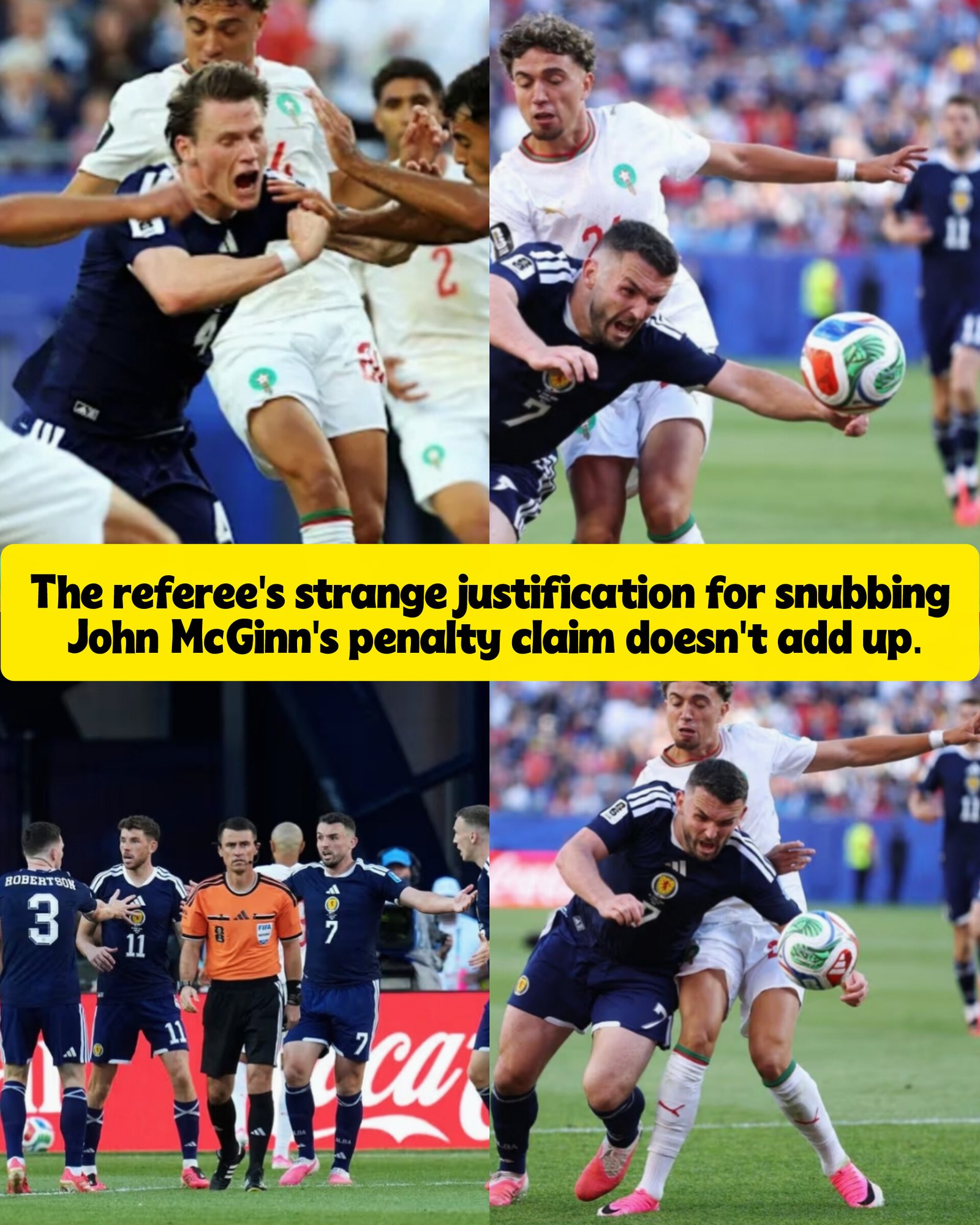
The controversial moment came when the Scotland captain appeared to be brought down inside the penalty area by Morocco midfielder Neil El Aynaoui. Despite strong appeals from McGinn and his teammates, the Uzbekistani official waved play on, and the decision was later supported by VAR.
The incident proved to be one of the defining moments of the match as Steve Clarke’s side eventually suffered a narrow 1-0 defeat in Boston.
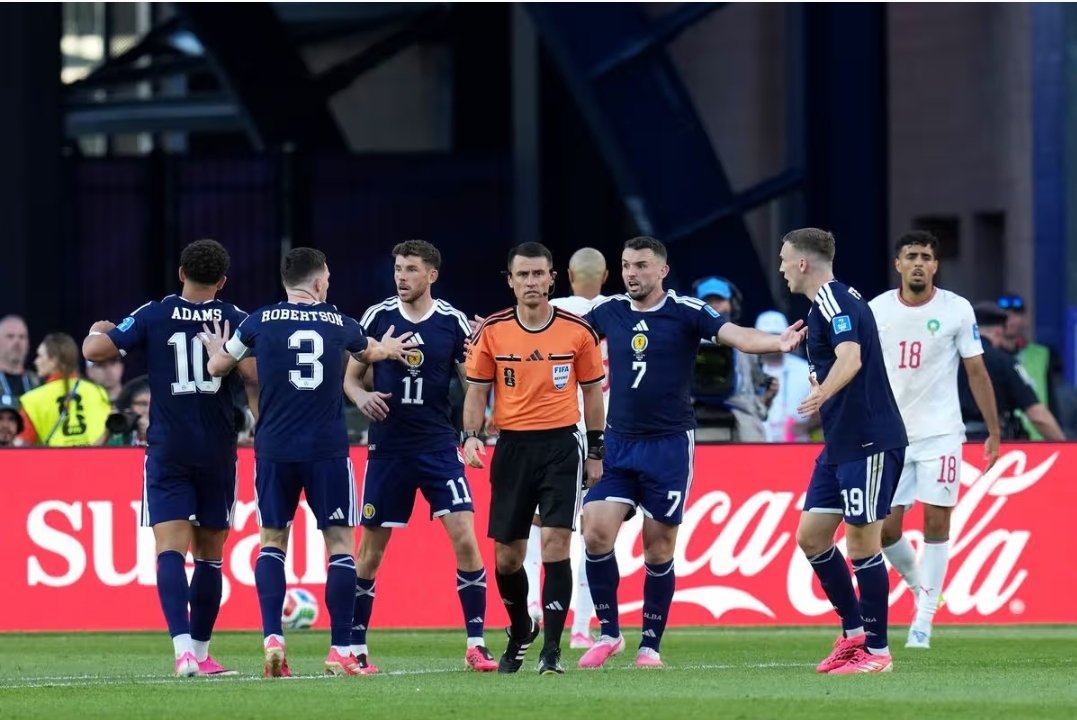
Scotland players surround referee Ilgiz Tantashev (centre) after John McGinn (centre right) went down
Had the penalty been awarded and converted, Scotland could have found themselves level and potentially within touching distance of securing a historic place in the knockout rounds of the World Cup.
Instead, the Tartan Army were left frustrated as a series of key moments appeared to go against them throughout the contest.
Following the defeat, Clarke admitted that his players were deeply disappointed by the outcome and the various decisions that unfolded during the game.
Morocco ultimately held on to secure all three points, but discussion after the final whistle quickly turned to the controversial penalty incident involving McGinn.
Now, the Scotland skipper’s brother Stephen has revealed the reasoning that Tantashev reportedly offered on the pitch when explaining why he had not awarded the spot kick.
Speaking on BBC Sportsound, Stephen McGinn expressed his disbelief at the explanation that was given.
He felt the referee’s overall performance had been frustrating from the opening stages of the game due to what he viewed as a lack of consistency in decision-making.
According to Stephen, the official allowed certain challenges to go unpunished while stopping play for other incidents that appeared less significant.
That inconsistency, he suggested, made it difficult for players and supporters alike to understand exactly where the line was being drawn throughout the match.
Reflecting specifically on the challenge involving his brother, Stephen admitted that his immediate reaction was that the incident would eventually result in a penalty once reviewed.
At the time, he believed VAR would intervene and advise the referee to reconsider the decision.
However, that review never produced a different outcome.
Having watched the incident back afterwards, Stephen remained convinced that Scotland should have been awarded a penalty.
In his view, there was no uncertainty surrounding the challenge and the decision should have been straightforward.
What surprised him even more, however, was the explanation reportedly offered by Tantashev after the incident.
According to Stephen, the referee told John McGinn that because the ball was running out of play, he did not consider the challenge to be a foul.
That reasoning left him completely baffled.
Stephen questioned how the direction of the ball could somehow negate a foul that had already occurred inside the penalty area.
He argued that in many attacking situations, especially when a player attempts to beat a defender, the ball will naturally continue travelling toward the byline or eventually move out of play.
That does not, in his opinion, change whether a player has been illegally challenged.
As a result, he struggled to understand the logic behind the referee’s explanation.
Stephen suggested that such reasoning simply did not align with how football laws are generally interpreted.
He pointed out that attackers are frequently fouled while chasing balls that are moving away from them, and referees regularly award free-kicks or penalties in those circumstances.
For that reason, he found it difficult to accept the explanation that had been given to his brother during the match.
The former footballer went on to suggest that the referee appeared determined to maintain complete control over the game and was reluctant to allow VAR to have too much influence on his decisions.
From his perspective, Tantashev looked like an official who preferred to trust his own judgement rather than revisit major incidents through video review.
Stephen felt the referee gave the impression that he wanted to be the central authority throughout the contest and did not want key decisions effectively re-officiated by technology.
That approach, he implied, may have contributed to Scotland’s frustration during the match.
The penalty appeal involving McGinn was not the only controversial moment Scotland experienced against Morocco.
Throughout the second half, Steve Clarke’s side felt they were on the wrong end of several marginal calls as they searched desperately for an equaliser.
Another strong appeal involving Scott McTominay was also dismissed, further increasing the sense of injustice among players and supporters.
Those incidents became even more significant because of the match situation.
Morocco had taken the lead after just 70 seconds through Ismael Saibari and successfully protected that advantage for the remainder of the contest.
Scotland improved considerably after a difficult opening period and created moments of pressure, but they were unable to find a breakthrough.
As the clock ticked down, every major refereeing decision carried added importance.
A successful penalty conversion from McGinn’s incident could have completely altered the outcome of the game and potentially transformed Scotland’s World Cup prospects.
Instead, Clarke’s men were left empty-handed and facing a crucial final group match to keep their qualification hopes alive.
The debate surrounding the penalty decision has continued long after the final whistle, with many Scotland supporters questioning both the original call and the explanation that followed.
For Stephen McGinn, the issue is not simply whether the challenge should have resulted in a penalty.
It is also the reasoning behind the decision that he finds difficult to comprehend.
From his perspective, the suggestion that a ball moving out of play somehow prevents a foul from being awarded does not fit with the way football is normally officiated.
That explanation, he believes, raises more questions than answers.
As Scotland prepare for their decisive final group fixture, attention will inevitably shift back to matters on the pitch.
However, the controversy surrounding the denied penalty and the referee’s unusual justification is unlikely to disappear anytime soon.
For many members of the Tartan Army, it remains one of the defining talking points from a frustrating evening in Boston that could yet prove costly in Scotland’s pursuit of World Cup history.
-
 Blog7 months ago
Celtic issues a fiery VAR statement after Trusty’s red card appeal is dismissed, as furious chiefs release referee audio publicly.
-

 Blog1 week ago
Former official calls on SFA to contact Rangers over fan scenes during Celtic match, labeling them “completely unacceptable.”
-

 Blog7 months ago
Celtic informed their January signing under Martin O’Neill that he wouldn’t play a single minute this season.
-

 Blog7 months ago
Celtic issued an £83 million warning amid looming UEFA threats.
-
 Blog7 months ago
SFA Expected to Review Missed Penalty in Rangers v Celtic Clash
-

 Blog6 months ago
Police respond after reported disorder following Middlesbrough vs Millwall clash
-

 Blog1 year ago
“Courtside to Aisle-Side: Tyrese Haliburton and Jade Jones Set New Wedding Date”
-

 Blog7 months ago
£6m star is looking to leave Rangers this summer and has already announced his next club publicly.