
Blog
Rangers’ £20m bid for Nico Raskin marks McInnes’s first major challenge.

Every squad rebuild eventually reaches a defining moment. At first, the focus is on ambition, fresh ideas, improved standards, and promises of change. But there comes a stage when those words must be backed up by difficult football decisions. For Rangers, that moment appears to have arrived with Nico Raskin.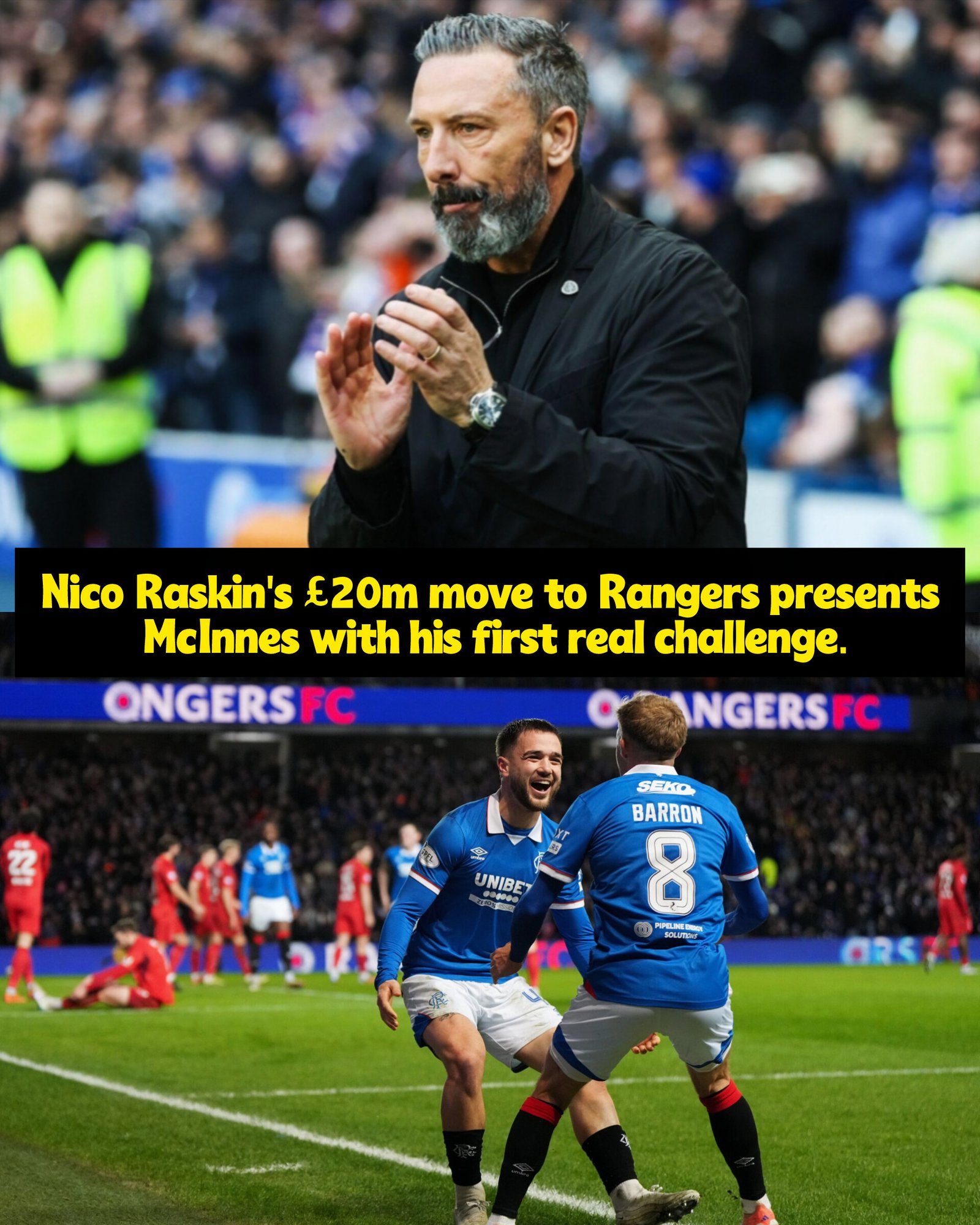
The Belgian midfielder has become one of the club’s biggest success stories in recent years. Signed from Standard Liege in January 2023 for a fee believed to be around £1.5 million plus add-ons, Raskin has developed into one of Rangers’ standout performers. His stock has risen considerably, and according to TEAMtalk, Serie A side Bologna have opened discussions over a potential transfer, while Rangers are understood to value the midfielder at approximately £20 million.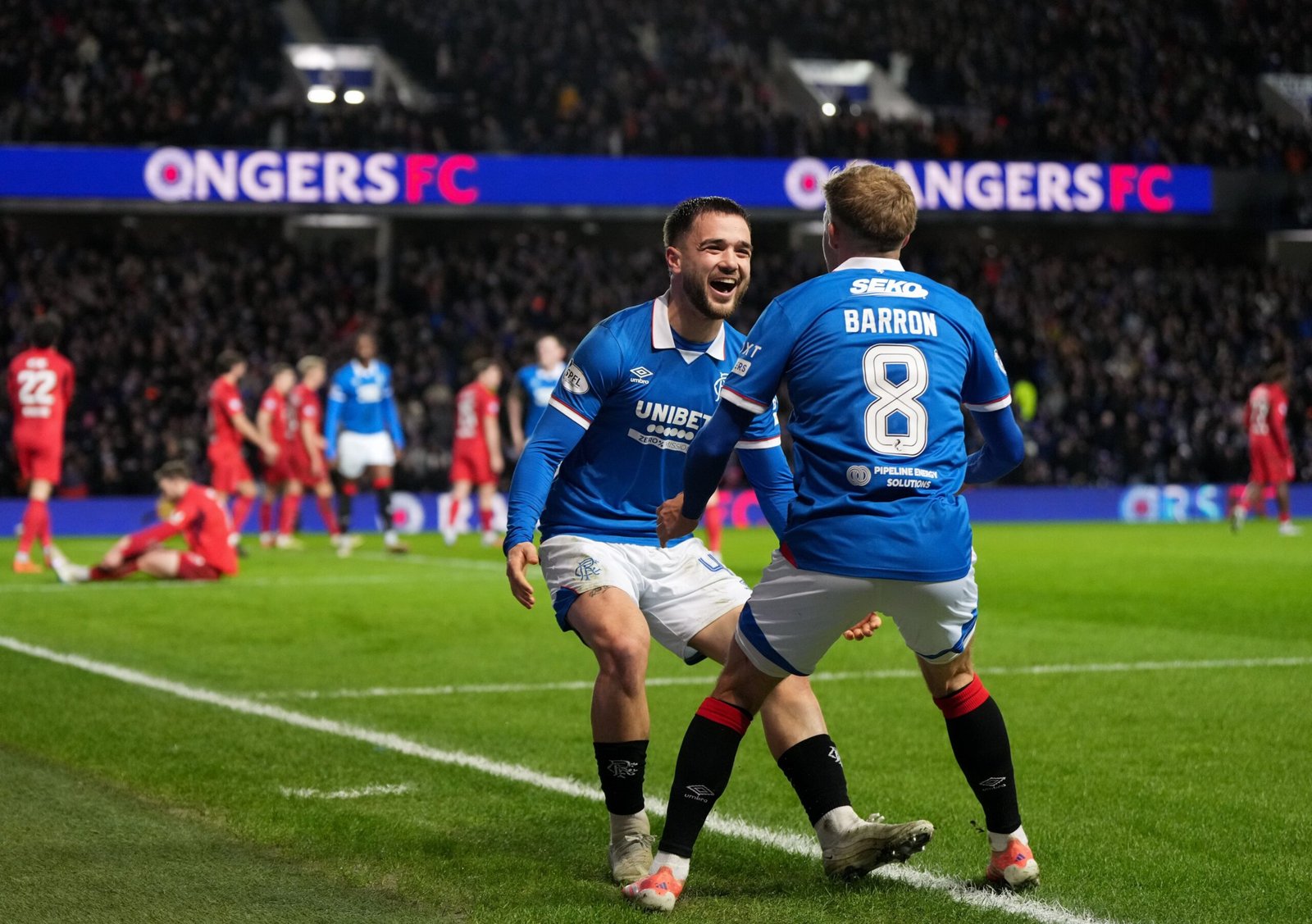
That valuation represents much more than a possible transfer fee. It reflects the challenge facing Derek McInnes during the early stages of his tenure. Rangers have spoken frequently about operating smarter in the transfer market, creating value through recruitment, and improving their long-term planning. The decision over Raskin will provide one of the first opportunities to demonstrate whether those ambitions are genuine.
Holding Firm On A £20 Million Valuation
For years, Rangers have struggled to maximise the value of their strongest assets. Too often, players have approached the final stages of their contracts without generating significant transfer income, while the club has frequently been forced into replacing weaknesses rather than profiting from strengths.
Raskin presents an entirely different scenario.
At 25 years old, the Belgium international has entered the prime years of his career. He has established himself in Scottish football while also attracting growing attention across Europe. TEAMtalk reports that he featured in 50 matches last season, contributing seven goals and nine assists, statistics that underline both his consistency and attacking influence from midfield.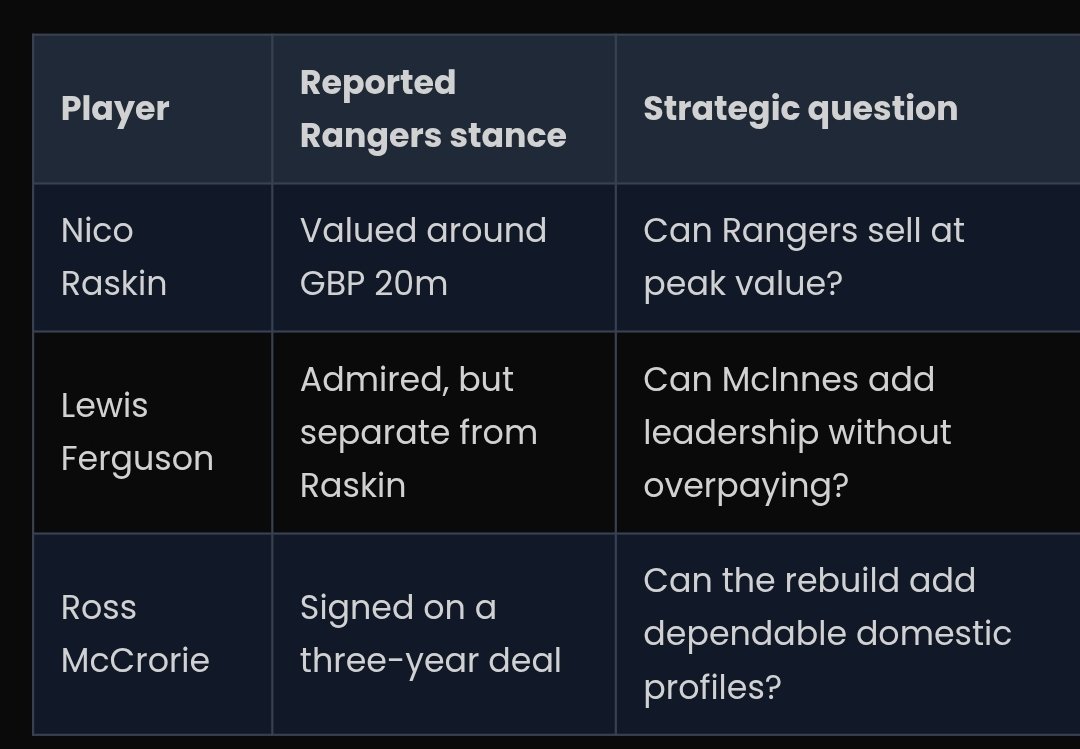
Interest from Bologna suggests Rangers have developed a player capable of commanding a substantial fee from one of Europe’s stronger leagues. Rather than viewing the reported £20 million valuation as an ambitious asking price, Rangers should see it as an opportunity to redefine how they conduct business.
Should they believe Raskin is worth that amount, they must be prepared to stand by it. Accepting a considerably lower offer would undermine both their negotiating position and the wider message they hope to send under McInnes’ leadership.
Supporters understandably focus on what Raskin brings to the pitch. He combines aggression with technical quality, presses relentlessly, and rarely shies away from responsibility during difficult matches. Players with those characteristics naturally become favourites among supporters.
However, successful football clubs cannot base transfer decisions purely on emotion. They must evaluate players as sporting assets while balancing immediate success against long-term squad development.
If Rangers genuinely want to become stronger financially and competitively, they cannot afford to compromise whenever one of their best players attracts outside interest.
Bologna’s Interest Elevates The Situation
Bologna’s reported interest changes the discussion significantly.
This is not speculation involving a lower-profile European club. Bologna compete in Serie A and have established an impressive reputation for intelligent recruitment and player development. Their growing status means they represent an attractive destination for ambitious footballers looking to compete at a higher tactical and competitive level.
That naturally makes Raskin’s situation more complicated.
The links also become more intriguing because of Bologna captain Lewis Ferguson. The Scotland international remains highly admired within Rangers circles, while McInnes knows him exceptionally well from their successful spell together at Aberdeen.
The possibility of Raskin departing while Ferguson arrives creates an appealing narrative for supporters. Earlier speculation surrounding a potential swap arrangement demonstrated why many fans quickly connected the two midfielders.
Nevertheless, recent reports indicate Rangers’ interest in Ferguson is separate from any negotiations involving Raskin. Bologna reportedly have little interest in selling their captain, making any direct exchange highly unlikely.
That distinction is important.
Football transfers rarely unfold in the neat, straightforward manner supporters often imagine. Selling one player does not automatically create a ready-made replacement. Rangers must resist allowing the Ferguson storyline to dictate their thinking regarding Raskin.
If the Belgian leaves, the money generated should strengthen several positions rather than being earmarked exclusively for one high-profile signing.
The squad still requires improvements across multiple areas. Midfield depth, defensive stability, ball retention, goalkeeping competition, and overall squad balance all remain priorities ahead of another demanding campaign.
McInnes Needs A Defining Transfer Success
Since arriving at Ibrox, Derek McInnes has shown signs of favouring reliability and familiarity.
The return of Ross McCrorie on a three-year contract illustrates that approach. Rangers highlighted both his academy background and his previous working relationship with McInnes at Aberdeen when confirming the transfer.
McCrorie represents sensible business. He knows the expectations at Rangers, understands Scottish football, and offers dependable versatility.
The Raskin situation, however, is a completely different challenge.
This decision will reveal far more about Rangers’ transfer strategy than any free transfer or low-cost signing ever could.
McInnes must decide whether retaining one of his strongest midfielders outweighs the financial opportunity presented by a significant transfer fee.
Keeping Raskin would undoubtedly preserve quality within the starting eleven. Yet it also risks creating months of speculation if interest continues throughout the transfer window.
Selling him provides considerable financial flexibility but removes an influential performer from the team.
Neither option is inherently wrong.
The genuine danger lies in failing to make a decisive choice.
Dragging negotiations deep into the summer before eventually accepting a reduced offer would represent the worst possible outcome. Rangers would lose leverage while simultaneously reducing the time available to recruit suitable replacements.
A club committed to modern recruitment should establish clear conditions early in the process. Interested clubs should know both the asking price and the deadline.
Anything less risks repeating mistakes that have limited Rangers’ progress in previous transfer windows.
Timing Could Be Just As Important As The Fee
The transfer fee itself is only one part of the equation.
Timing may ultimately prove even more important.
Rangers face an immediate return to competitive football, with their 2026/27 Premiership season beginning away to Dundee United on July 31 before McInnes takes charge of his first home league fixture against Hibernian. The opening Old Firm league meeting against Celtic follows in September.
Those fixtures leave little room for prolonged uncertainty.
Should Rangers complete a £20 million sale early in July, the recruitment department would have sufficient time to identify targets, negotiate deals, and integrate new arrivals before competitive matches begin.
Completing the same transfer during the closing days of the transfer window would create an entirely different scenario.
Replacement players become more expensive as deadlines approach. Negotiations grow increasingly difficult, while managers are forced to prepare for important fixtures without knowing exactly what their final squad will look like.
That uncertainty can quickly undermine an entire pre-season.
If Rangers truly intend to operate more professionally under their revised structure, they cannot allow the market to dictate every aspect of their planning.
Decisive action must replace hesitation.
The club already faces several other important decisions this summer, including uncertainty surrounding the goalkeeping department and Jack Butland’s future.
One unresolved position is manageable.
Several unresolved positions quickly become disruptive.
Lewis Ferguson Should Not Influence The Bigger Picture
There is little doubt Ferguson would appeal to Rangers supporters.
He has flourished since leaving Scotland, developed into an influential captain in Serie A, and possesses exactly the leadership qualities many believe Rangers have lacked during recent seasons.
His established relationship with McInnes only strengthens that attraction.
Yet allowing the possibility of signing Ferguson to shape the Raskin decision would be a mistake.
The central issue extends far beyond identifying one replacement.
It concerns whether Rangers have finally reached the point where they can confidently establish market values, negotiate from positions of strength, and reinvest transfer income intelligently.
Successfully selling Raskin for around £20 million would demonstrate that Rangers can generate meaningful profits from player development while maintaining control over negotiations.
That kind of reputation benefits future transfer windows just as much as immediate finances.
Of course, none of that matters unless the money is reinvested effectively.
Selling elite performers only becomes worthwhile if the overall squad improves afterwards.
Should Rangers use the proceeds to recruit multiple players capable of strengthening several departments, the team could emerge more balanced despite losing one outstanding individual.
Failure to replace his influence, however, would simply reinforce criticisms that the club continues to weaken itself whenever valuable assets depart.
Final Verdict
Nico Raskin’s future now represents something much bigger than one player’s career.
It has become an early test of Rangers’ entire rebuild.
The Belgian midfielder has rewarded excellent recruitment by increasing both his footballing importance and his transfer value. That is exactly the type of development every successful club seeks.
Now comes the difficult part.
If Bologna or another club meets Rangers’ reported £20 million valuation early in the transfer window, McInnes and the club’s hierarchy should seriously consider accepting the offer before reinvesting those funds with discipline and purpose.
If no club reaches that figure, Rangers should have the confidence to reject lower bids, retain one of their best players, and demand his complete commitment for another season.
What Rangers cannot afford is indecision.
Allowing uncertainty to dominate the summer would weaken their negotiating position, disrupt recruitment plans, and undermine the fresh standards McInnes hopes to establish.
Every rebuild requires defining moments.
For Rangers, the Nico Raskin decision is the first major one.
Whether he stays or leaves may ultimately matter less than whether the club demonstrates the conviction, discipline, and strategic thinking needed to control its own future.
That is the real challenge attached to a £20 million valuation.
-
 Blog7 months ago
Celtic issues a fiery VAR statement after Trusty’s red card appeal is dismissed, as furious chiefs release referee audio publicly.
-

 Blog1 week ago
Former official calls on SFA to contact Rangers over fan scenes during Celtic match, labeling them “completely unacceptable.”
-

 Blog7 months ago
Celtic informed their January signing under Martin O’Neill that he wouldn’t play a single minute this season.
-
 Blog7 months ago
Celtic issued an £83 million warning amid looming UEFA threats.
-

 Blog7 months ago
SFA Expected to Review Missed Penalty in Rangers v Celtic Clash
-

 Blog6 months ago
Police respond after reported disorder following Middlesbrough vs Millwall clash
-

 Blog1 year ago
“Courtside to Aisle-Side: Tyrese Haliburton and Jade Jones Set New Wedding Date”
-
 Blog7 months ago
£6m star is looking to leave Rangers this summer and has already announced his next club publicly.